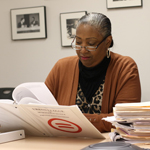
It’s Friday afternoon and Linda Taylor, housing director for the Urban League of Metropolitan Seattle, is in the process of wrapping up a meeting with a community business partner when the entire staff of the housing department walks in to her office.
The look on Taylor’s face says it all, ‘what is this about? And I hope they aren’t going to tell me that today is their last day.’
At the end of a challenging week, the group proceeds to present Taylor with a bouquet of roses. The flowers are a token of their appreciation for Taylor as their boss and as an unwavering advocate and resource for the people that they serve through Urban League’s housing program.
The moment is a testament not only to Taylor, but also to her team’s belief in the vision and commitment to helping people create, maintain, retain and pass along wealth through homeownership.
“Everybody who works in the housing department has the utmost respect for Ms. Taylor,” says Angela Williams, a mortgage default counselor with the Urban League. “Her leadership style is one of a kind. She’s very direct and she’s a go-getter, especially when it comes to her funding sources.”
Taylor, who previously worked as a real estate agent, started working for the Urban League in 1998 as a homeownership housing counselor. The transition for Taylor was an easy one as she was already helping people qualify for home loans.
“I was managing a twenty-seven person office and was really helping the clients of the agents get qualified [for mortgages],” said Taylor. “I saw a lot of people that really needed help with their credit and budgeting with different things to get them qualified to purchase a home.”
Taylor was eventually approached with the opportunity to do the same type of work at the Urban League – credit enhancements and finding people good mortgages – that would actually pay her for the work that she was already doing for free.
Under her leadership, the Urban League’s housing department grew from an organization that helped qualify people for mortgage loans to a very comprehensive program that addresses everything from credit counseling to mortgage foreclosure assistance and loan modifications from HUD certified counselors. And despite, having limited resources the department is, arguably, one of the most effective and respected housing programs in the state.
While other organizations hire people and train them to become housing counselors, Taylor believes in hiring people who’s previous work experience gives them a unique perspective that helps them find success with clients.
The benefit of this philosophy could not have been more apparent than when the recent foreclosure crisis hit and many families were in jeopardy of losing their homes. According to Taylor, some non-profits hired 15 – 20 counselors but wound up laying many of them off as funding sources ran out.
“We hired fewer [people] and we probably did more work,” says Taylor.
“Other people took a lot of housing counselors and turned them into foreclosure experts,” she continued. “All of our foreclosure experts have either a mortgage or legal background so they’re able to do forward mortgages as well as the foreclosure piece of it, and I think that’s what makes the Urban League stand out and makes us unique.”
According to Taylor, the success rate of the Urban League is really immeasurable because their process is to teach and empower people so that they are able to not only help themselves but they are also able to help others.
“We’re committed to helping people become self-sufficient, because as you know once you’ve taught someone how to do something they can help someone else,” said Taylor. “What we do is give people the information that they need in order to make an intelligent decision about where they need to go.”
Taylor refuses to be called a savoir, but her efforts to maintain a viable department during the Urban League’s recent financial crisis — that forced the organization to eliminate and restructure many of their other programs and sell their building – ensured that the Urban League was able to service new and existing clients in the midst of the foreclosure crisis.
While they must keep strict records on their cases and clients, Taylor believes that the overall success of the department is measured by what they are able to do day-by-day, and not by the overall number of clients and cases that they’ve served over the years.
“[We measure our effectiveness] one success at a time,” says Taylor. “With that one success you know that you are doing what you are called to do.”
Between October 2013 and September 2014, the Urban League’s housing department serviced nearly 2,000 clients, including prospective first time and returning homebuyers, mortgage default, credit counseling and reverse mortgage counseling. A remarkable feat considering that the average foreclosure file is about 3 – 4 inches thick with paperwork. And while the number of foreclosures are down, according to Taylor, the types of foreclosure cases that they are seeing are more difficult to resolve, which requires a much higher level of commitment from her staff than ever before.
“We’re working with people all day long that are in crisis mode,” says Williams. “It’s almost like a ministry because a lot of people come in and they are broken. We’re not going to sugar coat a situation, we tell them exactly what they need to do so they can maintain their home because the last thing we want to do is give someone lost hope.”
Taylor also believes that the term predatory lending is used too loosely. According to Taylor, many of the mortgage related issues that people face today are related to what she terms as ‘immoral lending’ rather than predatory lending. Predatory lending is described as a ‘bait and switch type of thing’. What the Urban League is now seeing are people being presented with the information and signing mortgage documents without fully reviewing or understanding the terms of the contract.
“All of the information is there,” says Taylor. “What you see are ridiculous things that are immoral but not predatory. Most people don’t understand all the information, but they sign it anyway. It feels predatory once you look at it, but it really isn’t.”
Taylor also says that it is very important for people to make informed decisions as it relates to their home. According to Taylor, many homeowners are not seeking assistance and end up either walking away from their home too soon or staying in the home for too long.
“You should always get educated about what works for you and your family,” says Taylor. “I’ve seen people walk away from their home with equity because a mortgage company sent them a note that said they were going to take their home. You can still sell [your home] and walk away with something.”
Taylor , who is often the only African American at the table, has also been instrumental in developing housing policies around the state and bringing resources into the community.
“When the foreclosure fairness act was written we were instrumental in writing it,” says Taylor. “This was a very big thing because the law provides homeowners who are facing foreclosure the opportunity to enter into mediation with their lender. The process allows the homeowner and lender to reach a fair, voluntary and negotiated agreement. We’re now one of three to four states with non-judicial foreclosures that have mediation available for homeowners.”
While the Urban League is busy helping people with foreclosure prevention and loan modifications, Taylor maintains that the most important component of the housing department is their homebuyer classes. The program, which shows prospective homeowners how to attain home ownership through education and financial assistance, not only explains the home-buying process in general terms but also offers specific advice based on personal circumstances.
“There are very few people in our foreclosure classes that have been through home ownership training,” says Taylor. “Out of 20 people maybe one has attended a home ownership class.”
Home ownership is an important part of the economic growth of the African American community, and the Urban League is a valuable resource for anyone looking to buy a home or save the one they have. With a staff of HUD certified counselors that are well versed in reverse mortgage, loan modifications, first-time and returning home buying, credit enhancement and foreclosure prevention they can help people with almost any aspect of homeownership.
“The [Urban League] housing department is very critical to the community,” says Williams. “As long as someone stays with the Urban League and take advantage of the classes, it will prepare them with a wealth of knowledge of what to do when they get in trouble.
“Ms. Taylor has done a phenomenal job and the training she continues to send us on so that we do have the knowledge to help someone is extremely important,” concluded Williams.
Taylor wants people to know that the Urban League is a great resource, and best of all their services are provided for free.
“People need to know that there is help available to them, and that there really is no need for them to pay someone for these types of services when they are available for free,” said Taylor.