
By Letisha Marrero
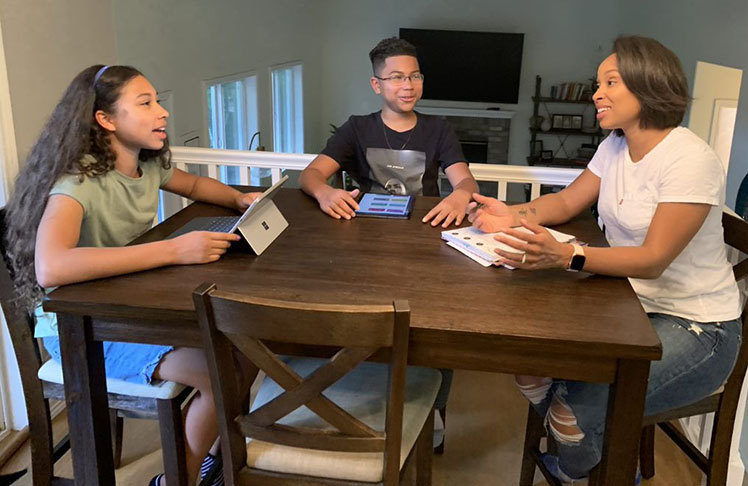
Six weeks into distance learning, Tiesha Clark’s 12-year-old son came into her home office, feeling overwhelmed. As a seventh grader in the Federal Way School District, he felt he had more work now than what he had in school, and wasn’t sure what to do. So, Clark and her son decided to write down all his assignments on a whiteboard, so he could see everything at once. They worked together to organize due dates, identify needs for support and set a plan of action for the week. That day’s lesson wasn’t necessarily a math equation — it was how to time manage, and how to prioritize what’s in front of you, especially when it feels insurmountable. Meanwhile, her 10-year-old daughter misses her friends and wonders when things can return to a sense of normalcy or even how to celebrate her birthday next week.
Clark finds herself trying to make space for meaningful conversations with her children, to help them face the new realties of their world.
This is a stressful time for parents, who have real fears about how their families will cope during the COVID-19 pandemic. According to a new statewide poll by The Education Trust, more than 3 in 4 (76%) public school parents in Washington report higher levels of stress than usual, including 34% who say their level of stress is much higher than usual. More acute feelings of stress are particularly common among parents of children with disabilities (54% much higher) and families earning less than $50,000/year (47% much higher).
“Our survey reveals that in Washington, this health crisis continues to exacerbate longstanding education equity challenges, including access to technology, academic support, and resources for students of color and students from lower-income communities,” said Ary Amerikaner, vice president for P-12 policy, practice, and research for The Education Trust.
Clark, who serves as the family engagement manager at the Community Center for Education Results, a regional education equity organization, speaks regularly to parents in seven King County, Washington school districts: Auburn, Federal Way, Highline, Kent, Renton, (South) Seattle, and Tukwila. She has heard them voice all kinds of concerns as they tried to get a grasp on the task at hand while figuring out how to survive. Parents are “overwhelmed, stressed, anxious, just for basic needs,” Clark said. “There was an uproar of people losing their jobs, difficulty paying their bills, being able to feed their children. We heard of parents allowing children to sleep in so they would only have to provide two meals instead of three.
There’s a need for computers, internet access, and the capacity to navigate online portals. Just a myriad of basic infrastructure that comes with being home and being online.” Then there was figuring out how to work full time amidst pressure from the school to show up in a way they’ve never been asked before.
It’s no wonder nearly 9 out of 10 parents in Washington are very concerned about their child falling behind academically as a result of not being in school. Their child’s inability to interact with other students coupled with an increase in boredom and lack of stimulation while at home is also a top worry — with parents concerned about the mental well-being of their child (41% very concerned/78% concerned).
Courtesy Photo.
“I’m always worried about my kids falling behind. I think that’s what’s keeping me motivated to oblige the schools in their ask of my children,” Clark says. “I think it’s unrealistic some of the things [the school is] asking for. It’s confusing because, while the district said they’re not grading, they’ve started taking attendance, our youth’s grades are changing and some teachers send emails that say the work is optional, but they will be entering it into the grade book. So, those who don’t or can’t fall inline, get left behind?”
“At the end of the day, whether they are “deemed” left behind or not, my children are building life skills,” continued Clark. “They’re managing stress, learning how to reframe their thinking, be creative, speak to their needs and put first things first. This character building is what’s going to take them to the next level.”
The poll also reveals that only 50% of Black parents say that their school is providing adequate contact with the school or teachers. Clark, a Black mom, says in her district, there’s really good one-way communication, but not a lot of opportunities for authentic two-way communication with her kids’ teachers and the school district.
“I’m impressed with my children’s ability to self-navigate, but we still have to adjust,” says Clark. “Learning how to break up the day, how to take opportunities to go outside, how to have fun while we’re in the house, while I figure out how to work full time. I feel like we’re doing well, but it’s one step at a time, knowing when you have to turn off the noise of the world. As engaged families, can we move away from the deficit? Let’s shift the conversation to what’s working. Even though there is a lot weighing on us, that pressure is creating diamonds.”
Letisha Marrero is a senior editor/writer for The Education Trust


