By Kiara Doyal, The Seattle Medium
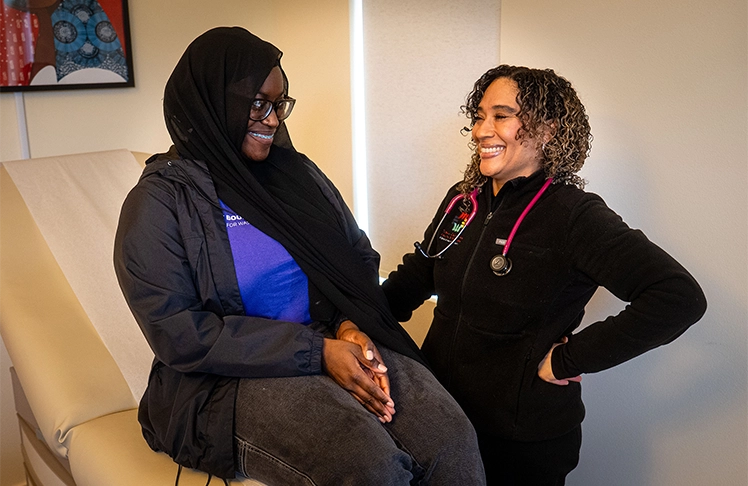
Recently, the Tubman Center for Health & Freedom released findings from its multi-year Designing Responsive, Equitable, and Accountable Models of Care (DREAM) Study. Out of that research came the Relational Medicine Model (RMM)—a first-of-its-kind, values-driven care model that places relationships, trust, and dignity at the center of healing.
Developed over the past five years by Black, Brown, LGBTQIA+, and other marginalized communities, the model challenges conventional healthcare structures and offers an alternative at a time when many are losing faith in the system.
“We built our own healthcare model,” said Danisha Jefferson-Abye, Founder & Chief Operating Officer at Tubman Health. “We knew from the start that the answers weren’t going to come from the same broken institutions. They were going to come directly from the community.”
According to Amanda Knights-Shi, Director of Research & Evaluation and lead researcher, the RMM model reflects years of community-driven research work at Tubman Health. This work has surfaced community-driven health solutions and the ways in which community wants to be cared for–centered on relationships and trusting patients as the experts in their own bodies.
“It’s bringing forth a new arrangement for care in a new setting,” said Knights-Shi. “It’s rooted in a relationship with your provider team, the relationship they have with one another, as well as the communal networks of healing that we have.”
The model aims to set a new standard of care—one that shifts away from profit-driven systems and instead prioritizes liberation from structures that keep people unwell.
“The mainstream healthcare model is very profit and volume-driven, and we’re flipping that upside down. Because Tubman Health staff are actually a part of the communities we serve, we already knew what this model could look like,” said Karina P. Patel, Public Affairs Manager, Tubman Center for Health & Freedom. “We each have our own experiences with healthcare in the mainstream system, and we know how powerful that collective vision for health justice can be. Our research is about documenting our collective vision so we can also be accountable to that model.”
Knights-Shi echoed that sentiment.
“For many Americans, we know that healthcare does not work for us and is not healing. Community has created a new medical model that responds to our collective needs,” said Knights-Shi. “The Relational Medicine Model is delivering on that promise. This isn’t a question of proof. It’s a question of how we honor and implement the model that the community has designed as an alternative to volume- and profit-driven medicine.”
During a time when U.S. healthcare faces federal cuts, clinician burnout, and rising mistrust fueled by systemic racism, Patel said the timing of the model is critical.
“As we know, the healthcare system is in crisis. We are seeing racism within the system that has always existed, but it is heightened now, and trust in the healthcare system is at an all-time low,” said Patel. “This year is our fifth anniversary, so after the pandemic, we knew we couldn’t come out going back to business as usual; we needed to do something different. So, it truly feels like we were made for this moment.”
Knights-Shi noted that much medical research has historically excluded Black and Brown communities, medically marginalized individuals, and people with disabilities. By building the RMM through intentional engagement and design, Tubman Health prioritized community ownership, accountability, and agency.
“If you look at who has been part Tubman Health’s research and design process from the start, a big part has been representatives of the local Black and African American communities,” said Knights-Shi. “Thinking about the history of research, it’s been extractive, exploitative, and exclusionary. Ensuring care is made available to community members is a big offering that the RMM provides.”
For Knights-Shi, the work also serves as a way to bring together collective dreams while honoring unique traditions of care.
“Whether it’s ancestral medicines that have been passed down, or the way we care for each other communally, that was important when creating this model,” said Knights-Shi. “We are more similar than we sometimes see in certain spaces, and being able to find that similarity and use our voices collectively to create something beautiful and new is the purpose.”
Looking ahead, Patel said the model’s strength lies in its origins—and its ability to transform care by staying rooted in community.
“Our message is really simple. This is a model that the community has designed, and it is bound to work. It was built by community for community,” said Patel. “This model is ready to be honored and implemented as an alternative to the mainstream system. And Tubman Health is acting on those dreams, and we really do want others to join us on this journey.”