By Aaron Allen, The Seattle Medium
Last Saturday, Washington state’s Legislative Black Caucus hosted its annual “State of Black Washington” Town Hall at Highline College, bringing together lawmakers, community leaders, and residents to assess the political and economic outlook for Black Washingtonians. The event marked a pivotal moment in statewide Black leadership, set against the backdrop of a rapidly shifting national landscape.
Despite making up less than five percent of the state’s population, Black residents in Washington are represented by the largest Legislative Black Caucus west of the Mississippi River, placing the state in a position both symbolically and strategically to advance the fight for racial equity on local and national levels.
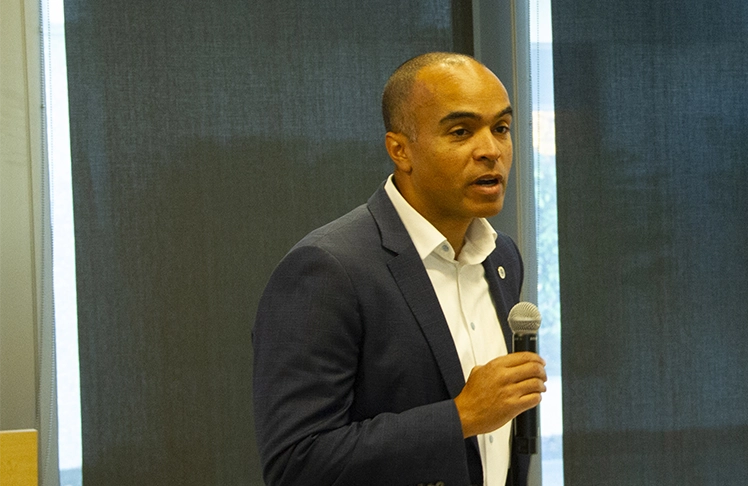
“The historic nature of this is really important and also the fact that we’re able to have this broad coalition of caucus members,” said Washington State Attorney General Nick Brown. “More than most other states, particularly given the relatively small Black population, I think it shows a need for these voices and perspectives and decision makers in the room.”
Brown, the first Black person elected to statewide office in Washington, served as the keynote speaker, while U.S. Rep. Marilyn Strickland joined virtually and Sen. T’wina Nobles served as master of ceremonies. Also in attendance were Paula Sardinas of the Washington Build Back Black Alliance and Legislative Black Caucus members Rep. Jamila Taylor, Rep. April Berg, Rep. Debra Entenman, Rep. Brandy Donaghy, Rep. Natasha Hill, Rep. Chipalo Street, and Rep. Brianna Thomas.
“My role as the AG and being the first Black statewide elected official takes on added meaning for me. So, I’m interested to see what the conversations are, because the Black voices are diverse,” said Brown. “It’s not a monolithic viewpoint on anything. So, to get some robust engagement today would be really, really good.”
As the 2024 presidential election looms and equity initiatives face renewed attacks, the urgency of collective action was a recurring theme. National anxieties over layoffs, government shutdowns, and social program rollbacks have left communities across the country in a state of uncertainty. The impact of these pressures is especially sharp in Black communities, where programs focused on diversity, equity, and inclusion have come under direct threat.
“With Trump dismantling DEI, with him dismantling Black certifications. We have never been able to bring together the Legislative Black Caucus, our Black state agencies that report to the governor’s office, and to have a voice where the Black community is participating in the Black agenda,” said Sardinas. “So, this is an opportunity for us to stand up and to take back our voice, our power and to be able to say, ‘We are not going to be erased. We are not going to be dismantled.’”
Town hall discussions explored the implications of legislation such as HR1—dubbed the “Big Beautiful Bill” by its sponsors—the anticipated effects of Project 2025, and preparations for the 2026 legislative session. Panel topics focused on navigating institutions not designed with Black inclusion in mind, the need for resilient organizing, and the demand for policy that centers Black lived experiences.
Community concerns, priorities, and solutions were posed directly to caucus members during interactive sessions.
“The community needs to come together. We have a wealth of knowledge and information to give leaders in the community, give the legislature insights on what we need to prioritize,” said Taylor. “Things—when you’re lifting up Black folks, you’re lifting up the whole community. And at this moment in time, in this juncture, we cannot forget about the Black community.”
Among attendees was Stasha Spinosa, of the Office of Financial Management under Governor Bob Ferguson. Speaking as a constituent, Spinoza voiced support for the caucus and its work. “I’m here today to just support all of the incredible policy work that’s happening to strengthen Washingtonians and specifically Black Washingtonians,” said Spinoza. “I think this is a time when our community is feeling the pressures of value and worth. All of that is just bubbling up. And this is a moment where we can recognize that we do have leaders in place here.”
“To get behind all of the good folks on the ground, I’m just excited to hear what the policy measures are that people are willing to push forward and how can we as constituents and community stand up behind them,” Spinoza continued.
Throughout the day, a central message emerged: unity within diversity. Caucus members and community leaders emphasized the importance of shared purpose, even amid different viewpoints and strategies.
“We need to think about how we can lift each other up. We need to ensure that we’re having these important conversations. And sometimes they’re difficult conversations,” said Taylor. “Sometimes we have different strategies within the Black community. As you know, we’re not a monolith. But at the end of the day, we are focused on the upliftment of the people.”
“If we can identify those small handful of issues where we can all get behind, I think that would be very important,” said Brown. “We’ve got a lot of diversity points and ideas and priorities, but if we can put our collective energy behind two or three most important priorities that are impacting our community, that would be fantastic.”
With the 2026 session on the horizon and national discourse growing increasingly volatile, the town hall served not only as a forum for discussion, but as a call to action. Washington’s Black lawmakers and residents alike are preparing to shape the state’s future with urgency, clarity, and resolve.