By Katelyn Hewitt, The Seattle Medium
After five seasons, the award-winning Seattle-based children’s show Look, Listen & Learn TV fell short of the funding needed for a sixth season and made the difficult decision to close its doors.
The live-action children’s educational program features the voices of Black, Indigenous and other children of color. The show stars your friendly neighbor Auntie Lena—played by founder Val Thomas-Matson—alongside her puppet partner, Possum.
Look, Listen & Learn is the realization of a dream Thomas-Matson has carried for decades. “This has been my blood for 50 something years,” she said recently in a Zoom interview.
Growing up in Seattle’s Central District, Thomas-Matson discovered she learned best in multifaceted ways. “I needed to read a little, to hear a little and to have conversations,” she said. Her school failed to recognize her style, which later informed the show’s approach to learning.
The program’s mission is backed by early learning research which highlights the role of educational media in promoting equity and school readiness. The work of researchers like Dr. Julie Dobrow—author of “Why It’s So Important for Kids to See DIverse TV and Movie Characters”—underscores how diverse representation in media can help close the achievement gap and support parents and caregivers with the resources for school readiness and success.
Thomas-Matson attended Highline Community College, where she often played the “scrap parts” in the theater program, she said. Her costume teacher, Jean Enticknap—whom she credits as integral to her story—was the first person she shared the idea for the show back in the late ‘70s.
She went on to get a degree in broadcast communications at Western Washington University, interning at KOMO and working as a receptionist at KING. Her later work in government, human and social services helped her realize how early learning and community support can change a child’s trajectory.
“I started to learn a lot about drug and alcohol and violence prevention, protective factors and risk factors,” she said. “I connected those threads to what puts kids at risk for violence and substance abuse. It matched up with what we were learning about brain development and how the brain needed to be stimulated in certain ways.”
Each episode of Look, Listen & Learn is based on a children’s book, such as “Kerry the Caring Koala – Where Feelings Find a Friend,” written by Nicholas K. Young. The book is about a koala that helps forest creatures talk through their feelings. The show uses stories like this to make complex topics accessible to younger audiences.
Amari Cash, communications lead for the show and associate producer, said, “We made sure every episode had different social emotional learning skills that we’re teaching the children.”
In Season 5, Episode 3 (“Talk It Out”), Look, Listen & Learn partnered with local mother-and-son business, Unbothered Toddler, for an art segment on making calming jars—water-filled containers that can be customized with glitter, beads or other small items that when shaken help children settle their big emotions. The episode also featured a visit to the Seattle Opera, where the cast explored how music can be used to express feelings.
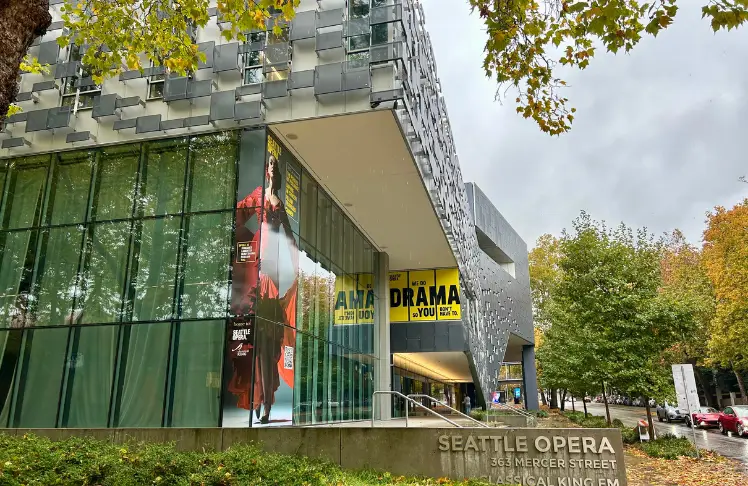
The television program has received several Telly Awards, and earlier this year, won its first local Emmy for “Do, Re, Take Me to the Opera” (Season 5, Episode 1). PBS and KBTC also announced it would begin airing Look, Listen & Learn in 2025, marking a major milestone in expanding the program’s reach to more families.
Then, despite a strong start to the year, the program learned in July that it would not receive the Food Equity Grant—a loss that made continuing impossible. This grant supports 501(c)(3) nonprofits, and is funded by revenue from the city of Seattle’s Sweetened Beverage Tax. The television program has other grants, but not enough to keep their doors open.
“In the midst of all these incredible highs, in the first six months of this year, we just got served the grand slam,” said Thomas-Matson. She said the decision to end the show—her life-long dream—was painful for her and the team.
Gene Yoon, president of the Look, Listen & Learn board of directors, said the nonprofit was intentional about its leadership. Its bylaws required that at least 85 percent of the board of directors identify as Black, Indigenous, or people of color, ensuring it reflects the communities the show serves.
Board members brought expertise in grant knowledge, nonprofit management, and children’s education. All of them have a shared passion for education, youth development, and helping children become school-ready, according to Yoon.
Thomas-Matson compared herself to Mr. Rogers when imagining the show as a community educational program. But she said many people had trouble seeing a Black woman in that role. “Too many people looked at this packaging and couldn’t believe that this is what an early learning television personality looked like. It was the most recurring theme—and finally, it was our demise,” she said.
Even after securing a home for the show in 2018, its official launch year, funding remained a constant hurdle.
“We struggled mightily each and every year for our funding,” she said. “Our actual working budget should have been $2 million to produce 12 episodes with a full staff. We got a fourth of that, and we did it for five seasons,” from 2018 to 2025.
Said Yoon: “We were always trying to chase every dollar and every penny to make the next month, sometimes.”
While Look, Listen & Learn continued to draw partnerships this year with institutions such as the Seattle Opera, 5th Avenue Theatre and the Seattle Storm, a complicated reality was occurring behind the scenes. Cash said the tone among funders began to change after the presidential election.
“The post-COVID era of wanting to support Black people and wanting to put your money where your mouth is just shifted,” she said. “After November 2024, there was a shift in values. You would just start hearing people say, ‘Oh this grant just isn’t available anymore.’”
Cash said that while community impact for Look, Listen & Learn persisted—creating relatable educational content for children of color that celebrates the uniqueness of cultures—the atmosphere among grantmakers and corporate sponsors grew more cautious.
“The same people, if not more, are falling in love with the show,” she said. “But there was a shift in the focus, a new unspoken feeling that if I continue to have these efforts, I may be punished for it, so it was just a safer choice to step back from that.” She was referring to the grant donors who felt pressure to pull back their support.
This year, children’s educational television programs nationwide have been experiencing challenges from shifts in funding.
In July, the Corporation for Public Broadcasting announced that it would be taking back $1.1 billion in public broadcasting funding through fiscal year 2027—a decision that has forced many member stations across the country to cut staff and stop production.
In a statement released by KBTC in May, the U.S. Department of Education announced that the 2020-2025 Ready To Learn grant cycle had been terminated, with the funding expiring on Sept. 30. As a result, KBTC and 43 other participating stations were directed to immediately halt all work supported by the grant.
The loss of this grant was an indirect hit to the Look, Listen & Learn, which depended on support from the same network of donors.
“Those were the same dollars that people would spend on PBS, so those would be the same dollars that it would spend on us,” said Thomas-Matson.
On Sept. 9, Look, Listen & Learn officially announced in a post on Instagram that, “LL+L TV is closing our doors, for now. Thanks to everyone who supported us.”
The team remains hopeful that their work will continue to reach children nationwide. The show is currently in negotiations with PBS to transfer its assets, allowing the network to continue sharing existing episodes with broader audiences.
“Even if we’re saying goodbye, we’re not saying goodbye forever. This is still going to be in the hands of someone else, who has the capacity and the experience and the expertise to make it really flourish,” said Yoon. “We’re just hoping that it will stay in front of people’s television screens for years to come even if it’s not in our own hands.”
For now, KBTC and PBS will continue to air existing episodes on Fridays at 11 a.m., and through the PBS app. The show is also featured on kweliTV, and all episodes remain available on YouTube.