By Aaron Allen, The Seattle Medium
As tobacco and cannabis companies increasingly market their products through social media and digital advertising, a Seattle nonprofit is helping young people recognize those tactics, think critically about the messages they receive and make informed decisions about their health.
Through its youth-led STAND program, the Center for MultiCultural Health (CMCH) is equipping teens across Washington with the tools to understand how commercial tobacco and cannabis companies target vulnerable communities while encouraging youth to become advocates for healthy living within their own neighborhoods.
“Our mission at CMCH is to do our best to eliminate health disparities in communities of color,” said Kerry Holifield-Alcantara, program director for the Center for MultiCultural Health. “The work that we do for the STAND program is cannabis and commercial tobacco prevention and education. We use an intersectional approach to prevention by encouraging youth to understand their agency and advocate for healthy living within their communities.”
Founded in 1976, the Center for MultiCultural Health serves communities of color, immigrants, refugees and individuals with limited English proficiency throughout Washington. Rather than relying on traditional prevention campaigns, the organization emphasizes culturally responsive education led by people who reflect the communities they serve.
Holifield-Alcantara said the organization’s approach is rooted in working alongside communities rather than prescribing solutions. By employing staff who share the lived experiences and cultural backgrounds of the people they serve, CMCH aims to build trust and create programs shaped by the voices of the community rather than outside assumptions.
Holifield-Alcantara said STAND moves beyond fear-based messaging by helping young people understand how advertising, social media and cultural stereotypes influence decisions.
“What that really means is making sure that they know that there are deeper things going on in our community besides what they’re seeing on social media,” she said. “Our power as a community comes from who we are as a culture and what we can do when we lean into listening to our elders and empowering our youth, aside from the way that we’re portrayed by other communities and on social media.”
The program also examines the long history of targeted marketing in communities of color. Past STAND campaigns have explored how tobacco companies heavily promoted menthol cigarettes in Black communities and how cannabis advertising can normalize substance use among young people. Holifield-Alcantara said understanding those strategies helps youth recognize when they are being targeted rather than simply marketed to.
But Holifield-Alcantara said STAND intentionally avoids judging youth who use substances.
“I just wanted to be clear for the youth that we do not vilify youth who use or misuse substances,” she said. “We know that there is a warranted historic distrust of the medical community in our culture, and it can make it really difficult to feel confident about accessing mental health resources. We just want youth to make educated decisions and know that the elders in their community are looking out for them and that there is a place for them to go.”
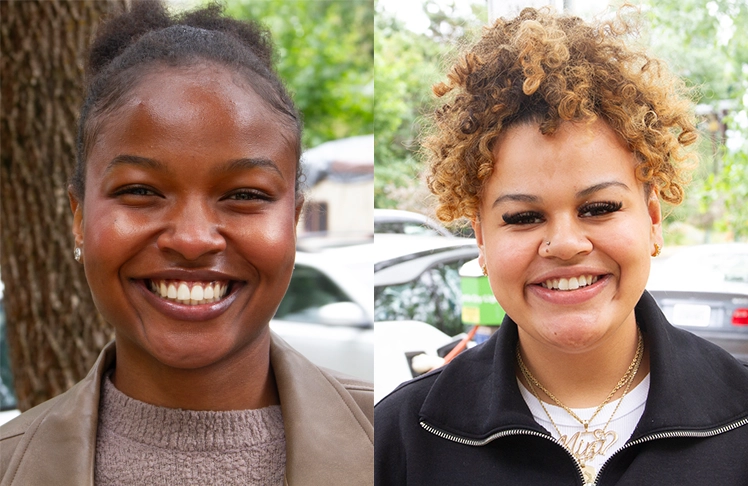
For Ana-Liyah Dumas, the program’s message became personal long before it became her career.
Dumas first joined STAND as a teenager and now serves as the program’s youth coordinator, helping guide the next generation of participants.
“It was useful for me as a youth because I truly learned things that I didn’t know when it came to subjects like marijuana and tobacco,” Dumas said. “Often it can be normalized, but I never fully knew the repercussions and the ways that it can affect your physical health as well as your mental health. And the targeted advertising that we experienced in our community, these are things that were around, but we never knew the ins and outs of it.”
She said understanding how companies market products to young people changed the way she viewed the world around her.
“Learning those things helped me make different decisions based on what I was being exposed to and what was around me,” Dumas said. “It was more about the awareness, having the right information to make educated decisions and to make my own outlook on stuff.”
Today, Dumas works to engage a new generation of youth, although she acknowledges that reaching teenagers has become more challenging.
“The challenges, I feel, are more so reaching the youth, getting them involved, active, and excited about doing what we’re doing,” she said. “The time has kind of changed a little bit from when I was a youth.”
For Divaa Nkanatta, an international student who moved to the United States in 2024, STAND provided something even more fundamental: a sense of belonging.
“I moved to America in 2024,” Nkanatta said. “And it was really hard finding my voice, finding my community, and just adjusting to the culture as a whole. In school, marijuana and tobacco were really easily accessible. It was really easy for me to go into those groups of people and kind of get persuaded into joining them just because I wanted to fit in.”
She said participating in the program gave her the confidence to make decisions based on her own values instead of social pressure.
“I joined STAND and it was really, really helpful for me to make my life choices based off the program, because now I know more about the use of marijuana and tobacco,” she said. “It shed light on me preserving my identity. If I was not in STAND, then it would have made me make choices I would regret in the future in terms of trying to fit into school and finding my people.”
Nkanatta now encourages other young people to reject stereotypes and define success on their own terms.
“It shows you that you can be who you are regardless of where you come from or what your background is,” she said. “You can have your own voice, have your own identity, and have your own purpose in life without having to battle with generational misconceptions and stigmas around your community. You can find yourself through this program.”
Holifield-Alcantara said that focus on empowerment is what separates STAND from traditional prevention programs.
Rather than simply telling young people to avoid tobacco or cannabis, the program encourages them to understand the broader social and cultural forces that shape decision-making while equipping them to become advocates within their schools and communities. Youth participate in discussions, creative projects, presentations and community outreach that encourage them to share what they have learned with their peers and families.
That approach has helped the program’s youth leaders reach more than 700,000 people across Washington through peer-led presentations at schools, community centers and places of worship.
As CMCH continues expanding the program, Holifield-Alcantara said the organization’s greatest source of optimism remains the young people themselves.
“Our tagline at STAND is that ‘we speak up for our block,'” she said. “STAND stands for Speaking Truth and New Direction. I’m not normally encouraged by the external forces that I see at play in the United States today, but every day I come into work and I’m inspired by the light in the youth of our community.”