By Aaron Allen, The Seattle Medium
Last Friday, Seattle civil rights leaders marked the 63rd anniversary of the March on Washington for Jobs and Freedom with calls for renewed action on voting rights, economic opportunity and racial justice, arguing that the unfinished work of the 1963 movement remains relevant more than six decades later.
The commemoration, part of a longstanding local tradition organized by the Seattle Martin Luther King Jr. Commemoration Committee and community partners, including the Seattle/King County NAACP, brought together civil rights advocates, faith leaders and community members to reflect on the historic march while addressing challenges facing Black communities today.
The Aug. 28, 1963, March on Washington for Jobs and Freedom drew approximately 250,000 people to the nation’s capital, where the Rev. Dr. Martin Luther King Jr. delivered his historic “I Have a Dream” speech. Organized by civil rights leaders including A. Philip Randolph and Bayard Rustin, the march called for civil rights protections as well as greater economic opportunity for Black Americans.
Seattle civil rights activist Eddie Rye said commemorating the march provides an opportunity to pass that history to younger generations while reminding the community that many of the issues raised in 1963 remain unresolved.
“63 years ago today, Reverend Dr. Martin Luther King Jr. gave us his ‘I Have a Dream’ speech. Bayard Rustin and A. Philip Randolph were two of the key organizers for that event that attracted 250,000 to the Lincoln Memorial to make a plea for full inclusion by demanding voting rights and civil rights,” Rye said. “It was African Americans who were denied civil rights and voting rights, so it helped open the door for everyone else.”
Rye also pointed to economic disparities in Washington state, including what he described as the persistently low share of state contracting dollars going to Black-owned businesses.
“We have got to renew our efforts to fight for justice, for inclusion, and for equality,” Rye said. “We have African American men and women all around the world defending our rights but not to be able to vote or be economically included, and the sad thing is that we have a lot of work to do in Washington state. African American businesses have not done half a percent in the last five or six years. We are a blue state, but the numbers don’t reflect that… It’s time for us to stand up once again.”
Hayward Evans, president of the Seattle/King County NAACP, said the anniversary also serves as a reminder of the organization’s long history of fighting for civil rights and the need to remain engaged in that work.
“NAACPs have existed for over 100 years. From the 1964 Civil Rights Act all the way up to the ’63 March on Washington, Black people have always stood up for what’s right. We stand up for social equity, and we’re gonna stay in the fight,” Evans said.
Evans said protecting voting rights and public confidence in elections remains part of that effort.
“We have people already lined up to be monitoring voting activity to make sure no one can come back and say it’s an illegal election,” Evans said. “Today is significant just to remember all those 250,000 people out there, all those folks sacrificing their time, their money, their energy to come together collectively to say, ‘We, the people.’ And that’s what it’s about.”
For Evans, sustaining that work also means creating opportunities for younger activists to assume leadership roles while benefiting from the experience of previous generations.
“NAACP is looking for young leadership. We want to pull in the young people and have old people like me be their mentors. It’s time to open doors for them and take this organization and our people to the next level. You can’t give up. Life is not a sideline sport, you gotta get in the game.”
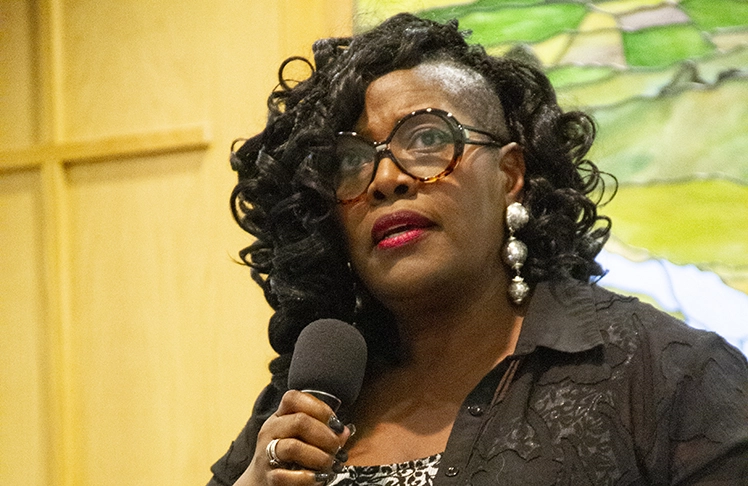
The Rev. Dr. Kelly Brown, senior pastor of Plymouth Church United Church of Christ in downtown Seattle, used the keynote address to focus on remembrance, resilience and the collective power of community.
“The significance of celebrating or commemorating the March on Washington is that we must remain vigilant and be children of remembrance,” Brown said. “It’s important for us to remember who we are, whose we are, and the power that we are endowed with, so that we might change not only the trajectory for ourselves and our children, but also the trajectory of this nation.”
Brown said the annual commemoration has particular significance in Seattle as the community has become increasingly dispersed.
“I believe that it’s of a particular importance for us to commemorate this every year in Seattle because there is a fracturing of community as people, for various reasons, are having to spread,” Brown said. “This is a recovery and a remembrance of the many things that this community has done. There have been folks who have made sure that this community has been successful, and it’s important for us to remember that we haven’t lost anything we’ve only gained. So this is a chance for us to say, ‘We’re recovering community, recovering our courage, recovering who we are together,’ so that Seattle doesn’t need to do anything but remember who we are and step into our power.”
During the keynote, Brown also invoked King’s warning in his “I Have a Dream” speech that America had given Black citizens a “bad check” marked “insufficient funds.” Brown argued that more than six decades later, the fundamental shortage is not one of resources but of moral commitment.
“Dr. King declared that not only were there insufficient funds, but that actually the bank of justice was not bankrupt. What was insufficient was the morality of this country,” Brown said. “This ain’t about a shortage of funds. The issue is about a shortage of consciousness. Our funds are sufficient, our faith is sufficient, our memory is sufficient, and our solidarity is sufficient. It is time to organize for the change that will come.”