By Aaron Allen, The Seattle Medium
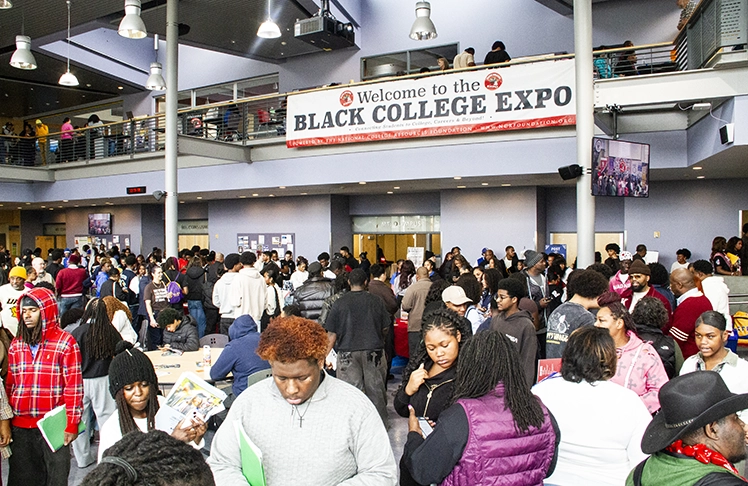
Marching band beats echoed through the halls of Highline College last Saturday as members of historically Black fraternities and sororities welcomed students carrying transcripts and hopes of attending college. Some students left with on-the-spot college acceptances and scholarship offers, while others discovered educational opportunities they had never considered.
The ninth annual Seattle Black College Expo, held Nov. 14, brought representatives from historically Black colleges and universities, local institutions, trade schools and apprenticeship programs together to help students explore their futures. Organizers reported approximately $10 million in scholarship opportunities, the largest amount in the Seattle event’s history.
For the first time in several years, the expo took place outside Rainier Beach High School, moving to Highline College in Des Moines to accommodate growing interest and provide greater regional access. The new location also offered connections to Link light rail and gave visiting students an opportunity to experience a college campus firsthand.
Organized by the National College Resources Foundation (NCRF) in partnership with Seattle Public Schools and its Office of African American Male Achievement, the expo addressed a longstanding challenge for Black students in Washington: the absence of historically Black colleges and universities in the state.
“Because Washington state has no HBCUs locally, we are not directly connected to HBCUs,” explained Ericka Townsend, who helps coordinate the event alongside Seattle Public Schools’ Office of African American Male Achievement. “A lot of us are first-generation Seattle; our parents are from somewhere in the South. Bringing this experience to the Northwest helps our kids understand the HBCU culture, and also the legacy that a lot of our parents and grandparents have.”
The foundation’s work began in 1999, when Theresa Price established NCRF in California following the passage of Proposition 209, which prohibited affirmative action in public education, employment and contracting. The organization held its first college expo in 2000 and reports assisting more than 800,000 students nationwide while facilitating over $5 billion in scholarships and grants.
The Seattle expo began in Renton in 2017 before moving to Rainier Beach High School. Its growth reflects continued interest among families seeking greater access to HBCUs and other educational opportunities.
For Nichelle Page of Seattle Public Schools’ Office of African American Male Achievement, the work is personal. Page attended a predominantly white high school where she said historically Black colleges were never presented to her as an option. She now helps create opportunities for students to learn about institutions they might otherwise overlook.
“Moving the 2026 event onto a college campus was intentional, allowing students to experience higher education firsthand in a “one-stop shop” alongside over 40 HBCUs, local institutions like the University of Washington, Washington State University, and Seattle Colleges, as well as trade schools and apprenticeship programs aligned with the 2026 expansion of federal Pell Grants,” explained Page.
The range of participating institutions gave students an opportunity to consider multiple paths after high school, from four-year universities to career training and apprenticeships. Students also learned about application fee waivers, financial aid and the possibility of receiving admissions decisions during the event.
Families traveled from as far as Portland, Oregon, Wenatchee and Bremerton. Aaron’s reporting also pointed to families encountering limited support from some school districts, underscoring the importance of outreach efforts that connect students directly with college representatives.
“The system’s not ready, but our people are ready,” said Page. “Our babies want to know. They are longing for this.”
For students, those opportunities were immediate and personal.
Rae Anna Carrington said the expo introduced her to colleges and resources she had not previously considered.
“This event is important to me because it just helps you network with colleges that you didn’t really know about and help you get the opportunities you didn’t know you would need in the future,” said Carrington.
For Jaden Murray, the event offered something beyond admissions information. Growing up in the Pacific Northwest, he said connecting with Black history and culture has become an important part of his identity.
“I think expos like this are important to bring the community together after so many people try to divide it for so long,” said Murray. “Being around my own people and learning about my history that’s kind of how I center my life right now, and I encourage others to do the same.”
His father, Herman Murray Jr., said the expo helped make HBCUs more visible to families who might have little direct experience with those institutions.
“Because there’s no HBCUs here, students won’t know about HBCUs if they aren’t from the South,” noted Murray. “Now they can get representation.”
That sense of representation extended beyond the college admissions tables. Members of the National Pan-Hellenic Council, representing the historically Black fraternities and sororities known as the Divine Nine, joined community leaders in greeting students, sharing experiences and offering mentorship.
Shawn Amour, president of the Seattle National Pan-Hellenic Council, described the gathering as an opportunity to bring generations together.
“This event is so significant because it brings together the village community, if you would,” said Amour. “The younger parts of our village get to see the older members of the village, and we all get to interact together and bring all of our resources under one roof.”
Stephen Ball of the Seattle Alumni Chapter of Kappa Alpha Psi Fraternity emphasized the importance of giving Black youth “a toolkit at their disposal.” Jana Matthews, representing Jacqueline Faucher and the Seattle Alumnae Chapter of Delta Sigma Theta Sorority Inc., highlighted the organization’s commitment to “scholarship, sisterhood, and service” through educational support and access to funding.
The BE Project HBCU College Tours also participated, helping students discover institutions beyond the handful of historically Black colleges that receive the most national attention.
“Being up in the Northwest, we don’t get a lot of exposure except for the big four or five,” said Craig Jackson of the BE Project. “Just being exposed can actually change and alter lives going to a school that was set up to fail and is now still thriving and putting out great individuals in this world.”
Allen Brooks, executive director of the BE Project, said seeing students receive college acceptances demonstrates the value of giving young people meaningful choices and opportunities beyond their immediate surroundings.
“We need to get our kids to be able to have choices, and off these streets of Seattle, to do positive things in other places and come back and give back to the Seattle community.”
The expo also featured workshops led by celebrity ambassadors Yo-Yo and London Brown, along with an after-show featuring live cash giveaways.
For students who arrived with transcripts, questions and uncertainty about their futures, the event offered more than information about college. It brought the history and culture of Black higher education closer to home, connecting young people with institutions, mentors and opportunities that could help shape their next steps.