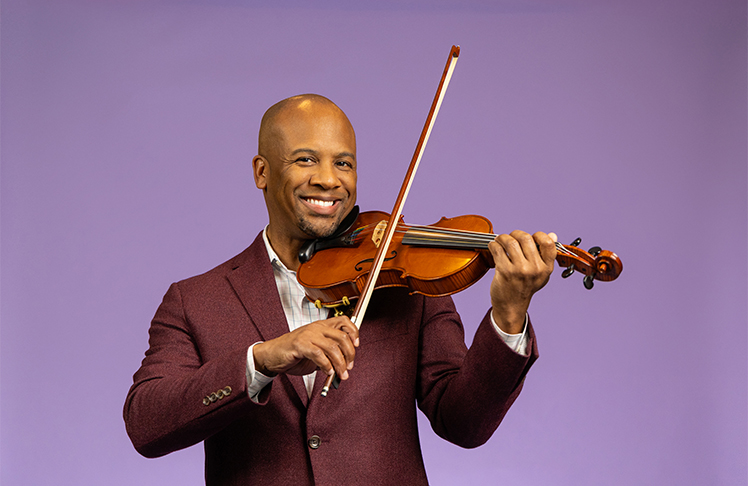
By Kiara Doyal, The Seattle Medium
Key to Change, a nonprofit founded in 2017, is transforming the lives of middle and high school students in South King County by providing world-class music education and mentorship. Focused on serving racially and economically diverse communities, the program offers young musicians an opportunity to thrive in an area that has historically lacked access to such resources.
Dr. Quinton Morris, a graduate of Renton High School, founded Key to Change to address a challenge he faced growing up — the lack of access to quality music instruction in his community. A world-renowned concert violinist, chamber musician, educator, entrepreneur, and filmmaker, Morris has performed across the globe, captivating audiences in the United States, Europe, Africa, Asia, Australia, and the Middle East. His achievements include the rare honor of presenting sold-out recitals at Carnegie Hall’s prestigious Weill Recital Hall for three consecutive seasons. Despite his international acclaim, Morris remains deeply connected to his roots and created Key to Change to fill a void he experienced as a young musician growing up in Seattle.
“Growing up, there was not a program like Key to Change,” Morris said. “I used to have to take the bus from Renton Highlands to Bothell every week just for my violin lesson.”
“I founded this organization to provide world-class music instruction to students living in the South King County area, which is a heavily underserved population,” Morris said. “I believe there is a lot of talent in South King County, and I wanted to invest in it by providing world-class music instruction. It just made sense because I am from South King County.”
According to Morris, the program, which is arguably the most diverse private lesson music program in the Pacific Northwest, has created many opportunities for his students that may have otherwise not been available to them.
“The students that are in our program have had enormous success,” Morris said. “They performed for Kamala Harris, First Lady Dr. Jill Biden, and have made their debuts with the Seattle Symphony.”
Zora Rose Mtunga, an alumna of Key to Change, appreciates the experience she had being a part of Key to Change and said that Morris is someone who has navigated the challenges of the Seattle Public Schools system, the rigid world of academia, and the global classical arts scene.
“As a young Black woman in STEM, his example taught me the importance of taking up space and working hard in all areas of my life. He inspired me to believe that I belong, as long as I continue to maintain my work ethic and my passion for education, learning, and community service,” Mtunga said. “For me, this was especially meaningful when transitioning out of private school, where I often felt like an outsider. Dr. Morris held high standards for people of color but always paired them with empathy, understanding, and encouragement, helping me to feel valued and capable.”
The program focuses its efforts on middle and high school students. It is during this stage in their life that teens may face an array of negative influences that can impact their personal growth and development. Morris, who is committed to working exclusively with these age groups, says that his program not only gives them the fundamentals of music but also fosters the development of skills that can help them be successful in life.
“We only take middle and high school students because that’s when the influences that are negative really start to happen, and we want to get them and start working with them right when things start to go scary,” Morris said.
“They are learning how to become accountable, responsible, caring citizens in our community. The violin and the viola are just the vehicle to the bigger picture, which is to give students a holistic artistic experience that is transformative and life-changing,” Morris continued.
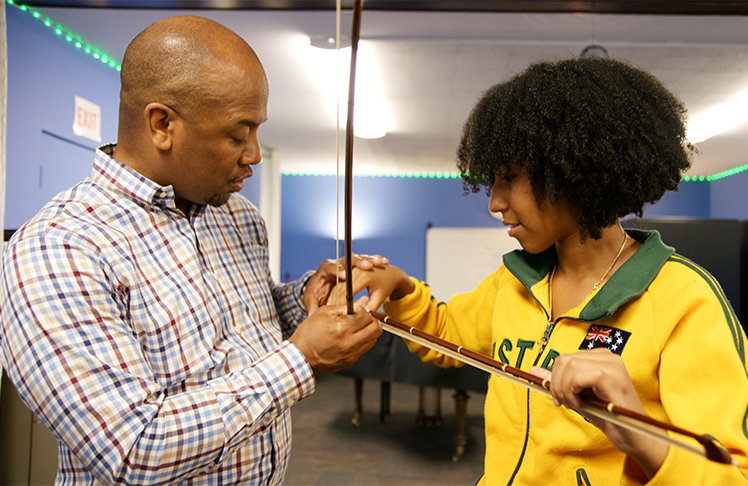
As a musician who has spent most of his life navigating the world of classical music, Morris is fully aware of the challenges Black musicians face to make a name for themselves.
“How many classical Black musicians do you know? Many people can hardly name five, but playing classical music in general is something that is well-respected, but as a Black person, it can be enormously difficult for that recognition,” Morris said. “It comes with an insurmountable amount of racism, classism, sexism, homophobia — all of this. The stack is very high.”
“I am the second living Black violinist in the United States history to ever receive the rank of tenure and promotion to full professor, and that is the top of the professor chain. Out of the thousands of universities here in this country, less than 20% of them have full professors, and out of that 20%, I received that rank,” Morris said. “Harvard University, my alma mater, is considered one of the first universities in this country to have full professors, and that was founded in the 17th century. So from then to the 21st century, thousands of professors have become full professors, and out of that 20%, the thousands of Black violinists who have taught at the university level, there’s only been two who have ever gotten the rank, and I am the second one. So, the fact that we have so many Black students in the program who are excelling is an enormous accomplishment.”
Morris said that the awareness they can bring through the work at Key to Change is groundbreaking for Black people.
“Our community, while they might have an appreciation for classical music, they aren’t well-versed in it, but they have an appreciation enough to recognize how hard it is and see that Black people are able to do it, and that is just amazing,” Morris said. “Recognizing that what our students are doing is hard is so groundbreaking and is probably one of my greatest moments of joy, and for that, I want more students.”
“Black people are not a monolith. We are so diverse, and so the fact that we have so many diverse walks of life from the Black community who are all coming in, I think is just beautiful, and that is what I love, and I want more of our people. I want more Black students,” Morris continued.
Black-led organizations and Black-owned businesses are crucial for our community to be able to provide a platform for Black voices. With Seattle recently experiencing the loss of many vital Black-owned businesses, Morris is grateful to be one of the few Black-led organizations still around today that are focused on changing the lives of kids from underserved communities.
“I am very grateful. It is very sad that there are Black organizations, companies, and businesses that have gone out of business, and my heart breaks for them and for the communities that have experienced that loss, and I would say that I am grateful to be here and grateful to be alive,” Morris concluded.
Mtunga said that Morris’s mentorship had an immense impact on her and helped her realize that hard work, dedication, and empathy can coexist, especially for people of color pursuing success in traditionally white spaces.
“His ability to balance high expectations with support and encouragement has shaped the way I approach challenges. I’m honored to still volunteer with the organization whenever I can because of how much Dr. Morris has influenced my own journey. His commitment to excellence and community service is something I continue to carry with me in all my endeavors, whether it’s creative, educational, or communal,” Mtunga said. “His teachings remind me daily that I can carve out space for myself in any environment, and I am deeply grateful for his lasting impact on my life.”
This story is part of the Digital Equity Local Voices Fellowship lab. The lab initiative is made possible with support from Comcast NBC Universal.