By Sydney Goitia-Doran, The Seattle Medium
Each year, the NAACP hosts the Afro-Academic, Cultural, Technological and Scientific Olympics (ACT-SO), a nationwide competition where students showcase their talents in 32 categories spanning the disciplines of STEM, performing arts, humanities, visual arts, business, and culinary arts.
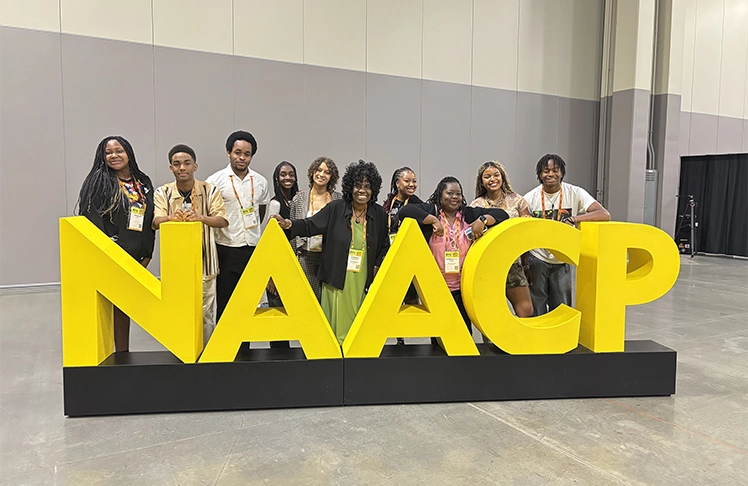
According to Carolyn Riley-Payne, who chaired the Seattle King County NAACP ACT-SO program for many years, the Seattle branch has been part of the national ACT-SO program since its second year. Most recently, the branch had nine students participate in this year’s competition in North Carolina, with two observing and seven competing.
Over the years, Riley-Payne has seen firsthand how the program helps young people uncover hidden strengths and creative potential, illuminating life paths based on intellect and talent.
“I have seen young people grow so much, and they say that they don’t have any particular talent and then we’ll talk to them and we’ll help them identify [one],” Riley-Payne said. “Everybody can tell a story. Everybody can be a poet. You might not be a scientist, but there is something, there is a category in which you can excel.”
Riley-Payne has mentored many students through the program, including Leonetta Elaiho, who says the ACT-SO program inspired her to reach a high level of excellence that she carried with her into adulthood.
“I think that level of rigor and standard of excellence has certainly shaped my professional work and how I show up in spaces,” Elaiho said. “I try to always hold myself and teams or young people that I’m working with to the highest standard, knowing that with support they can meet it because I’ve seen it time and time again.”
Elaiho’s ACT-SO legacy does not end with her. Her son, Efe, a recent high school graduate, participated in ACT-SO for the last four years in the fields of computer science and filmmaking, earning medals three times.
“It’s been an incredible run and seeing the leadership formation in my son through the program, and how it’s shaped him,” said Elaiho.
Quiana Butler, a team member and ACT-SO coordinator, says that the competition is valuable because it gives students the chance to connect with successful Black role models and peers.
“This is literally the Olympics of the mind, and it’s a great opportunity for the students that do place with the gold medal locally to then compete nationally,” Butler said. “Because then it opens their eyes so much to see the representation of students that look like them from all over the United States participating in STEM, culinary, business, visual arts.”
In the year leading up to the national competition, local NAACP branches host mentoring opportunities to help students prepare and develop confidence. According to Butler, many students feel like winners just by participating, and they take away lessons they can use for the rest of their lives.
“Just instilling that little piece of ‘You can set your mind out, you can do anything that you put your mind to in life.’ And I feel it’s life lessons in preparing them for their next step as they go on to college,” Butler said. “That a lot of times we may not hear the yes in that moment, but how to prepare them for when their names not called, to not give up, to keep going.”
Butler says that one of the most important aspects of the competition is the networking that takes place. With famous alumni like Alicia Keys, Anthony Anderson and Jada Pinkett Smith the national competition connects many future leaders in their fields with peers that can inspire them to achieve greatness.
Angela Rye, a political commentator, attorney, and advocate, also participated in ACT-SO. Rye, who was born and raised in Seattle, says the competition truly brought the phrase “young, gifted, and Black” to life for many of its participants.
“In Seattle, I grew up going to the ACT-SO banquet at First AME with my parents and could not wait to get to high school to compete like Tara Chatard, Curtis Midkiff, and so many others,” Rye said. “Under the tutelage of Mrs. Carolyn Riley-Payne and the late Lacy Steele, I learned that all I had to do was my best and the worst thing they can say is no. Those are life lessons, pillars that have guided by calling and have certainly been the foundation of my work.”
Elaiho says that in today’s cultural climate, programs like ACT-SO show the agency Black people have in their own community.
“We are not just contributors, but we are shapers, we’re leaders, we’re inventors, we’re entrepreneurs. And I think that understanding is most chiefly important for our own community to understand, because we’re the first victims of that fallacy,” said Elaiho. “And then how does that ripple out into the change that we can be in the world in helping to reshift the cultural narrative? But particularly for our kids getting that narrative firsthand from people that look like them and talk like them and appreciate who they are and their brilliance.”