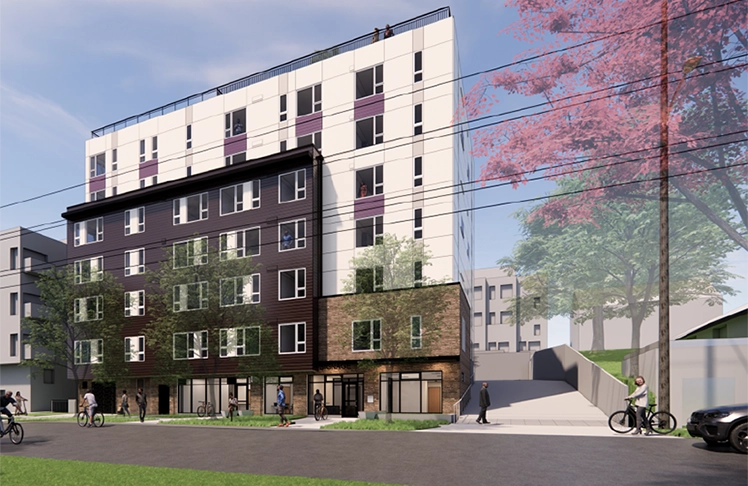
The New Hope Community Development Institute (NHCDI) and the Low Income Housing Institute (LIHI) have announced the start of construction on New Hope Family Housing, a 92-unit affordable housing development located in Seattle’s Central Area.
The housing will be built on two properties owned by New Hope Missionary Baptist Church, at 114 and 123 21st Ave. The buildings will face each other across the street and feature a mix of studio, one-bedroom, and two-bedroom apartments for individuals and families earning up to 50% and 60% of the area median income. The development will also include office space for NHCDI and Clean Greens, a nonprofit produce market focused on food justice.
“We are thrilled that construction will start immediately on 92 affordable apartments on church-owned land,” said NHCDI Vice Chair Rev. Dr. Robert L. Jeffrey Sr. “This provides a unique opportunity to build housing for community members as the Central Area has experienced significant rent increases and displacement. We applaud our funders, NHCDI, LIHI, and members of the New Hope Missionary Baptist Church for taking action to address an urgent housing need.”
The development is the first affordable workforce housing project in the Central Area to take advantage of a new Seattle city code that allows increased density on land owned by religious institutions.
“We are proud to partner with the New Hope Community Development Institute in building the first affordable workforce project in the Central Area utilizing Seattle’s innovative new code that provides increased density on land owned by religious institutions,” said LIHI Executive Director Sharon Lee. “The church continues to own the land and offered a 99-year lease so that NHCDI can launch the first of many housing development efforts to benefit the community.”
The architect for the project is Weber Thompson. The general contractor is WG Clark. The development will span a 23,838-square-foot site with a total building area of 71,530 gross square feet. Construction is expected to be completed in spring 2027.
Financing for the project includes support from the Seattle Office of Housing, Washington State Department of Commerce Housing Trust Fund, Transit-Oriented Development funds, Washington State Local Community Projects funding, Washington Community Reinvestment Association, Washington State Housing Finance Commission, Seattle Equitable Development Initiative funding, and low-income housing tax credit investments from Enterprise. KeyBank is providing construction financing.