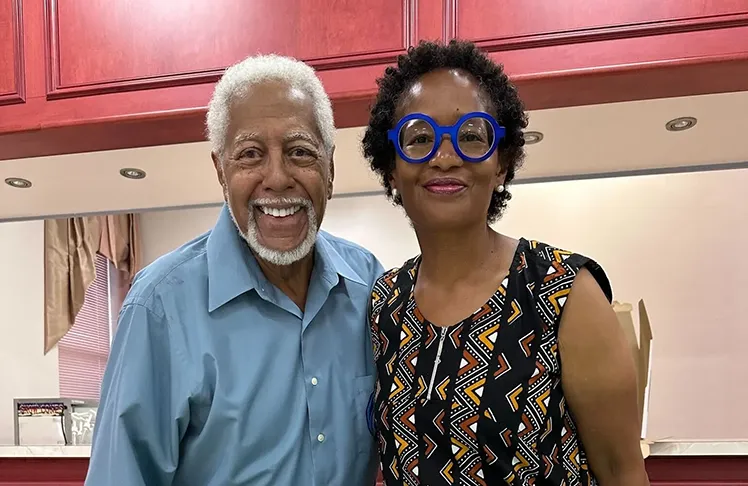
For his entire life, John Leeke understood his family history and his own, as well as how his deeply rooted Catholic faith shaped his sense of identity and justice. He was, more or less, a lifelong Catholic, raised in Washington, D.C., and educated by nuns throughout grade school.
So when he and his daughter, Madelyn “Ananda” Cheryl Leeke, set out to document what they thought they knew, they dug into records and searched databases like Ancestry.com.
What they actually found, however, upended Leeke’s sense of himself, sending him and his daughter on a journey that transcended time, distance, and faith. The path began in Africa, wound through two tribes in two nations, crossed the ocean to central Maryland, and ended with what likely was a harrowing journey from slavery to freedom in Canada.
Perhaps most surprisingly, Leeke’s search for his roots revealed that his ancestors weren’t exclulsively Catholics but Black Protestants — and that the African Methodist Episcopal Church likely helped the family escape north on the Underground Railroad.
‘Good, Strong Stock’
The discoveries are the subject of father and daughter’s new book, American Change Agent. The two are sharing their stories as part of Black Catholic History Month.
As Leeke traced part of that journey firsthand in central Maryland, he put himself in their shoes.
“I just tried to imagine what that must have been like: to have been 16 people walking and going on the steamboat, being in carriages, probably in wagons, having to be out in the cold and trying to survive,” John Leeke says. That they all survived, he added, “said to me, clearly, I come from good, strong stock.”
The revelation emphasized the role of faith in their family, Ananda Leeke says, and “the faith that came from the community and the Black church — from the AME Church to the Baptist Church and to the Black Catholic Church.”
I just tried to imagine what that must have been like: to have been 16 people walking and going on the steamboat, being in carriages, probably in wagons, having to be out in the cold, and trying to survive.
Dr. john leeke
“No matter where you are in this country, and I would even say the world, wherever there are people of African descent, we have leaned into the church,” she said. “It provides for faith and for community, no matter what the domination is. That’s something we do.”
Roots in Ghana, Freedom in Canada
The journey for father and daughter began when Ananada Leeke obtained photos from a cousin. They led her to the obituary of Leonard Leeke, her great great-grandfather; the outline of her family’s story came together using Ancestry.com and the Canadian census.
Next came a DNA test for her father from African Ancestry, a Black-owned company. The results unearthed the family’s Nigerian roots; the genetic patterns also indicated that Leeke had strong connections to the Akan tribe in Ghana and the Yoruba people, a West African ethnic group that inhabits Nigeria, Benin, and Togo.
The revelation was “such a big surprise,” John Leeke says proudly. “I can connect with the mother country,”
The Middle Passage brought the family to Maryland, and the family tree grew around the dawn of the 18th century.
Genealogy searches revealed Leeke’s great-great-grandparents were born in Maryland in 1799 and 1811. The couple had 14 children, all enslaved in Hagerstown, until they escaped by way of the Underground Railroad.
Aid from the AME Church
Ananda Leeke shared insights about their ancestors’ migration from Hagerstown, Maryland, to Amherstburg, Canada, emphasizing the significance of the AME church in aiding freedom seekers. She also noted the existence of the Dolman Black Heritage Museum, which documents the local history of the slave trade.
The church members and the pastor were helping people escape, Ananda Leeke says. At that time, there was only one northbound road out of Hagerstown to go up north, and her father took the opportunity to walk it on a recent trip to the city, about 75 miles west of Baltimore.
“I had a chance to walk on that road,” John Leeke says. “And believe it or not, that road, a big part of that road and the church are in a Black community. “You can look at the map and see where they walked, see where they got rides.”
The discoveries included the fact that Leeke’s paternal grandmother is descended from the Roberts family of Terra Haute, Indiana. His father’s grandfather was Henry Osborne Roberts, a mason and a member of Spruce Street AME Church.
“Henry Osborne Roberts chose to live as a colored man, although he had a clear choice,” Ananda Leeke says. “His wife, Eunice Ananda Thomas Roberts, was a member of Oak Street Second Baptist Church and a member of the Eastern Star.”
‘I’ve Met Her Spirit’
The Black church in Terre Haute played “a major role in helping our community take advantage of opportunities,” she says.“It grounded them, because my dad can tell you stories about his grandmother and her commitment to the church before she had a way. I never met her, but I’ve met her spirit.”
”Yes, Eunice Ananda was quite a woman, statuesque almost — like royalty in some ways,” John Leeke says. “And when she went out, she was always impeccably dressed. She was an entrepreneur, a dressmaker. If they were still alive, they would have fit right in with some of the TV programs.”
Given his history, it’s easy to understand John Leeke’s passion for social justice, which included his work at the National Education Association, the nation’s largest teachers’ union. He worked to enhance minority representation and later collaborated with Elsie Y. Cross Associates on diversity initiatives in Fortune 500 companies. Additionally, he was instrumental in developing the NEA Minority Intern Program, which significantly impacted the lives of nearly 300 individuals over 27 years.
And all this justice work was strengthened by his resolve for equality and by his strong faith in the gospel of Jesus Christ that demands such justice.
That fire was fanned by the religious upbringing he’d received in the church and continues in fellowship with St. Joseph Catholic Church in Largo, Maryland. And the story is shared repeatedly as he and his daughter tour the country with their book.