by Rann Miller
Let’s set the record straight: “Say her name” shouldn’t be used for everyone who is unjustly killed at the hands of the state.
To be more specific, it ain’t for white folks. And yes, I meant to say “ain’t.”
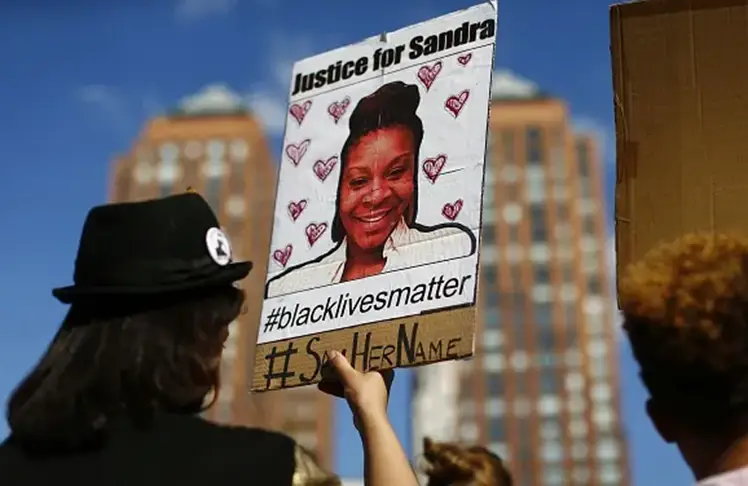
The hashtag, #SayHerName, isn’t simply a one-off catchphrase. It is a social justice visibility movement that Dr. Kimberlé Crenshaw, a professor at UCLA Law School and Columbia University Law School, created to highlight law enforcement violence against Black women and girls within an anti-Black society. It shone a spotlight on the killing of Sandra Bland, the 28-year-old Black woman who died in Texas after allegedly assaulting a police officer during a traffic stop.
Since its creation in 2017, it has evolved into a rallying cry — one that has been used way too often for far too many Black women killed by law enforcement or found dead in official custody.
Now, white activists in Minnesota, angry at the federal Immigration and Customs Enforcement agents who killed Renee Nicole Good, are using #SayHerName in social media posts and shouting it in protests on the snow-covered streets of Minneapolis. And it’s not a good look.
ICE, Not Invisibility, is the Problem
Let me be clear: it’s outrageous that an ICE agent shot and killed Good, 37, without justification, at point-blank range, and illegally. The Trump administration made things worse when it branded her a terrorist, sent more immigration agents to the city, and declared it would not investigate her death. People in Minneapolis and across the country are right to demand accountability for her murder, and they are right to demand that ICE leave their city.
But protesters shouldn’t co-opt #SayHerName to do it.
People have been saying Good’s name from the moment she was killed Jan. 7 inside her SUV while attempting to steer away from ICE agents confronting her on an icy residential street. The presence of ICE paramilitary troops is also responsible for the murders of Alex Pretti and Keith Porter, Jr., in Los Angeles.
The tone-deaf use of #SayHerName to protest Good’s killing illustrates society’s collective failure to act on behalf of Black humanity, particularly after Black women spoke up.
Rann Miller
Within hours of Good’s slaying, the news made national headlines, just like the murders of Heather Heyer, who was run down by a white supremacist during the 2017 “Unite the Right” rally in Charlottesville, Virginia, and Justine Damond, shot to death by a Black Minneapolis cop that same year. Good, Heyer, and Damond were all white women.
Black Women Matter
But Bland’s death was just as outrageous. She was found hanging in a Walker County, Texas, jail cell three days after a heated confrontation with an officer during a routine traffic stop. A coroner ruled her death a suicide, but her family rejected that. Despite repeated demands, no one — not the aggressive cop who arrested her, nor the jail guards responsible for her safety — has answered for her death.
If it weren’t for the #SayHerName campaign, few people would know about Bland or the circumstances of her senseless death. That’s not an accident.
Studies show that the murders and disappearances of white women receive disproportionate attention in the news and public discourse, especially when compared to those of Black women. It’s problematic, which is why Crenshaw created #SayHerName in the first place. Before then, Bland was anonymous, and her death was a mystery. The campaign helped her be seen.
More broadly, using the hashtag to protest Good’s killing is yet another example of white people co-opting Black language. The Trump administration has weaponized “woke,” is using the language of the civil rights movement to dismantle actual civil rights, and the far right used “say her name” to publicize the death of a January 6 rioter. Usually, whites talk like Black folks to make a profit, become relevant, become the center of attention, or mock Black people.
Co-opted and Tone-Deaf
It’s a fact that white people appropriate the everyday phrases and cadence of Black speech, too, not just what’s culturally significant; I see it all the time on social media. Unfortunately, I’ve also witnessed white folks do it at work, to sound cool or appear cool to Black people. It’s problematic, considering how Black language is stigmatized as uneducated or uncouth in certain spaces.
Most importantly, the tone-deaf use of #SayHerName to protest Good’s killing ironically illustrates society’s collective failure to act on behalf of Black humanity, particularly after Black women spoke up.
A Black woman coined the hashtag to rally support for the end of law enforcement killing Black women, but it’s bigger than that. Historically, policy outcomes that benefit Black people typically benefit everyone. The Civil Rights Act of 1964 and the Voting Rights Act of 1965, making it easier for all people to register to vote, are evidence of that.
However, the warnings of Black women are often disregarded and dismissed. Maybe it’s because most folks aren’t Black women, or aren’t emotionally connected to Black women, or simply don’t care about Black women or Black lives in general. But they should.
To interpolate the famous poem, first they came for Black people, but no one spoke out because they weren’t Black women. Then, when they came for those who were silent, the silent found no one was left to speak for them.
Maybe, had they spoken up when Black folks sounded the alarm, laws would have been in place to prevent the murder of Renee Nicole Good.
Rann Miller is an educator, opinion columnist and author or Resistance Stories from Black History for Kids. You can follow him on twitter @UrbanEdDJ and on Instagram @urbanedmixtape.