By Aaron Allen, The Seattle Medium
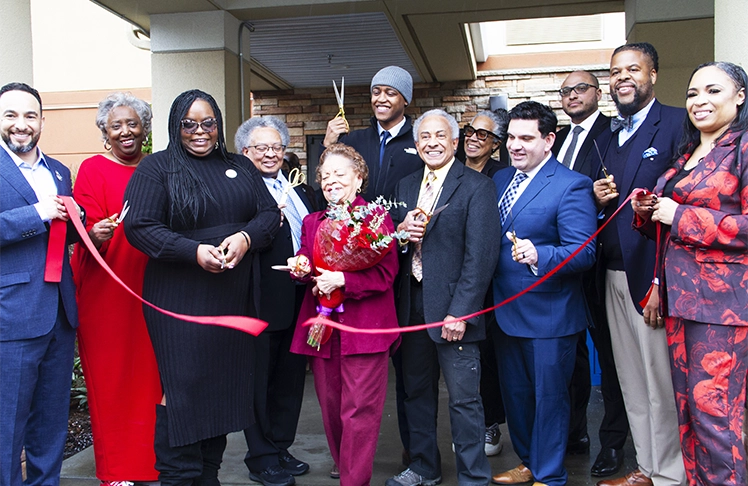
A powerful example of collaboration and community commitment opened its doors in Federal Way, as local and regional leaders recently celebrated the launch of the Booker House. The permanent supportive housing project is part of the Health Through Housing initiative, a program uniting the Urban League of Metropolitan Seattle, King County and the city of Federal Way in their ongoing efforts to address homelessness and housing insecurity.
The goal of Health Through Housing, or HTH, is to create stability, safety and permanent housing for individuals and families experiencing homelessness or struggling with low income. The initiative focuses on building affordable homes while integrating critical services to help residents rebuild their lives.
With 15 properties established across King County, HTH has become a growing network of housing solutions. According to program data from December 2024, HTH has secured 1,434 homes for permanent supportive housing. Ninety-five percent of residents have achieved stability or transitioned into permanent homes. The program served 1,281 people in 2024 and has contributed to a 17 percent reduction in emergency department visits related to homelessness and mental health.
King County Executive Girmay Zahilay, who served as the keynote speaker at the grand opening of Booker House, said the project is urgent and impactful.
“This is so important because it shows people hope during really dark times,” said Zahilay. “The top issues in our region of King County are the homelessness crisis, the housing affordability crisis, and mental health and addiction issues that are plaguing so many people.”
Booker House is named in honor of Harold G. Booker, a fierce advocate for human rights and long-serving commissioner for the Housing Authority of King County. During his tenure, Booker played a pivotal role in the development of the “turn-key” housing method for low-income families, a model that gained national recognition. Under his leadership, the county’s public housing inventory grew from 1,000 to over 10,000 units.
Booker was not only a policy expert but also a hands-on advocate, using his legal background and personal resources to fight for housing justice. His family members, including son Harold Booker II and sister Vivian Lee, were present for the ceremony and shared personal reflections on his legacy.
“Dad was always interested in equal housing, in fairness in housing,” said Booker II. “He spent 35 years on the King County Housing Authority Executive Board, including being the director of the board five times, but he was always looking at housing, equitability, housing, and how we can help lift up people.
Lee shared a firsthand account of her brother’s ability to bring people together, even those initially opposed to his work.
“We really feel this would be a project that Harold would be supporting with all of his heart,” said Lee. “In fact, it is just amazing to us that he did so much work voluntarily, using his attorney skills, using his financial resources, just because he cared about homeless.”
“One of the incidents, for example, was when our church wanted to host a homeless camp. We had a huge lawn, and we could host one of the camps, like the Nicholsville. The neighbors were incensed, because many of them had these lake view homes all around the church, and there was a whole new committee right next to the church. And they were irate,” continued Lee.
“Well, my brother, Harold, was so persuasive, not only did he persuade them that it would be okay, but they would also have their privacy. We would be there looking, and tending, and getting other resources, like public health, to come in. He not only persuaded them, but he actually had them bringing resources, food, and everything to help the camp once it was established.
“And that’s when I learned, my brother was kind of a superhero to all of us, and we already knew that. But it did mean my first look at how he dealt with public.”
Michelle Merriweather, president and CEO of the Urban League of Metropolitan Seattle, spoke about the vision behind the project and what it represents for individuals in need.
“The importance of this space is providing safety, dignity, a safe place for individuals who have experienced challenges in their life,” said Merriweather. “And this is their fresh start, their new beginning, their home.”
Merriweather noted that while the project officially opened in 2024, it began in 2022 and evolved through sustained collaboration.
“Every day is a challenge and an opportunity,” said Merriweather. “So, while this project began in 2022 and we’re opening the doors today, it gave an opportunity for us to get to know the county, for the city of Federal Way to get to know us and to create a true partnership in alignment.
“So, while there were ebbs and flows and starts and steps for various reasons, everything happened for a reason and in the right timing. And I think it all led up to where we are today, a beautiful space, a place for folks to call home and be safe and feel good about being here,” she added.
Jelani Jackson, interim deputy director of housing and community development for the Urban League, underscored the unique value of combining direct services with public investment.
“The amazing part about Health Through Housing is we combine an amazing suite of services, provided by the Urban Link here in Federal Way, married with the power of government, bringing those two things together to fund all of the services, to remodel buildings and supply all of the capital to make this an amazing space for folks to call home,” said Jackson.