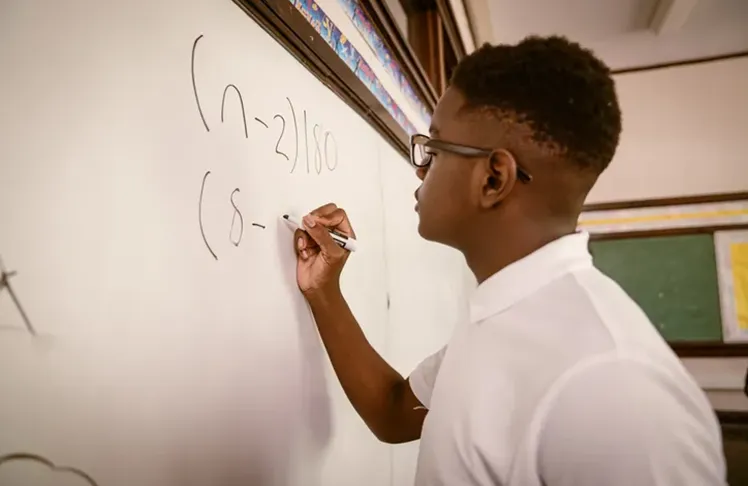
When I was 22, I walked into my Teach For America Greater New Orleans interview confident that I’d be a history teacher. Therefore, it was a shock when I was asked to pivot to math to meet community needs. I was intimidated, but ready to rise to the challenge. Eleven years later, I’m grateful I did. That shift reignited a passion for math and taught me a key lesson: What matters most isn’t what I teach, but how I teach.
That lesson feels especially urgent today. Louisiana is the only state in the country where students have increased learning since 2019, according to recent NAEP results (a national report that provides benchmarks for student achievements).
But even as our state bucks national trends, gaps persist, especially for Black and Hispanic students and for students who are economically disadvantaged. Nationally, Black and Hispanic students experienced greater math score declines between 2019 and 2022 than their white peers, widening both achievement and opportunity gaps. Here in Louisiana, those gaps remain visible in the math and reading results of the very students I teach.
Yet I’m optimistic, because I know what is possible. As a Black woman growing up in Atlanta, I was inspired by educators who looked like me. Now as a Black teacher in STEM — when Black educators who teach STEM only make up 7% of the teacher workforce — I see firsthand the importance of students being led by those who look like them and are genuinely invested in their success. Teaching is a profound act. Content knowledge matters, but true impact comes from serving as a role model and advocate for students.
When I think about why I said yes to becoming a math teacher all those years ago, and why I’ve stayed, the answer is clear: I have seen the students I serve make significant growth toward closing both the achievement gap and the opportunity gap. And I believe young people today want to contribute to real change. When they can connect their leadership and purpose to the work of shaping the next generation, we begin to solve some of our most persistent challenges. In addition, I continue to say yes to this work everyday because I have the privilege to help young people connect their leadership and purpose to the work of solving some of our most persistent challenges, and I have seen how much this generation of young people want to contribute to real change.
Teaching isn’t easy, and success doesn’t come overnight. My guidance for every teacher, regardless of what subject to teach, is to be a great teacher for your students. After more than a decade in the classroom, here are my three best practices to help teachers thrive:
Build strong relationships. Trust can unlock confidence, especially in math where math anxiety is common. I strive to make my classroom a safe space and to see students as individuals, not statistics. I do so by sharing about myself, asking about their interests, and offering each student a fresh start every day.
As a teacher, I have a responsibility to advocate for students and to hold mindsets that honor who they are, not their demographics, their potential limitations, or any assumptions others may place on them. Many of my kids tell me I’m their first Black or first female math teacher, and that representation matters, especially for Black students who rarely see themselves reflected in STEM spaces. Students shine when they’re taught by someone who believes in their brilliance and understands their lived experience.
Embrace feedback and seek out people who will help you grow. You don’t have to reinvent the wheel in the classroom. Find other educators you can observe, learn from strong educators, ask for feedback often, and use the roadmaps they offer. At the end of the day, students must be at the center of every decision.
I leaned on my network of support: my Teach For America coaches, veteran teachers, and trusted colleagues who challenged and encouraged me. I have a full folder of feedback I often revisit that helps push me to seek, reflect, and implement best practices. The longer you stay in this work and seek continuous improvement, the more excellent you become, and your students benefit most.
Think beyond the classroom. Preparation matters; you must know your lesson every day and find ways to make it engaging and relevant for students. For example, math is more than equations; it shapes problem-solving and communication skills. I weave writing into math, asking students to articulate their reasoning, which strengthens both critical thinking and communication skills. These skills will serve them long after they leave my classroom.
I’ve seen the impact of this approach over time. In my first year, only 22% of my scholars passed the state test. It wasn’t enough. But I kept working at my craft, and year after year, their growth reflected that effort. Change doesn’t happen overnight; learned practices take patience but are worth the effort. This year, 93% of my scholars passed, meeting and exceeding state expectations. I’m confident we are on the right track to prepare our students not just for their next classes, but for the world beyond the classroom.
When I build trust, lean on my network, and make learning meaningful, students thrive. My path as a math teacher wasn’t what I expected, but the goals I had as a prospective history teacher still guide me: Serve as a role model, help students see their potential, and equip them to lead. If you’re already in the classroom, thank you. If you’re considering this work — as a TFA corps member, teacher, volunteer, or partner — I hope you join us. Advocate for students. Invest in their futures. You may end up loving this work as much as I do.
Alexandria Brown is an Algebra 1 teacher and ninth-grade level chair at Collegiate Academies, and a 2014 Teach For America Greater New Orleans alumna.