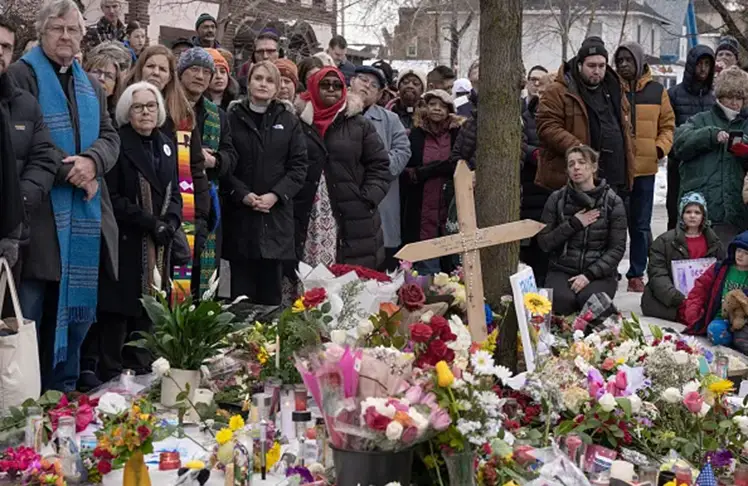
As large crowds chanted “ICE out now” in sub-zero temperatures in downtown Minneapolis and surrounding neighborhoods last weekend, clergy and church leaders from across the country worked shoulder-to-shoulder beside residents and activists to protest federal immigration enforcement actions and provide spiritual, logistical, and moral support to the community.
Responding to a call from the Minnesota-based Multifaith Antiracism, Change & Healing (MARCH) coalition, more than 600 people – Christians, Jews, Buddhists, Muslims, Indigenous practitioners – joined local residents in Minneapolis, ground zero of the Trump administration’s Immigration and Customs Enforcement crackdown. They marched, prayed, documented ICE activity and offered a highly visible religious presence intended to underscore moral objections to the federal tactics.
The gathering was not a one-time event, according to the thank-you letter on the MARCH website. Rather, the letter states, it was “an initial act of collective responsibility—rooted in relationship, spiritual grounding, and commitment to communities facing heightened harm and scrutiny in this moment.”
“Do Justice. Love Kindness. Abolish ICE”
Rabbi Marc Israel of Rockville, Maryland, was among the faith leaders who arrived in Minneapolis to join the protests.
”We came at the call of local organizers who were resisting the ICE invasion of their city,” said Israel, who traveled with a group of rabbis. “We stand with our neighbors in Minneapolis in demanding human decency and protection for all people.”
Last week, the group joined hundreds of others at Westminster Presbyterian Church in downtown Minneapolis for spiritual revival and protest training. A sign on the pulpit, a reference to the Hebrew prophet Micah, read, “Do justice. Love kindness. Abolish ICE.
We stand with our neighbors in Minneapolis in demanding human decency and protection for all people.RABBI MARC ISRAEL, ROCKVILLE, MD
It didn’t take long for the faith leaders to become involved on the ground.
In one instance, three ministers, all wearing clerical stoles, witnessed twelve ICE agents descend on a minivan, demanding its occupants show citizenship papers. The ministers blew whistles to call attention to the encounter, which ended peacefully when the woman at the wheel produced proof of citizenship.
She thanked the ministers profusely, but the incident left an impression on everyone involved.
Faith Leaders Speaking Out
“I’m becoming radicalized,” James Galasinski, a Unitarian Universalist, told RNS. “I’m seeing our nation become more and more fascist before my eyes — I saw it. I saw it. I mean, demanding papers? I never thought I would live in a country like this.”
Before their delegation left for Minnesota, the Episcopal Diocese of Maryland issued kits containing items such as protest stoles, plastic bags, extra T-shirts, first-aid kits, cell phone power banks, cash, snacks, and Sharpies for writing identifying information on one’s body.
Along with participating in demonstrations on the ground, faith leaders are speaking out against the ICE crackdown.
More than 154 bishops — including Bishop Paula Clark, presiding prelate of the Chicago diocese — signed a letter decrying ICE’s treatment of Minneapolis residents. Meanwhile, United Methodist leaders including several bishops, are increasingly speaking out against the federal government’s tactics.
Far From the ‘Beloved Community’
“The Church has long taught that human dignity is not granted by governments,” wrote Missouri Conference Bishop Robert Farr in a letter calling for courageous Christian witness. “It is given by God. Jesus tells us that whatever we do to the least of these, we do to him. Again and again, Scripture reveals that God’s heart is found among those pushed to the margins.”
People of all faiths, he said, “must stand with immigrants, refugees and all who seek safety, dignity and due process.”
The United Methodist Council of Bishops also issued a statement condemning the violence in Minnesota.
“The United Methodist Church deplores the use of violence, fear, separation, and intimidation as a means of creating social order,” Council of Bishops President Tracy S. Malone wrote on behalf of the council. “Such means do not build beloved community. We reaffirm our longstanding commitment to the sacred worth of every person and to the way of peace taught and embodied by Jesus.”
Furthermore, “[w]e stand against the separation of children from their families,” according to the statement. “We detest the inhumane, evil actions that are perpetuated by governmental authorities.”