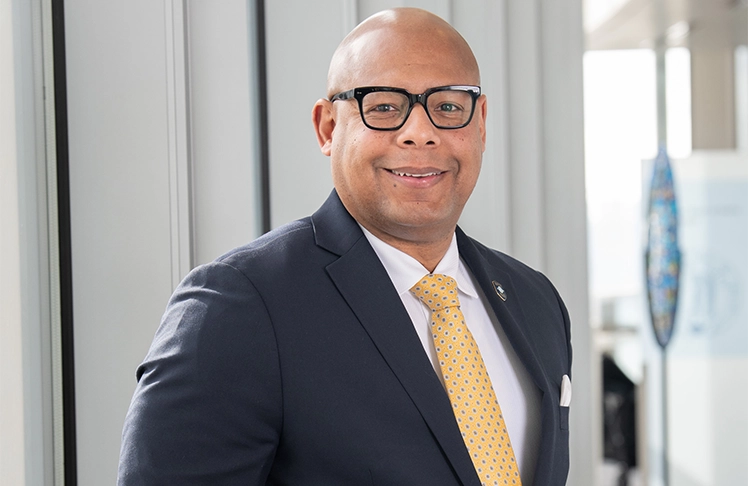
By Kiara Doyal, The Seattle Medium
Over the past year, the Seattle Police Department cleared 86% of its homicide cases, a sharp increase from 57% the previous year and well above the national average of 61.4%. Although every homicide investigation presents unique challenges, Seattle Police Chief Shon Barnes said the improvement reflects the department’s ongoing commitment to better serve the community and continually improve its performance.
In all, detectives cleared 32 of 37 homicide cases. The gains come as Seattle also saw an 18% reduction in overall crime. Homicide victims dropped from 58 in 2024 to 37 in 2025, representing 21 fewer lives lost. Other categories also declined, with stolen vehicles down 24% and burglaries down 18%.
“In the police department and under my administration, we are committed to being better. We know we’re going to have setbacks, but the answer to setbacks is: are we going to be consistent in what we’re going to do,” said Barnes. “We do not believe in the concept of a cold case. That is actually a term from television. But in policing, we investigate our cases the same way, no matter who our victim is, no matter where they are, but we obviously can’t do it by ourselves.”
According to Barnes, a strong emphasis on teamwork has been key to improving the department’s ability to close homicide cases and achieve a higher clearance rate.
“One of the things that we were pushing heavily on was this concept of teams and working together as teams. You can have one skill set, which may be understanding public space cameras, but someone else may have a particular specialty in talking to the community,” said Barnes.
Barnes also said the department has brought in new leadership, including Assistant Chief Nicole Powell from the New Orleans Police Department, as part of an effort to bring new perspectives to the agency. Barnes noted that New Orleans faces significantly higher levels of gun violence, adding that experience from that environment can help inform strategies in Seattle.
While those changes and other internal SPD initiatives may have contributed to the recent gains, Barnes said reaching such a high clearance rate would not be possible without the support and cooperation of the community.
“Having community engagement opportunities, doing community walks, listening to the community and not talking so much, and listening to the community when they say, we are fed up,” said Barnes. “We don’t need people to necessarily get on the stand for us unless they want to, but point us in the right direction. Just saying, ‘Hey, officer, he ran that way,’ helps us get to where we need to be. The community is our compass, and that compass points us in the right direction, which enables us to solve cases.”
Barnes says community trust is essential, linking the department’s success in solving cases directly to the level of trust and cooperation it has with the public.
“When we clear cases, and this is from my experiences as well, it is usually because someone told us who did it. That’s not what people want to hear, because the television shows will show you different, but in reality, we are really good at solving crimes when people help us find who did it,” said Barnes.
“I define trust as the voluntary dissemination of information to whom someone believes has good intentions. When you have to ask people for information, that demonstrates that there is not a lot of trust,” added Barnes. “So, when people are willing to give us information and voluntarily give that information, that is trust, because it means that they believe we’re going to do something with it that’s going to be the betterment of the community.”
Officials say technology has also played a key role in supporting homicide investigations. The department’s Real Time Crime Center, or RTCC, assisted in 17 homicide cases. The center uses real-time information to help officers locate victims and suspects more quickly, improve officer and community safety and strengthen investigative outcomes.
One of the biggest challenges in solving the remaining homicide cases is that some involve juvenile witnesses or suspects, which can make investigations more complex.
“Those cases are really hard to solve because, for example, in the case of the Rainier Beach homicide, three lives were lost. We lost two to gun violence, and we lost one to the criminal justice system, and because there are a lot of guidelines when talking to juveniles,” said Barnes. “And so sometimes there is a cocooning effect that occurs around cases when there are juveniles that are involved as either a suspect, witness, or a person who was involved.”
In addition to those challenges, Barnes noted the department is also confronting the broader role guns continue to play in violent crime. SPD’s year-in-review shows that about 80% of homicides involve gun violence. In 2025, officers recovered 1,523 firearms, up from 875 the year before. At the same time, Barnes said more than 200 guns were stolen from motor vehicles in Seattle, a trend that should concern the community.
“People often will search for guns in or around nightlife. They do that because if you are having or carrying a gun, you can’t bring it into the nightlife facility because they search people,” said Barnes. “Which is why we normally have parking enforcement around our nightlife. We want people to park in designated parking areas and not park their cars in places that are not designated so that they do not get broken into or become a victim of a crime.”
To address that trend, Barnes said the department is using a targeted strategy known as focused deterrence, based on the idea that a small number of individuals are often responsible for a disproportionate share of crime.
“Focused deterrence says that if you focus on the small number of people that are creating an enormous amount of crime and or infecting or influencing, if you will, other people to commit crime, and you offer them services to change their life, you are resolute and ensuring that they can change their life,” said Barnes. “We’re in the beginning stages of it now. Looking at the data, trying to figure out what that number looks like, and I think it’s going to be really, really good for our city, because it’s predicated on, let’s provide the services that people need to support their lives.”
“And if they refuse services, and they continue to carry guns and pick up guns and hurt other people, we have to ensure that they are held accountable swiftly, certainly, and severely,” added Barnes.
According to Barnes, there was also a 63% increase in juveniles ages 13 to 17 being identified as suspects in crimes, a trend Barnes said plays a significant role in the department’s efforts to curb gun violence.
“It plays into it a lot, and it just underscores the fact that we have a lot of work to do. And it’s everyone’s responsibility. It is not just on the police. It’s everyone working together,” said Barnes. “It’s supporting families, supporting communities, supporting schools, supporting the police department, supporting mental health services, like our crisis care responders.”
Barnes said taking a holistic approach and establishing earlier points of intervention can help parents and community members recognize warning signs that a child may be involved in conflict and guide them on how to respond effectively.
“There was a time when we spent all our time in the high schools. I think we need to start talking to our middle school students, and some people will even argue that we need to start talking to our elementary school students about what it means to be a good community member, what it means to be a value to the community, what to do if you’re faced with anger, and what to do if you’re faced with conflict,” said Barnes.
Barnes said the department is building on past leadership while working to improve outcomes moving forward.
“I’m fully aware that we have a lot of obstacles in our way, and I do understand that we are also battling perception of what we may have been in the past, but there was good work going on in the past, despite some of the things that were highlighted, there was good leaders here in the past, and I appreciate them,” said Barnes.
“I’m looking at the foundation that they have set, and I’m adding additional support to that foundation with my level of expertise and my commitment to community and community safety. I just ask that the community give us an opportunity to understand that we’re not going to be perfect, but under my leadership, we will be committed. I’m proud of the men and women of the Department; they have bought into what I’m trying to do, and we’re going to keep pushing and keep trying to be better every single day,” Barnes concluded.