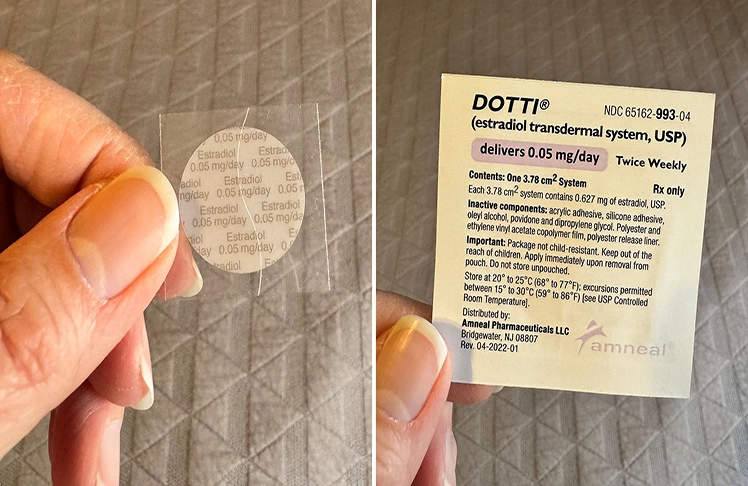
(CNN) — Emily Padgett has spent months trying to get her hands on estrogen patches, bouncing between pharmacies, transferring prescriptions and switching brands three times.
For a couple of anxious weeks in January, she had to go without them entirely.
“There’s definitely some symptoms that I noticed popping back after I went off of the patch for a while, and they still haven’t completely gone away since then,” said Padgett, who is in perimenopause.
After a long stretch of uncertainty, she is now finally able to access estrogen patches at a small independent pharmacy in her neighborhood. But each time she walks up to the counter to refill her prescription, she worries about hearing those three words she’s come to fear: “Out of stock.”
For many women in the United States who encounter drenching night sweats, sudden hot flashes, debilitating exhaustion and other menopause-related symptoms, small estradiol patches have become a steady source of relief.
That relief is becoming harder to find – and doctors brace themselves for potentially more shortages to come.
Manufacturers point to a rise in demand, driven by a greater awareness of menopause care and recent action by federal regulators to clarify the risks versus benefits of hormone therapies.
The estradiol patch, a tiny square worn on the skin, may be discreet, but its impact is powerful. It delivers a consistent stream of estrogen to the body, which gets absorbed through the skin. The estrogen hormone naturally declines with age and when levels drop during menopause, symptoms can surge. During perimenopause, the transitional period before menopause, levels of estrogen can start to decrease.
Padgett, a 49-year-old mother of two in Atlanta, said that she had to go those two weeks in January without medication because she could not find a pharmacy that had estrogen patches in stock.
“It’s just an inconvenience more than anything,” Padgett said.
Her perimenopause symptoms of irritability, insomnia and brain fog came back during that time, and she thinks they were exacerbated by the stress of the estrogen patch shortage.
“I was definitely stressed about not getting them, and so my main symptoms were irritability and waking up in the middle of the night stressed and not sleeping,” she said. “I feel like my symptoms have still not completely gone away.”
After switching from different CVS locations and Amazon to the neighborhood pharmacy that ultimately came through, Padgett said that she is back to her regular routine of applying a twice-weekly estrogen patch – but it is a different brand than she is used to.
“I’m on my third different brand now,” she said, and she still worries about future supply.
Estrogen supply challenges
Estrogen patches are available through a doctor’s prescription only. But lately, some prescriptions are taking longer to fill as supplies run low.
“Manufacturers have been unable to provide sufficient supply of hormone replacement therapies (HRT) over the last several weeks,” CVS spokesperson Amy Thibault said in an email. “When these manufacturer supply interruptions occur, our pharmacy teams make every effort to ensure patients have access to the medications they need and, if possible, will work with patients and prescribers to identify potential alternatives.”
Doctors say some women are scrambling to switch brands or dosages, while others are weighing whether they can manage without treatment at all.
Dr. Timberly Butler, a board-certified ob/gyn based in Marietta, Georgia, said that for about six months now she has seen more women she treats for menopausal symptoms face obstacles in getting their estradiol patches due to ongoing shortages.
Because there are different brands of patches on the market, Butler said that she can try to switch her patients to another product if supplies run low, but sometimes that can lead to higher costs.
“Depending on your insurance policy, they may or may not have one or more brands on their formularies, so sometimes the alternative patch brand is not on formulary, and there can be a huge cost to the patient for switching to a brand that’s not on formulary,” said Butler, a Menopause Society Certified Practitioner. Additionally, “If there’s someone who changes their patch once-a-week with their usual brand. The next brand may say you have to change your patch twice a week. So, the instructions might be a little bit different too.”
For several years now, “we’ve seen intermittent shortages in pockets throughout the US,” said Dr. Kathleen Jordan, chief medical officer at Midi Health, a telehealth company that specializes women’s health.
Jordan added that Midi Health has been actively working to help patients find estrogen patch formulations that are in stock, and in various markets, the company has intermittently experienced delays in the availability of patches since 2022. The current shortage is causing more disruption than before, she said.
“Patients are reporting this more frequently in recent months with January seeing more delays than ever before. There has been very little additional capacity in the pharmacy supply,” Jordan said. “The demand, I think, is only going to increase.”
Increased awareness
Systemic estrogen therapy – a widely used form of menopausal hormone therapy – has been shown to be the “best treatment” for hot flashes and night sweats, according to the American College of Obstetricians and Gynecologists. While it can be delivered transdermally through the skin as a patch, alternative forms of estrogen therapy include pills, gels, injections and vaginal inserts.
Federal regulators have made a recent move that could reshape access to menopause treatment.
This month, the US Food and Drug Administration formally approved changing the drug labels for menopausal hormone therapy products, including estrogen therapies. The updates involve removing the long-standing “boxed warning” that highlighted risks such as cardiovascular disease, breast cancer and probable dementia. The change reflects newer research that paints a more nuanced picture of the risks and benefits for many women.
The FDA first started the removal of these warnings in November — a shift expected to open the door to more treatment options and generate a surge in new prescriptions.
Leading up to the FDA’s removal of the boxed warning, Butler said that at the time she already was seeing at least a “50% increase” in her patients seeking hormone therapies, including estrogen patches.
“A lot of women prior to this were just told to kind of suffer through, that the risks of hormone use outweigh the benefit. But with more research, we’ve actually found that that was not the case, and so many women can have hormone replacement safely,” Butler said. “And from a medical perspective, we know that estrogen is important for our overall longevity, important for our heart health, for our bone health, and so those are other byproducts of having sufficient estrogen in the body.”
Now with labels changing and demand rising, the supply crunch could deepen before it eases, Jordan said.
“We have increased awareness of menopause and its broad impact to women. And as that awareness has occurred, we see clinicians more aware. We see patients more aware. We see increased use of hormone therapy. And I think if we continue to do our job well, we’re going to see that demand continue to increase,” she said. “So, we need pharma and the manufacturing industry to respond with increased supply.”
Trying to meet demand
Some of the main pharmaceutical companies producing estradiol transdermal patches sold in the US include Amneal, Sandoz, Noven, Viatris and Zydus.
As of Thursday, products by Sandoz and Amneal are currently in shortage, according to the latest data from the American Society of Health-System Pharmacists.
“We are aware of reports that some patients have experienced intermittent difficulty accessing certain estradiol patch products, which reflects broader supply constraints affecting parts of the category. Our customers have reported a surge in estradiol patch utilization at the pharmacy level in recent months,” Andy Boyer, executive vice president and chief commercial officer of generics and biosimilars at Amneal Pharmaceuticals, said in an email.
“These transdermal systems are complex dosage forms that require specialized formulation and manufacturing, and there is finite industry capacity for producing them. Amneal continues to meet our contracted supply volumes and does not speculate on specific drivers of market dynamics,” Boyer said, adding that Amneal also manufactures other forms of estrogen therapies, including gels. “For patients impacted, we understand how important continuity of therapy is and are actively working across our network to support supply of needed treatments.”
Pharmaceutical company Sandoz, a Switzerland-based manufacturer of hormone replacement therapy patches, said that it takes the current shortage of estradiol patches “very seriously” and is shipping more product to the US to better meet demand.
“Recent changes in prescribing behavior due to the FDA’s removal of boxed warnings on HRT patches have created an unprecedented demand that cannot be fully met at present. We know this situation is frustrating and inconvenient for the women who rely on these patches,” a spokesperson for Sandoz said in an email.
“We are working on increasing global capacity to ensure adequate supply of HRT transdermal patches and to support continuity of treatment for patients around the world. In the interim, to help women in the US specifically, we have shipped additional quantities to the States to better meet the increase in demand.”
Noven Pharmaceuticals said in an email that it has been able to fulfill all orders despite increased demand.
“Although the FDA’s removal of boxed warnings has contributed to unprecedented demand, we are successfully fulfilling our commitments and intend to fully support health care providers’ decisions to prescribe Noven’s products for their patients. As with any uptick in demand, supply challenges are possible, however we have fulfilled all orders and anticipate sustaining that performance,” according to the company’s statement.
The pharmaceutical company Viatris said in a statement that it also is currently meeting its supply plans and preparing for future increased demands.
“It is important to note that we are one of several manufacturers of estradiol patches and we are committed to supporting patient access to this needed treatment. We are meeting our current supply plans,” a company spokesperson said in an email Wednesday. “In addition, we know demand for this product has increased and we are currently taking steps to optimize current capacity and further expand production long-term.”
Other options for women
Worry remains around the impact shortages may have on patients’ wellbeing across the United States and Canada, Dr. Lindsay Shirreff, an ob/gyn based in Canada and chief medical officer for the women’s health care platform Blair Health, said in an email.
“Even short interruptions in estrogen therapy can lead to the return of symptoms such as hot flashes, night sweats, sleep disruption, and mood changes, creating stress for patients and requiring clinicians to discuss alternative options,” Shirreff said in the email.
“Other transdermal options, such as estrogen gels or sprays, may be appropriate alternatives. It is important to speak with a healthcare provider about equivalent dosing when switching formulations,” she said. “Some women may also be able to use oral estradiol tablets, although absorption and metabolism differ from transdermal forms. Oral estrogen is not appropriate for everyone, so patients should review their medical history with their provider to determine whether it is a safe option for them.”
Many doctors may choose to prescribe estrogen patches as a first-line therapy for menopausal symptoms because it has a more positive safety profile compared with other forms of estrogen, Butler said.
“We know that estrogen patches in general tend to be the safest way to deliver estrogen in a post-menopausal patient. There’s less risk of cardiovascular side effects with the use of patches, so less risk of heart attack and stroke and blood clot,” she said. “If a patient’s insurance company doesn’t have a patch on formulary at all, then we do have the option to go with an estrogen tablet by mouth.”
Oral versions of estrogen may not be appropriate for certain patients because they come with a slightly increased risk of blood clots and stroke compared with transdermal. Taking oral estrogen hormone therapy for menopause in pill form also may be associated with a slightly higher risk of high blood pressure compared with transdermal and vaginal estrogen, according to a study published in the journal Hypertension in 2023.
“That is related to the way that the body metabolizes transdermal medications versus oral. Whenever you take a pill by mouth, that medicine has to be metabolized by your liver, and as a result of that, it is how we get the increased clotting factors and the things that increases your risk for the cardiovascular events. Transdermal patches do not have to be metabolized through the liver, so that’s why that has a lower side effect profile,” Butler said, adding that for both options benefits still outweigh risks.
“And no matter the form, there’s definitely more demand,” she said. “People are wanting hormone replacement much more often than they used to be.”