By Alexandra Skores, Pete Muntean, CNN
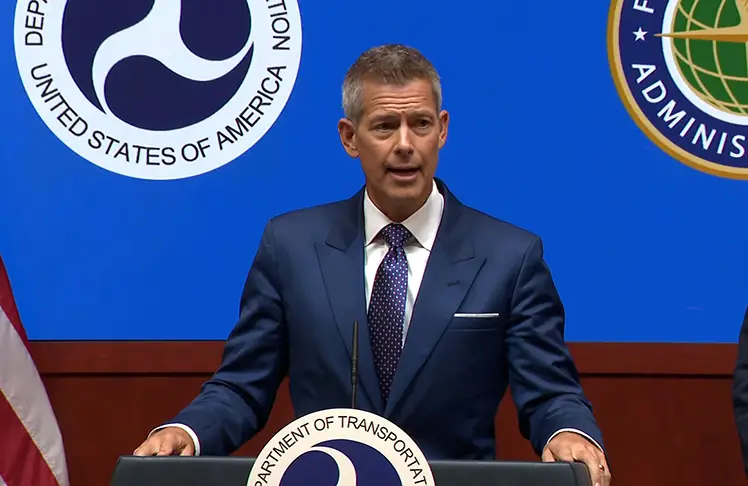
Washington (CNN) — The Federal Aviation Administration will reduce flights at dozens of major airports as early as Friday if no shutdown deal is reached, Transportation Secretary Sean Duffy announced at a news conference Wednesday.
Ten percent of air traffic at 40 busy airports would be cut, potentially impacting thousands of flights, though the details of how many and which specific airports will be cut was not announced.
The nation’s “core 30” airports – including New York City’s three big hubs, plus major airports in Washington, DC, Chicago, Atlanta, Dallas, and across the West from Phoenix to Seattle – are among those on a preliminary list of sites expected to be impacted by the drawdown, an FAA source with direct knowledge of the situation told CNN.
“As we start to implement this drawdown in service. It will be restricted to these 40 high volume traffic markets,” FAA Administrator Bryan Bedford said. “We’re going to ask the airlines to work with us collaboratively to reduce their schedules.”
The drawdown is “the right thing to do,” National Transportation Safety Board Chairperson Jennifer Homendy posted early Thursday on X, adding, “pressures are building in the system.”
The announcement comes as air traffic controller staffing shortages during the shutdown are delaying an increasing number of flights throughout the country. Controllers will miss their second full paycheck next week and some are taking second jobs to make ends meet or calling in sick in protest.
Controllers, like Transportation Security Administration screeners, are considered essential employees and must work during the shutdown, but are not being paid.
“Controllers are dedicated safety professionals,” Homendy posted. Duffy “can’t just ignore it; he took action to mitigate risk and ensure safety. THIS is safety management, the very foundation of our aviation system, and it’s the right thing to do.”
The FAA was scheduled to meet Wednesday night with airlines to discuss implementation of the new plan. The change is “prescriptive” and “surgical,” Bedford called.
“We are going to proactively make decisions that keep the airspace safe,” Duffy said.
“We have asked (air traffic controllers) to show up for work, but I’m not naive to understand that they’re trying to figure out how they meet their daily obligations,” Duffy said. “Because of that, we have seen staffing pressures throughout our airspace. Those who travel will see that we’ve had more delays. We’ve had more cancelations.”
More than 400 staffing shortages have been reported at FAA facilities since the start of the shutdown, according to a CNN analysis. The number is more than four times what was seen on the same days last year.
The airlines were notified of the plan only about an hour before it was announced, an airline source told CNN.
“We are working with the federal government to understand all details of the new reduction mandate and will strive to mitigate impacts to passengers and shippers,” Airlines for America, the industry trade group, said in a statement.
Schedule reductions will begin Friday and gradually increase throughout the weekend and into next week, a source with knowledge of airline plans told CNN.
Bedford said the new measures would also go beyond commercial airspace and include restrictions on space launches and small aircraft traffic in certain markets.
“I want to applaud the controllers who continue to come to work on a daily basis keeping our system safe,” Bedford said. “But I also want to recognize the fact that the data is telling us we need to do more.”
Most major airlines said the impact would be limited or said they’re evaluating the potential impact.
But the no-frills carrier Frontier warned passengers to book a backup ticket or risk “being stranded.”
“If your flight is cancelled your chances of being stranded are high so I would simply have a backup ticket on another airline,” Frontier Airlines CEO Barry Biffle wrote in a statement. “I’m sorry this is happening. Hopefully the shutdown is over soon.”
He also urged travelers to avoid booking a nonrefundable basic fare.
United Airlines CEO Scott Kirby said in a memo to employees that its “long-haul international flying” and “hub-to-hub flying” wouldn’t be affected. The airline will focus cuts on regional flights and domestic mainline flights that don’t travel between hubs.
“That’s important to maintain the integrity of our network, give impacted customers as many options as possible to resume their trip, and sustain our crew pairing systems,” he wrote.
All passengers with flights during this period are eligible for a refund, even for nonrefundable tickets, Kirby wrote.
Delta Air Lines said it would be “complying” with the FAA and DOT’s directions. However, the airline expects to operate the “vast majority” of scheduled flights, including its long-haul international flights.
“We are providing additional flexibility to all of our customers during the impacted travel period to change, cancel or refund their flights, including our basic economy fares, without penalty,” Delta said in a statement.
American Airlines said it expects that the “vast majority” of its customers’ fights would not be affected and long-haul international service will remain as scheduled.
“In the meantime, we continue to urge leaders in Washington, DC, to reach an immediate resolution to end the shutdown,” the airline said in a statement.
Travelers flying American whose flights are cancelled for any reason or who choose not to travel will be able to change their flight or request a refund, without any penalty, the airline said.
A Southwest Airlines spokesperson urged Congress to “immediately resolve its impasse” and said it is evaluating how the flight restrictions would affect its schedule.
CNN’s Aaron Cooper contributed to this report.
The-CNN-Wire
™ & © 2025 Cable News Network, Inc., a Warner Bros. Discovery Company. All rights reserved.