By Lornet Turnbull
Special to The Medium
When the Dallas Desperados, a now-defunct team of the Arena Football League, rescinded an offer to sign him back in 2003, Mario Bailey knew it was time to put an end to his lagging football career.
That’s when he went to visit his former coach at the University of Washington and learned about a coaching job that would help him repair his legacy and get back in the game.
A Husky Hall of Famer and All American receiver, Bailey had been the hometown face of a standout Husky team during the glory days of the early-1990s, helping lead the team to the Rose Bowl two years in a row and to a co-national championship in 1991.
The two-sport star in basketball and football graduated from Franklin High School in 1988, played as a true freshman for the Huskies that fall and four years later was drafted into the NFL, with a year still to graduate.
More than a decade later, sitting before Huskies Head Coach Keith Gilbertson, that bit of unfinished business came back to haunt him: He’d need at least a bachelor’s degree to land the coaching job.
Bailey, now 44, shares this story with young people as a cautionary tale about the true cost of a college education and the importance of supplementing raw talent with hard work.
It’s the playbook of a once-promising pro football career that in the end never fully took off, in large part, because Bailey believes he failed to put in the necessary hard work.
By the time he finally earned his bachelor’s degree – 18 years after he entered the UW as a freshman – Gilbertson was gone and so was the job.
“So often, kids want to hear dollar figures, so I tell them: ‘a college degree cost me a (coaching) career,’” Bailey said.
“I’m always preaching to kids, telling them you have to take advantage of every opportunity,” Bailey continued. “I tell them, ‘I did make it, but I didn’t take full advantage once I got there.’”
Bailey believes his message resonates because many of the high school and college kids he shares it with come from the same place he did.
“Single-parent home. Free lunches. A mother who had to work two jobs to support us and family members who were on drugs,” he said. “I’m from the neighborhood. You’re not going to know my story just by looking at me.”
Bailey speaks to young people as part of a broader effort to remake himself now that his football career is behind him.
His Mario D. Bailey Foundation started three years ago also hosts an all-you-can-eat Thanksgiving Day feast at the Royal Esquire Club on Rainier Avenue that serves hundreds.
Started as a random act of kindness, the annual dinner, now in its fourth year, is open to everyone – the homeless as well as those far from home.
Bailey, who works for King County, hopes his foundation can begin awarding college scholarships to needy students by next year.
“Giving back is very important for him,” his mother Margaret Briscoe said. “It’s what makes me the proudest. You didn’t get here by yourself; somebody helped you along the way, and you should try to give back.”
The making of a star athlete
There was a time when giving back meant something a little different to Bailey, back when he was wowing area Husky fans with his talents on the field.
Some in the sport had written off the 5-feet-9 and 165-pound receiver as too small for the Pac-10 and later, the NFL. It’s something he coped with throughout his career, his mother said.
But with his sure hands and quickness, Bailey as a Husky destroyed any doubts about his abilities. As a senior in 1991, he set a Pac-10 single-season record with 18 receiving touchdowns, earning co-Offensive Player of the Year honors.
He left his mark on Husky history, finishing his career as the all-time leader in career receiving yards (2,093) and touchdowns (26).
The Houston Oilers picked him in the sixth round of the NFL draft in 1992 and he describes the transition to pro football as a “dream come true.”
But the dream wouldn’t last. He lost the final receiving spot with the Oilers to a free agent in his rookie year. The following year, he signed a free-agent contract with the New York Jets, but didn’t make the team. Bailey returned to the Oilers the next season and made the team but was later demoted to the practice squad.
It seemed he just couldn’t catch a break. For three years, he said, he would lead his team in receiving during preseason, only to get cut.
In 1995, the Oilers sent him to NFL Europe, where he was an all-time reception leader. It was the highlight of his professional career.
“Initially I didn’t want to go,” he said. “But it turned out to be a great experience.”
NFL teams typically send players to the world league for a year or so to gain experience, before they return stateside to an NFL team.
One year, Bailey came back to Atlanta; another year it was to Seattle.
In a 2004 interview, he told the Seattle Post-Intelligencer that he was so sure the Seahawks wouldn’t give him a fair shot, he walked out of camp to avoid the embarrassment of getting cut in his hometown. Coach Mike Holmgren talked him into coming back.
Unable to find a home in the NFL, Bailey kept returning to Europe.
He took his team, the Frankfurt Galaxy, to the championships four of his five years.
“I was the first pro-athlete to be on a credit card there; my picture was on a Master Card,” he said. “I had a street named after me; they treated me like no other.”
But it wasn’t the NFL.
Bailey knows the nature of the league, knows that many great college players don’t even make it to the NFL and many who do, don’t get a chance to make a first down.
Still, he’s pretty hard on himself. He did well in Europe, he has said, because he didn’t have to push himself as much. And he blames himself for failing to make the kinds of plays that might have made a difference in the NFL.
“It’s one of those things, like a pact with God: ‘Yea, you did great, but you know you could have done better,” he said.
“A lot of people make excuses for their situations …coach didn’t like me…I was injured. But I know the truth. Knew it the entire time,” Bailey said. “I didn’t put in the blood, sweat and tears that others put into it. So I ended up playing in the NFL, the XFL, the CFL (Canadian Football League), AFL, NFL Europe.”
His mother said she became his sounding board.
“He gets cut, I’m on vacation, I get a call,” Briscoe said. “My child was somewhere on the East Coast and I couldn’t give him the hugs he needed.”
Keith Gilbertson was the Huskies’ offensive coordinator during the early 1990s and was the head coach in 2003-2004 who had talked to Bailey about a coaching opportunity there.
Gilbertson has been like a father figure, of sorts, to Bailey and describes him as a unique athlete who under the right circumstances could have made it in the NFL. But positions within the league are naturally loaded with great, veteran players, making it tough for rookie players to advance, he noted.
“Sometimes…you are lucky to be in a place where you get that chance,” Gilbertson said. “I do think given the right system and the right chance, he could have played.”
He added, “Mario distinguished himself in the world league and they still talk about that.”
The end of a career
For years, as his career faltered, Bailey grew more reclusive. At home when he was cut or during the off-seasons, he avoided everyone – friends, even his own family — because he didn’t have a good answer to their inevitable question: What are you doing now?
“I would hide when I was in town,” he admits sheepishly. “I didn’t come around my family either. I isolated myself from everyone.”
After Europe, he turned down what he said was a half-hearted offer from the Tampa Bay Buccaneers to sign instead with the Orlando Rage, a franchise in the now-defunct XFL organization. Two years later, he signed with the AFL’s Detroit Fury.
In 2003, when the Desperados withdrew the offer to sign him, “For me, at that moment, that was it,” Bailey said.
“I told myself: ‘You gotta stop. You are tainting any legacy you may have left,” he continued. “If you aren’t going to work for it, don’t embarrass yourself and your family’s name.”
It was around that time he sat down with Gilbertson.
The Husky coaching job would have given him a chance to repair his legacy and work with young people, something he enjoys.
“I thought I could help them avoid the mistakes I made,” he said.
The $150,000 salary that came with the job wasn’t bad either.
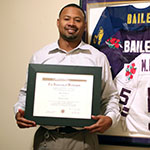
He attended community college for a quarter to prove to the UW that he was serious and then returned there to complete his bachelor’s degree, graduating in 2006.
Bailey describes it as “one of the greatest accomplishments of my life because no Bailey had done it prior to me.”
It also made his mother happy, he said.
Gilbertson said he was surprised the Huskies didn’t grab Bailey after he himself was let go following a losing 2004 season.
“I wish I could have had a chance to facilitate that,” Gilbertson said. “I always imagined he would have been a fabulous coach. He gets it on so many levels. He’s a bright guy and had a great rapport with his teammates. He got the game and understood what it took to win and compete on the highest level.”
With the UW job gone, Bailey accepted the coaching position with his alma mater, the Franklin Quakers, after his former high school coach, Joe Slye, retired. He stayed four years.
He earned his real estate license earlier this year and said more than anything he wants to grow his foundation so he can help more people, including needy students looking for a way to pay for college.
An admirer of basketball legend Michael Jordan, he looks at the kind of structure Jordan as a businessman has created in his post-NBA career and envisions something similar for himself.
“I want to be known as the kind of businessman who gave back to my community,” he said.
And his mentor has no doubt this once star athlete can find success.
“He has a wonderful name in Seattle and in the Husky nation,” Gilbertson said. “He can use that name to help people.”