By Aaron Allen, The Seattle Medium
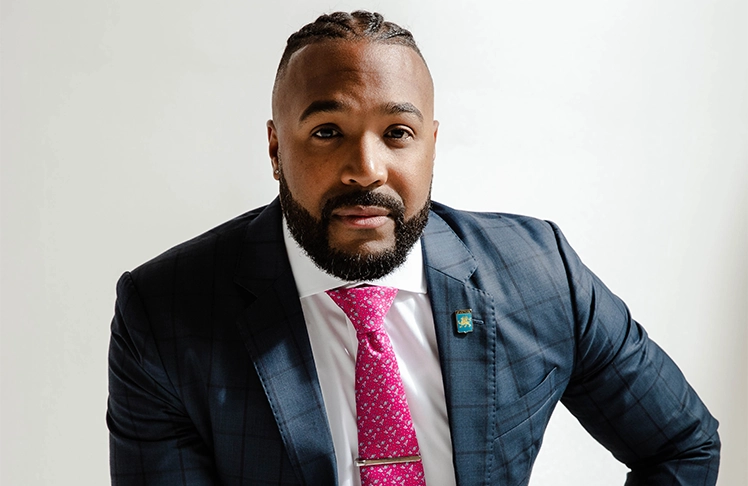
More than a decade after being laid off during the Great Recession, real estate developer Jaebadiah Gardner is leading one of Seattle’s most anticipated Black-owned housing projects. At the former site of Mount Calvary Christian Center, Gardner and his firm Gardner Global are developing The Sarah Queen—a $50 million mixed-use building that will feature 112 apartment homes, commercial or live-work space, and underground parking. Located at 23rd and Union in the heart of Seattle’s Central District, the project represents a mission-driven effort to build Black community wealth in a historically Black neighborhood reshaped by decades of displacement.
Gardner, who identifies as a commercial developer focused solely on multi-family housing, emphasized the scale of the work already in motion.
“Apartments, yeah, only apartments, no single family, no residential. I’m a commercial developer,” said Gardner. “This is not my biggest project. I have several projects in the pipeline. One of my largest projects is probably over $125 million—400-unit projects in Skyway. So, the Sarah Queen project on a CD is about a $50 million project.”
Originally born in San Antonio, Gardner spent his early childhood in Spokane before moving to Southgate, Los Angeles. At age 14, he returned to Seattle to live with his father and has remained in the city since. He earned a bachelor’s degree in English from the University of Washington and later received a law degree from Western Michigan Law School in 2012—not to practice law, but to prepare for a career in development.
“I didn’t go to law school to be a practicing attorney. I literally went to law school to build my real estate development company,” said Gardner.
Gardner’s real estate journey began in construction. After graduating from the University of Washington, he worked as a project engineer for Turner Construction.
“My first career job was being a project engineer for Turner Construction,” said Gardner. “I came through understanding real estate through the construction side of things. I was tasked with working on $100 million-plus commercial buildings in my early twenties… and I quickly realized that I really love building.”
“But what I loved more was development and how to leverage development to build wealth for Black and brown communities,” Gardner added. “Once I did my research on who developers were, I wanted to be on that side of the table.”
When Gardner was unexpectedly laid off after the recession, it accelerated a plan he had already begun developing.
“I started the business, filed with the state, got my little business license, thought I was doing something, and then I applied to several law schools,” said Gardner. “The plan was always to get a law degree and to focus on business and real estate law and to leverage that education to build Gardner Global.”
As Seattle continues to grapple with housing affordability and rising displacement, Gardner is one of several Black developers working to reclaim space and create pathways to ownership and equity. Through the city’s Mandatory Housing Affordability (MHA) program, developers must either pay into an affordability fund or directly include affordable units in their buildings. Gardner has chosen the latter.
“You can either pay the city per square foot cost on your total building square footage… or what we did is I elected to participate and create those units,” said Gardner. “Instead of just paying the city off to do market rate units, we’re going to actually perform and create those affordable units, and those affordable units are under covenant, so they’ll be affordable for like the next 30 to 50 years.”
Despite credentials and capital, Gardner said systemic gatekeeping still limits opportunity for developers of color.
“Yes. Capital is always going to be an issue outside of development, right? Just being a small business owner, you are always going to need money. So, let’s put that aside, because that’s a given,” said Gardner. “What is particular about development is, even if you have the capital, do you have the opportunity?”
“And the opportunity is where all the value is. And if you’re not in a room, if you don’t know the right people, then those opportunities aren’t coming your way. I don’t care how much money you got. If you don’t have the opportunity to get the right deal, the deal won’t happen. You will not grow.”
For Gardner, self-belief is non-negotiable in entrepreneurship.
“Believe in yourself (BIY). I’m always hash tagging it and putting that all across my social media,” said Gardner. “I think the power of belief in oneself can take you very, very far. So yeah, I think believing in yourself is definitely something that, that I would say is a part of the philosophy.”
Gardner is equally direct in his advice to young Black entrepreneurs.
“My advice would be that nobody’s coming to save us and there’s no excuse moving forward. We’ve got to take back our own community with our own responsibility. No one’s coming to save us,” said Gardner. “Stop finger pointing at white people, stop blaming white people. Stop acting like we don’t know who they are and what they do. We know that. We know who they are in certain circles. So, let’s not worry about them anymore. Let’s worry about ourselves and figure out a way for us to grow economically and build wealth. That’s what I would tell these young folks.”