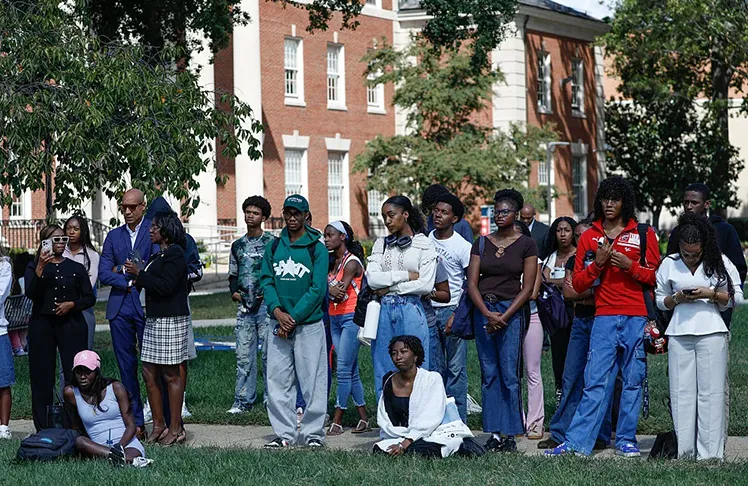
The women of Howard University are taught to push boundaries. From novelist Toni Morrison and former Vice President Kamala Harris to fashion designer Kahlana Barfield Brown and actress Taraji P. Henson, Howard women show that Black women were never the afterthought of movements — we were often the architects of them. As a Howard alumna, I carry that legacy with pride.
That’s why I’m joining the growing outcry from students and alumni across the globe over the university’s new policy banning kneeling during the national anthem.
A Long Tradition of Protest at Howard
The policy comes after Howard’s women’s basketball team kneeled during a game against the United States Military Academy at West Point, continuing a long tradition of protest on Howard’s campus. In 2016, Howard cheerleaders knelt in solidarity with former NFL quarterback Colin Kaepernick. Four years later, during the racial reckoning of 2020, Howard’s women’s basketball team carried the tradition forward — kneeling in solidarity with Black women, men, and children facing injustice across the diaspora.
Now the university says kneeling is no longer allowed.
Silencing Black women just after Black History Month and during Women’s History Month sends a troubling message — one that reflects a broader pattern in this country: the minimization of Black women’s voices, even when we are central to the movement.
When journalist Georgia Fort was arrested alongside Don Lemon during protests, her name rarely trended. When Joy-Ann Reid lost her show months before controversies surrounding Jimmy Kimmel prompted national outrage, many boycotts only mentioned the latter.
Black women are used to being erased. But being silenced by your own institution — one that claims to value truth and service — is a different kind of pain.
Sports Have Always Been a Platform for Protest
Sports have long been one of the spaces where women learn to use their voices. According to research from EY and espnW, 94% of women in C-suite leadership roles played sports growing up. Participation builds confidence, resilience, and leadership—skills that help women challenge systems that expect their silence.
It’s why Black women athletes, in particular, have often stood at the intersection of sport and protest. Tennis champion Serena Williams famously boycotted the Indian Wells tournament for 14 years after enduring racist booing and jeering there. In 2020, players across the WNBA — a league made up largely of Black women — wore “Say Her Name” shirts honoring Breonna Taylor and others lost to racial violence. At Howard, that blueprint meets a long-standing expectation that students speak out — and the basketball team did.
Finding My Voice at Howard
I know the power of sports firsthand. During my high school years as a member of two varsity teams, I learned self-advocacy — and the importance of advocating for others. Our coaches had a phrase: one band, one sound. If one teammate made a mistake, the entire team ran extra laps in the New Orleans heat. The lesson was clear—we were responsible for one another.
Those lessons followed me to Howard.
On campus, I joined a legacy of women who refused to stay silent. I joined my sorority because my founders fought for women’s right to vote at a time when they faced opposition from both white and Black men. Later, I helped coordinate events around the 30th anniversary of the Million Man March. My classmates and I walked from Howard’s campus to the U.S. Capitol, reciting historical speeches and sharing our own demands.
We believed we had a responsibility to speak—to advocate—to be heard.
Years later, as a programming director at a nonprofit supporting girls with incarcerated parents in Louisiana, I saw how transformative those lessons could be. Statistically, these girls were among those most likely to experience teen pregnancy, drop out of school, or encounter incarceration within their families. At the center of many of those challenges was self-esteem — shaped by repeated rejection from systems meant to support them.
Our programs helped them find their voices. As part of the program, I took five of those girls to Washington, D.C., where we met with lawmakers to advocate for children with incarcerated parents. During the trip, we also toured Howard University.
Walking across campus again, I remembered the sisterhood and purpose the university instilled in me. But I also remembered the protests — about dorm conditions, food safety, and national injustice. Many of them were led by Black women determined to demand better from the country and from Howard itself.
Howard has never been perfect. But it was a place where I felt empowered, supported, and encouraged to speak truth to power. And I told the girls this: sports taught me community, and Howard empowered me to use my voice.
What Howard’s New Policy Means Now
That’s why this moment feels so dissonant.
The team has chosen to continue its protest by remaining in the locker room during the national anthem for the rest of the season. Their decision reflects the courage the university has historically encouraged in its students.
But the policy banning kneeling sends a different message — one that risks muting the very voices Howard helped Black women create.
When those young women look back on their time at Howard, will they remember the legacy of empowerment that shaped generations before them? Or will they remember that the place meant to nurture their voices was also the place that tried to silence them?
Julienne Louis-Anderson is Howard alum who writes about the intersection of culture and politics with education and human development. She is also a Public Voices Fellow of The OpEd Project in partnership with the National Black Child Development Institute.