By Aaron Allen
The Seattle Medium
Growing up in America as a descendent of those brought here from the continent of Africa, I remember society telling me two things about myself outside of what my family instilled in me, one, we were descendants of slaves and two, that’s all you’re going to be.
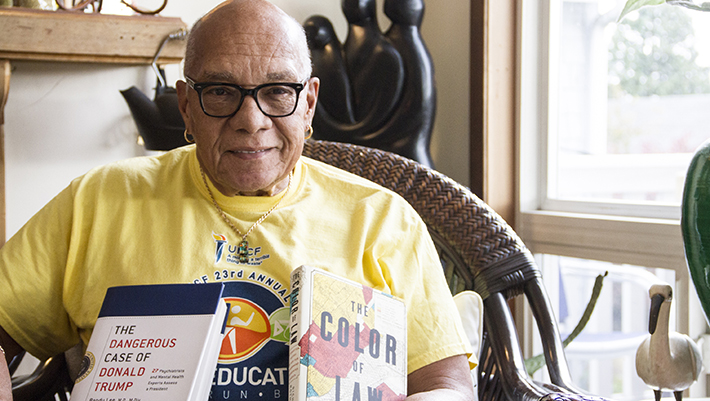
That was until I discovered reggae music and Dr. Albert W. Black Jr., a Sociology and African American studies professor at the University of Washington.
The Colonized and the Colonizer was mandatory reading material in his course. His teaching style is not for the weak-minded or undisciplined. Preparedness was a must to succeed, no, survive his tutelage.
It has been a long time since college for me and my experience with Dr. Black, I wanted to be prepared, to prepare I engaged in due diligence and perused the ether, and researched as much as I could before the interview. I came across the website RateMyProfessor and there were mixed emotions. The rating ranged from awesome to awful and were split down the middle, from “awesome” to “it gave me clinical migraines and I had to hardship withdrawal after 1 week!” Sounds like Dr. Al Black.
Dr. Black introduced me to my heritage through the study of Black people and their history beyond the White American interpretation, the stuff we learned in public schools. That my story not necessarily his-story had major relevance and impact not just on the descendants of Africa, the darker brother, but humanity and its cultivation. This was his influence on me as young descendant of Africa born and raised in America.
Dr. Black was that catalyst some African Americans experience and most of us need, when they first hear a positive historical fact or characterization about our people that contradicts the negative imagery they were taught and you have to go “really?” As well as giving it to you straight no chaser regarding the plight of our people and solutions to overcome those plights.
Black is a passionate and engaging educator, he makes you want to achieve, with a sense of humor when needed as he puts it, “sometimes lecturing can get boring and so I engage in laughter or change it up, to break up the lecture, but then it’s back to work,” he explains.
Maria Edmondson Roth, a former student at the University of Washington, recalls Black’s classes as “fascinating because he taught the old history as well as more current topics and encouraged discussion.”
As I entered the room to interview Dr. Black, the room was well lit by the natural sunlight that pierced the large windows, opening up his living room to the morning. Black artist and African décor adorned his home emblematic of his consciousness as I complimented him and his wife’s taste he replied, “built it myself, with help of course”, as he sauntered to retrieve a photo album documenting the experience. Books from a long, distinguished career in academia and years of study, rested on coffee tables, shelves and chairs. Quite welcoming.
Albert W. Black, Jr. was born in Detroit, Michigan in 1939. His father, a maintenance man who worked two jobs to provide for his family, instilled two things in him and his siblings, and that was if you want to succeed in this world, a sound work ethic and an education is a must.
“My father was very particular about the issue of what I called responsibility and accountability,” recalled Black.
“His thing was I’m not going to go to work every day and work these two jobs for my family and you guys are going to lay up here at home and think that somebody supposed to support you,” continued Black. “So, when we got to be teenagers we had to work with him.”
“He taught us, while cleaning toilets, the importance of doing for self, the importance of earning what you get and not asking that someone else support you, the importance of hard work was as far as my father was concerned the most important thing if you don’t want to clean the White man’s toilet was to get an education.”
Black’s mother was essentially a housewife and a beautician, but she too understood the importance of education as she was a high school graduate which was rare for women of those times, particularly in the South where she was from.
Black was a gifted athlete and did well in school but not yet confident in his academic prowess, he got involved with an organization of doctors and mentors who saw promise in him and upon graduating from high school offered him a scholarship to attend the University of Michigan.
A graduate of the University of Michigan in 1963 with a Bachelor of Science in zoology, Black began to understand and respect education and began applying himself and with the help of men like a doctor named Caesar Blake he discovered a love for learning. After Michigan, he went on to study at Wayne State University with the idea of becoming a doctor engrained as a goal.
After attending and graduating from Michigan, Black journeyed to the Midwest and then the West Coast and it wasn’t until he ventured to northern California, the Bay Area, as the Civil Rights Movement began to morph into the Black Power Movement that Black’s social awareness became acute. The Black Nationalist movement as well as Malcolm X and the Nation, Dr. King, influenced him greatly in his early years as his involvement against the injustices heaped upon the descendants of Africa began to evolve.
At that moment Black made a change in direction and decided to go into sociology and in 1968 he attained a Masters in Sociology from Wayne State University and 1976 received a PH.D from Cal-Berkeley in Sociology.
“America is never going to change,” says Black. “America is going to continue segregation, and racism and all the rest, we [as a generation] organized something we called the Civil Rights Movement and we forced America to change.”
Black began engaging academia as a tutor and teaching assistant during and after his college career as his social consciousness sharpened during his civil rights activism and the need to make a difference in the lives of his people became paramount.
“Even though I was pursuing medicine partially because of these men I was around, the Civil Rights Movement spoke to me and so I wanted to be a doctor of society, I want to be a doctor of social problems in society, that’s when I switched to sociology,” says Black.
“There were discussion classes associated with the large lecture series I was very affective in that and that’s where I started thinking about the teaching thing,” said Black.
“Professor Black possessed an uncanny ability to take complex material and explain them in way that most people could understand. They weren’t easy particularly his test, but he wanted to bring the best out of you regarding your studies. Especially athletes and Black students,” explains a former student.
Another student states, “He had an open-door policy and made himself very approachable and available.”
During our time together, I inquired what did it mean to be a teacher? Professor Black believed that out of the population of Black youth there’s a percent who are failing miserably and a percentage who are achieving as they should. But, from his perspective, he is more concerned about the population who are falling through cracks of academics and he wanted to contribute in his way to help those kids find their academic success.
So, after Berkeley he began teaching at the University of Washington, where they were looking to diversify and searching for capable researchers and lecturers. The University at that time was primarily a research institution but thought highly of enough of Black to give him an opportunity as a teacher.
“I started teaching classes and what I noticed right away is the Black students were failing, even my classes,” said Black. “I’m not going to run around here and people patting me on the back calling me smart and my students are failing, then what does it mean to be a teacher?”
“Obviously to be a teacher is not about whether you’re smart or whether you’re articulate or even knowledgeable, it’s about whether your students learn, period,” he continued.
At that moment, his students weren’t learning and essentially, he was reinforcing this sense of failure amongst our children, from his perspective his people didn’t struggle to get him this opportunity so he could reinforce a sense of failure amongst Black children. He needed to find a way to be more affective in teaching.
“Well I’m not going to do that, my people didn’t struggle to get me in this position so I can reinforce this failure among our Black youngsters,” says Black.
Through different techniques he worked in order to get young people to put in a little extra effort, he learned as they tried to read the material and may not understand right off the bat, they would get frustrated and would give up on putting in that effort.
But then he discovered that most students were trying to put in the effort, but their educational background wasn’t sufficient for them to develop the kind of skills needed to compete at the collegiate level.
Through his own work, he began finding ways to motivate his pupils, encourage them and low and behold he started attracting large numbers of students of color and others because his methods began to make them better students. He would hold night study groups and was surprised that students showed up.
John, former student recalls, “as a student in his AFRAM (African American studies) course I do remember he was always available after class to go over reading material and he would teach us how to decipher the material as to better understand it and be better prepared for when test time came.”
As I stated previously, Dr. Black had a profound influence on me and my perception of my people. His humility forbids him from taking responsibility for any influence, he just wanted to strengthen the minds of his students.
Teaching is a selfless position, it doesn’t pay as much as say a lawyer or a doctor, but where would a doctor be if it weren’t for the master, and Professor Al Black exemplified the mastery and what it takes to teach and get the most out of our Black youth.
As we end our interview, he remembers I asked him for a quote and he left me with this:
“You mentioned you would like a quote and there is a specific quote that I think is extremely important for us as a people, that we should never, ever lose sight of and that quote is “in spite of”, that particular idea is the reason that we survive in this country, it is the reason we have been as successful as we have in terms of our survival in this country and it’s the reason why we continue to struggle. So “in spite of” my fear, my concern is we are losing sight of that.”