By Sofia Schwarzwalder, The Seattle Medium
Kaitlyn Washington wanted to be just like her brother growing up. He played baseball, so at 4 years old she started playing Little League.
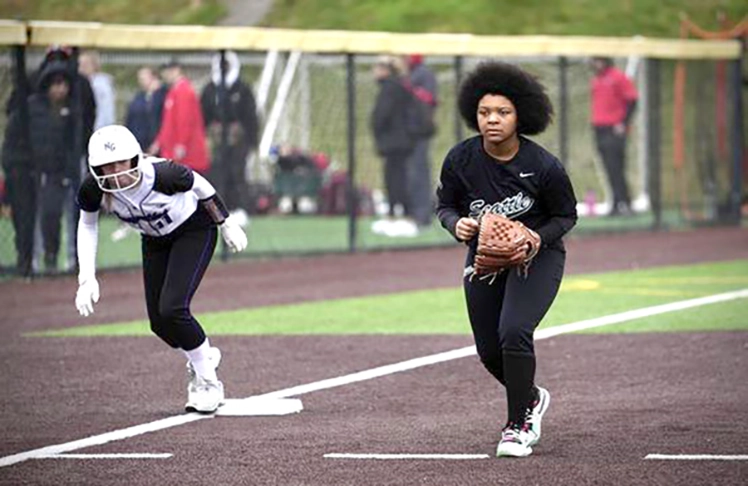
Her love of the sport only grew into her teenage years. Washington, now 17 and a junior at Garfield High School, has been playing softball for 11 years. She has received financial, athletic and academic support from the Seattle Mariners organization since 2022, when she was selected to be a part of the Hometown Nine fellowship.
It’s been five years since the Mariners founded the program to support local youth softball and baseball players with the goal of reducing some of the common barriers that student-athletes of color often face.
Each year the program accepts nine incoming eighth graders from King, Pierce and Snohomish counties and provides them with holistic support through high school graduation. This past summer, the inaugural class graduated. The Hometown Nine set a goal of having a 100% high school graduation rate and securing college scholarships for 75% of fellows interested in playing at the collegiate level. Many of the Class of 2025 fellows went on to play at the collegiate level.
The Mariners remain committed to the program, according to Nova Newcomer, CEO of the Mariners Care Foundation. Following the Trump administration’s crackdown on DEI programs, some companies and organizations backed away from previous commitments. Newcomer said not the Mariners.
“The Mariners are just committed to the work that we committed to do,” she said. “There’s no change in our long-term support of this program and the work that we do. We’re committed to reducing barriers to access.”
The idea for the fellowship came after a group of Black players approached the Mariners’ ownership amid the Black Lives Matter protests in the summer of 2020. The players, including J.P. Crawford and former Mariner Dee Strange-Gordon, asked ownership to invest in growing the game for athletes of color.
“It really came from that advocacy of the players being, like, ‘I don’t want to be the only player of color on the team,’” Newcomer said. “That experience is challenging for kids and adults alike.”
The Mariners Care Foundation is the Seattle Mariners’ nonprofit organization that runs a variety of community programs and initiatives, including the Hometown Nine. Businesses including T-Mobile, Nike and KeyBank have provided financial support to the program over the years.
But fundraising from the greater Mariners community, including fans, is a huge part of what keeps the program running. Newcomer explained that fellows and their families often take an active role in the fundraising, including selling raffle tickets for the Mariners 50/50 raffle at games.
Student-athletes admitted into the program are provided with financial, academic, professional and personal support. For some athletes, the Hometown Nine is what allows them to continue playing the sport they love at a higher level.
High school baseball and softball players are often on travel teams, which can be thousands of dollars a year in participation and travel costs alone.
Washington said that her Little League team when she was younger was diverse. That hasn’t been the case playing travel softball.
“My family definitely couldn’t afford to put me on a travel team,” Washington said, explaining that the Hometown Nine has made it possible for her. “It’s been cool to see in recent years how the diversity in softball is growing. It’s been really nice to not feel like an outsider sometimes as the sport is growing.”
In addition to providing financial support, the program offers mentors who support students through the challenges of high school and provide professional development opportunities.
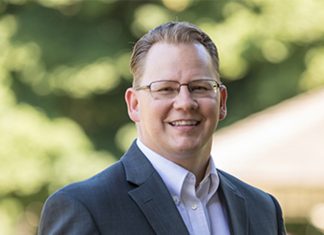
Mason Shigenaka is the manager of business analytics at the Mariners, and he’s been a mentor with the Hometown Nine program since its first year.
As a student at Ingraham High School, he received mentorship through the Dream Project, a program at UW that works to reduce barriers that low-income and minority students face in the college application process.
His experience with the Dream Project helped him see the difference support systems can make for students. When he got the email asking for volunteers to help with the Hometown Nine, he knew it was right for him.
“I like helping people recognize what type of secondary education is right for them, because it’s not a one shoe fits all,” he said. “But I also love giving back to my community. I care very deeply about Seattle and this is a way that I can help out my community as much as possible.
Shigenaka said the experience has been incredibly rewarding. Last year, one of Shigenaka’s mentees from the inaugural class invited Shigenaka to his senior night with the O’Dea football team. But it wasn’t just to watch. Instead, he asked Shigenaka to walk out alongside his family.
“That meant a lot to me,” Shigenaka said. “We see each other as family.”
As students near graduation, they have access to college application workshops and support through the athletic recruiting process, if that’s something they want to pursue.
Washington is still a junior, and her main focus is finding an academic fit.
She explained that she’s grateful to the program for teaching her problem solving skills that she believes will serve her far beyond high school. The mentors have invested in sharing their life experiences and relaying them in ways that can help serve the fellows, she explained.
“Whenever we need anything, they’re always there,” Washington said.