by Frances Murphy (Toni) Draper
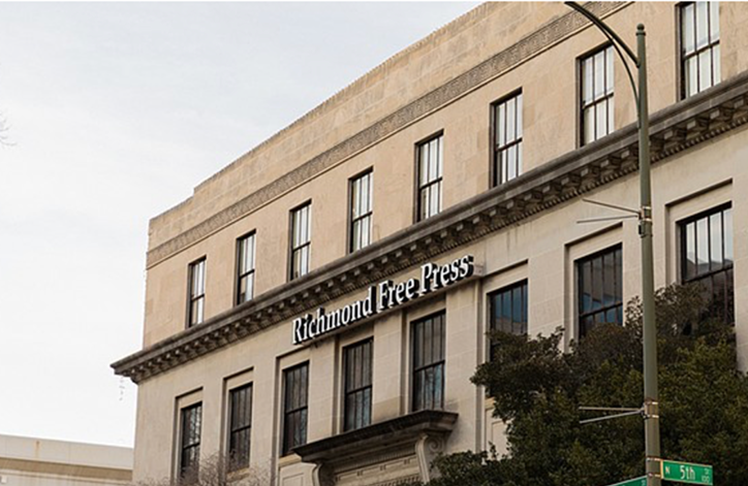
The closing of the Richmond Free Press marks more than the end of a newspaper.
It marks the quieting of a civic institution.
Founded in 1992 by Raymond H. Boone Sr., the Richmond Free Press was created to provide independent, accountable journalism for Black Richmond. Boone brought deep professional grounding to that mission. Before launching the Free Press, he served as editor and vice president of the Baltimore-based Afro-American Newspaper Group and later as a member of its board. He understood standards, governance and the responsibility that accompanies independent ownership.
The Free Press reflected that understanding.
It was disciplined. It was careful. It did not chase spectacle. It practiced journalism.
After Boone’s passing in 2014, leadership continued under his wife, Jean Patterson Boone, who sustained the paper with steadiness and resolve. Their daughter, Regina H. Boone, an accomplished photojournalist, also contributed to the publication’s work. This was not merely a business. It was a family’s commitment to community accountability.
What Communities Lose
The Free Press closes amid structural pressures reshaping local journalism nationwide — shrinking local advertising revenue, the growth of dominant digital platforms and changing patterns of news consumption. These forces have strained community newsrooms across the country.
But when a Black newspaper closes, the loss is distinct and profound.
Communities lose coverage of church anniversaries and pastoral transitions — the spiritual infrastructure that holds neighborhoods together. They lose the social news documenting graduations, civic honors, small-business openings, fraternity and sorority milestones, neighborhood achievements and community triumphs that rarely appear elsewhere but define local life.
They lose coverage of Black Richmond that exists nowhere else.
When a Black newspaper closes, the loss is distinct and profound.
They lose journalists who understand the context beneath the headline — who know the history of a block, the arc of a congregation, the stakes of a zoning decision.
And they lose something even more consequential.
They lose sustained pressure on elected officials to craft, pass and enforce legislation that serves the entire community — not just the well-positioned few.
Accountability Is Not Automatic
Black newspapers have long monitored school boards, city councils, housing authorities, development commissions, state legislatures and congressional offices with cultural competence and institutional memory. They have asked the follow-up question. They have returned after the cameras left. They have tracked whether commitments were honored.
When that scrutiny fades, accountability weakens.
When accountability weakens, equity erodes.
This moment arrives at a significant crossroads. In 2027, the Black Press will mark 200 years since the founding of Freedom’s Journal in 1827, the first Black-owned and operated newspaper in the United States. For two centuries, Black newspapers have functioned as record-keepers, critics and civic watchdogs.
The Structural Crisis Facing Black Media
The crisis facing journalism is broad. Thousands of local newspapers have shuttered over the past two decades. Entire communities now lack consistent local reporting. Significant portions of local advertising have shifted to large digital platforms, reducing revenue available to community newsrooms. At the same time, corporate and philanthropic commitments to diversity, equity and inclusion have faced retrenchment. As DEI budgets contract or are restructured, Black-owned media often feel the impact directly.
Some suggest that in a digitally connected age, specialized media is less necessary. The evidence suggests the opposite. As media ownership consolidates and local reporting shrinks, independently owned Black newspapers remain among the few institutions with both proximity to community and the will to apply sustained pressure on power.
The Black Press is not relevant because it is historic. It is relevant because the conditions that required its founding have not disappeared.
Policy decisions continue to shape housing access, education equity, voting rights, public safety and economic opportunity. Communities still require culturally competent reporting that understands local institutions and lived experience. Elected officials still respond to sustained public scrutiny.
Narrative sovereignty is not ornamental.
It is civic infrastructure.
A Bicentennial Moment — And a Call to Act
If quality alone guaranteed survival, the Richmond Free Press would still be publishing. Its closing signals not irrelevance, but fragility — even for institutions grounded in credibility and trust.
As the bicentennial of the Black Press approaches, this moment calls for clarity and commitment.
Advertisers must treat Black newspapers as essential civic partners.
Readers must subscribe, donate and engage with the understanding that journalism requires sustained investment.
Philanthropy must support operational capacity, not only short-term initiatives.
Black institutions — churches, fraternities, sororities, civic organizations and nonprofits — must intentionally strengthen the media platforms that document their work.
Publishers must continue adapting for a digital era while preserving editorial independence and mission integrity.
The Black Press has endured for two centuries not because it was sentimental, but because it was necessary.
The conditions that required its founding have not disappeared.

The question is not whether it has a future.
The question is whether we are willing to invest in it.
Dr. Frances Murphy Draper is CEO and publisher of The AFRO-American Newspapers.