By Rayjaun Stelly, The Seattle Medium
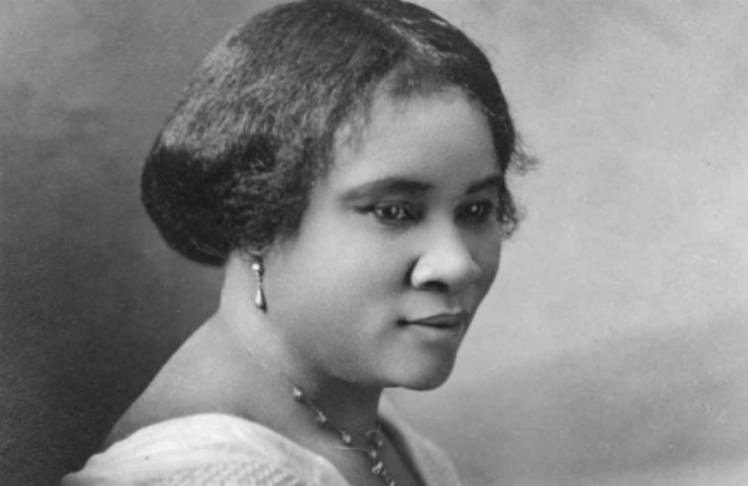
Madam C.J. Walker was a trailblazer in every sense of the word. Born into slavery, she transformed herself from an uneducated farm laborer and laundress into one of the twentieth century’s most successful and self-made women entrepreneurs. Her journey was marked by determination, innovation, and a relentless pursuit of excellence, which allowed her to develop a homemade line of hair care products for Black women worldwide, create her own factory, and even fund scholarships for women at Tuskegee Institute.
Walker was born on December 23, 1867, in Delta, Louisiana, on the same plantation where her parents, Owen and Minerva Anderson Breedlove, were enslaved before the Civil War ended.
As an orphan, she worked with her older sister in the cotton fields of Delta and Vicksburg, Mississippi. Her life changed dramatically when, at the age of 14, she married Moses McWilliams to escape abuse from a brother-in-law. Sadly, two years later, her husband died, and she moved to St. Louis, where she worked for $1.50 a day and saved enough money to educate her daughter in the city’s public schools.
Developing friendships with other Black women who were part of the St. Paul A.M.E Church and the National Association of Colored Women opened her thinking to a new way of viewing the world itself. Forming those relationships helped her during the 1880s when she suffered from a scalp ailment that caused significant hair loss. Walker experimented with homemade remedies and store products that were made by Annie Malone, a Black woman entrepreneur.
Walker’s health condition led to her entrepreneurship. She moved to Denver as a sales agent and founded her own business selling ‘Madam Walker’s Wonderful Hair Grower,’ a scalp conditioning and healing formula she created herself. Apart from owning a business, promoting, and marketing, Walker traveled for a year and a half throughout the heavily black South and Southeast, selling her products door-to-door and demonstrating scalp treatments at churches and lodges.
Her success in sales and marketing led her to move to Pittsburgh, Pennsylvania, and open ‘Lelia College’ to train hair culturists. From opening a college in 1908, Walker continued to expand. By early 1910, she moved the business to Indianapolis, the nation’s largest inland manufacturing center, where she built a factory, hair, and manicure salon and another training school.
Just a year after being in Indianapolis, Walker grabbed national headlines with the Black press after she donated $1,000 to the building fund of the Colored YMCA in Indianapolis.
In 1913, she traveled to Central America and the Caribbean for business expansion and opened another salon in Harlem. By 1916, Walker lived in New York and was heavily involved in Harlem’s social and political life, during which time she donated $5,000 to the NAACP’s antilynching movement. She joined Harlem leaders who went to the White House to advocate for federal anti-lynching legislation.
Interested in the movement, she joined Harlem leaders who went to the White House to help advocate for federal anti-lynching legislation. While taking a stance for Black people as a whole, her business continued to grow. With that, she organized the ‘Madam C.J. Walker Hair Culturists Union of America Convention’ in Philadelphia in 1917, one of the first national meetings among businesswomen in the country. During the convention, Walker honored those who worked for her and encouraged them to get involved with political activism.
In her speech during the convention, Walker said, “This is the greatest country under the sun. But we must not let our love of country, our patriotic loyalty cause us to abate one whit in our protest against wrong and injustice. We should protest until the American sense of justice is so aroused that such affairs as the East St. Louis riot be forever impossible.”
On May 25, 1919, Walker passed away at her home in Irvington, New York, due to complications of hypertension. Her legacy and fortune were credited to her homemade line of hair care products for Black women worldwide. She used her wealth to fund scholarships for women at Tuskegee Institute and donated significant amounts to the NAACP, Black YMCA, and other charities.
“I am a woman who came from the cotton field of the South, from there I was promoted to the wash-tub. From there, I was promoted to the cook kitchen, and from there, I promoted myself into the business of manufacturing hair goods and preparations. I have built my own factory on my own ground,” said Walker.
Providing such an impact, Madam C.J. Walker’s legacy is still ongoing today, as the makers of Shea Moisture and Nubian Heritage announced the launch of a new hair brand inspired by her named ‘MADAM by Madam C.J. Walker’.