Any person who wears a uniform and badge in any police department in this country should know the history of this profession. My uncle Darren was certainly aware of it in 1992 when he refused to get into a squad car, by himself, with the white officer who had just called him the N-word. We don’t have to reach back to our great-grandparents’ era to find incidents of police killings of Black people that sparked outrage. In our own lifetimes, many incidents have affirmed the deep-rooted distrust that some Black people in our country have toward the policing profession—whether or not an officer’s use of deadly force was deemed justified by the courts. George Floyd was preceded by Eric Garner, Breonna Taylor, Freddie Gray, Tamir Rice, Michael Brown, and others, nationally.
His death was preceded by Philando Castile, Jamar Clark, and others, in Minnesota. Not only did Derek Chauvin crush George Floyd under his knee for more than nine minutes, three other officers at the scene failed to stop him.
It’s also true that there are examples of police officers who protected Black students during school desegregation nationally or, in Minneapolis, protected Arthur and Edith Lee from a white mob just eleven years after the lynchings in Duluth and some thirty years before the beginning of the Civil Rights Movement. History is layered and multifaceted. It does not always supply easy answers, but it is imperative that we learn from it. As a nation, we must be willing to have difficult conversations about the dynamics of race and policing.
In Black families, these difficult conversations take place between parents and their children in a rite of passage so ubiquitous it is known simply as “the talk.” This refers to the instruction Black parents must give to our children about how to behave so that they can survive an encounter with the wrong police officer on the wrong day. When I take off my uniform, I am treated the same as any other Black man in America. I had to give my son the talk just like other Black fathers. In many Black households, parents deliver the talk when their teenager gets a driver’s license.
I needed him to understand that his engagement with a police officer is governed by an inherent power imbalance.
My days as the family chauffeur were coming to an end. I felt both excitement and dread for my son, Medaria, to take on the responsibility of driving. While it was absolutely a requirement that I teach him how to change lanes and parallel park—as every parent must—there was an added mandate for me as a Black father. Medaria was about to be driving independently in the city, out of my reach and no longer in my care.
As a young Black male, my son is disproportionately likely to be pulled over by the police. I needed him to understand that his engagement with a police officer is governed by an inherent power imbalance, from the minute he rolls down the driver’s-side window. His survival can depend on his acceptance and understanding of this dynamic. Yes, my son is a citizen and yes, he has civil rights and freedom of speech. But here’s the caveat: He doesn’t have the right to detain someone or use deadly force if justified. Period. Full stop. Only the police officer has those rights. If my son sees red lights flashing behind him, I need him to understand that this imbalance exists with the most professional police officers—and with the least professional police officers. Police departments across the country are imperfect, because society is imperfect, and that’s where police departments get their officers from.
The talk teaches our Black children that showing respect is the best way to fortify themselves during an encounter with the police. I have raised my children to be universally respectful. That’s how I was raised, too. But now, at sixteen, my son would have to learn that the respectfulness taught down through the generations is not, and has never been, solely a matter of manners. Respect has a more important significance during a police encounter, because it could save his life. Yes, the police officer should also be respectful—but even if he or she isn’t, my son has to be. That’s nonnegotiable. Even if it means his pride is hurt. I’m well aware that the invisible scars of wounded dignity are the most difficult to heal and have been inflicted on generation after generation of Black people. But we can work on healing those wounds together if my son comes home. If he feels his rights have been violated, we can file a complaint—but only if he lives to fight another day.
The talk” includes specific instructions on what to do and say: “Yes, Officer. No, Officer. Here, Officer, my driver’s license and insurance card are in the glove compartment. Would you like me to get them for you?” Keep your hands on the steering wheel during this conversation. Don’t make any furtive movements. Make eye contact. You should neither confront the officer nor flee—because if you do, your odds of walking away from this encounter will plummet. You must instead try to tip the odds in your favor because you don’t have the advantage. This encounter is not equal. It was never intended to be.
The stakes of this lesson are life or death, but parents are speaking to kids who have only been on the earth for sixteen years. Black parents must have this talk with our teenagers whether they have the emotional maturity for it or not. After spending sixteen years working to instill confidence and self-assurance in our children, we as parents now have to make sure they can integrate this new message. Yes, we’ve been teaching you about your own worth and power—but if you find yourself in an encounter with the police, all that needs to go in the back seat because your safety depends on it. The talk is like the passenger safety instruction required by the Federal Aviation Administration. Most planes are going to take off and land just fine. A water landing is unlikely. But they’re telling you about the flotation device for a reason—because that kind of disaster has happened before.
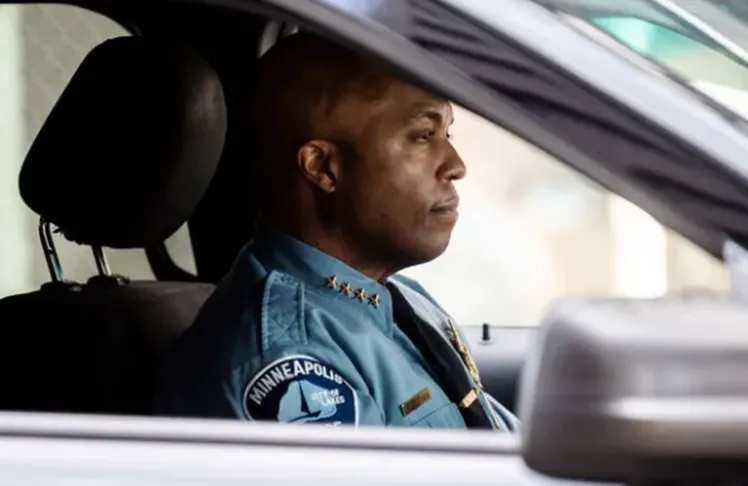
As I said, being a Black police chief is complicated. I existed in two worlds—one I came from and one I worked hard to join. At times, those worlds were in conflict. But when they were in harmony, my profession enabled me to serve the people of Minneapolis and keep them safe. In those moments of harmony, I could glimpse a world that might be, a future world in which the Minneapolis Police Department earned, and was worthy of, the public trust. Perhaps in this world, my son wouldn’t need to give his son “the talk.” If police officers perform their jobs in a procedurally just way, a teenaged driver who is pulled over will still need to understand and respect the inherent imbalance between us. But he won’t need to fear its repercussions every time he borrows the car keys, because officers will have risen above any temptation to flex that power or to use it to intimidate. When police officers give voice, show respect, are neutral, and build spaces of trust, a brighter future is possible. And in this brighter future, the officer won’t have pulled the driver over just because he is Black. There are many policies in place now to move us closer to that world, including body-worn cameras and measures to prevent biased traffic stops. But there is more work to be done. We’ve got to do all we can as a society to prevent any new entries in the ledger of police violence and intimidation. History is important, and we will never clear the shelf. But we shouldn’t be adding any more books to it.
Adapted from CHIEF RONDO: SECURING JUSTICE FOR THE MURDER OF GEORGE FLOYD by Medaria “Rondo” Arradondo, co-written by Jennifer Amie. Excerpted by permission of the publisher, DIVERSION BOOKS. Copyright 2025 by Medaria Arradondo and Jennifer Amie. All rights reserved.