By Aaron Allen, The Seattle Medium
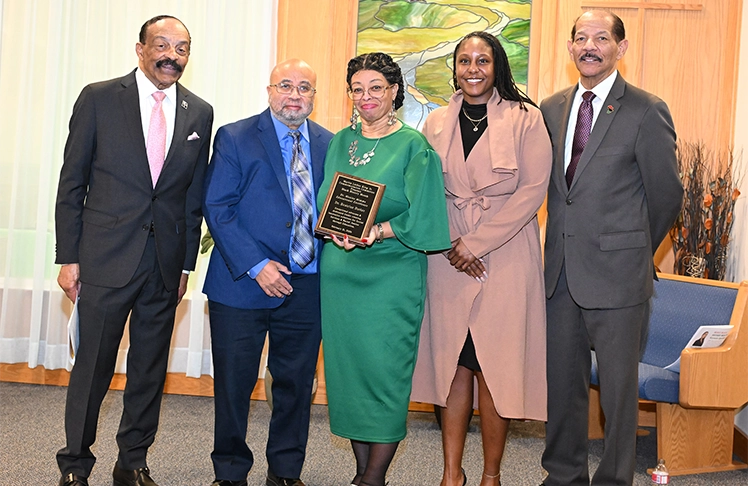
Last Saturday, The Dr. Martin Luther King Jr. Celebration Committee marked Black History Month with its annual awards ceremony. The event, held at Holgate Street Church of Christ, honored Black leaders across the Pacific Northwest in education, labor, public service and legacy. The event brought together community members for an afternoon of music, fellowship and reflection, while also paying tribute to the legacy of Dr. King and acknowledging the recent passing of the Rev. Jesse Jackson.
Founded in 1986, the Dr. Martin Luther King Jr. Celebration Committee is a nonprofit organization dedicated to preserving Dr. King’s legacy and promoting social, racial and ethnic harmony.
This year’s honorees included Dr. Beatrice Butler, who received the Dr. Maxine Mimms Educational Excellence Award; Sean Bagsby, recipient of the Tyree Scott and Bev Sims Labor Award; Sen. T’wina Nobles, who received the Peggie Maxie Public Servant Award; and the Black Heritage Society, which was presented with the inaugural Dr. Quintard Taylor Legacy Award.
The legacy award is named for the late historian Dr. Quintard Taylor, who died in 2025. LaNesha DeBardelaben, executive director of Blackpast.org, spoke about Taylor’s enduring impact.
“Because you are living history among us, let us just honor all of our elders, who are among us today. BlackPast.org is saying thank you,” says DeBardelaben. In thanking the committee for naming an award after Dr. Quintard Taylor, DeBardelaben thanked, “Brother Eddie Rye, Jr. Brother Hayward Evans, and the entire MLK commemoration committee for the continuation of his legacy, this gathering, this empowerment for community. And I stand in front of you on behalf of Blackpast.org, and Representative Jamila Taylor, who sends her regrets. She could not be here tonight. But we thank the MLK commemoration committee for designating an award named after the founder of BlackPast.org, Dr. Quintard Taylor Jr.”
“As your program indicates, he was a nationally respected historian, scholar, professor, Pulitzer Prize-nominated author, Fulbright scholar, visionary, mentor, and an extraordinary storyteller,” DeBardelaben continued.
Carol Peoples-Procter accepted the award on behalf of the Black Heritage Society and President Stephanie Johnson Tolliver.
“President Stephanie Johnson Tolliver, who is incredible, she was not able to come today. But I gladly and proudly accept this award, this inaugural award, and it couldn’t be more fitting that it’s Dr. Quintard Taylor Jr. because he was a history keeper,” says Peoples-Procter. “We are a time capsule and so, if you don’t see something that you think should be in the time capsule, it’s time that you become a member. Or make an appointment, Black Heritage Society is all volunteers. We may not be able to be volunteers for long. So anyway, yes, if you don’t see something historically, it’s probably because you haven’t donated or told us about it. So, think about it.”
“Our most recent collection was Judge Charles Z. Smith. Recently, his widow donated to us, and so we’re excited about all the things that we’re going to do. We just recently did a whole event about judiciary. That’s the only thing holding our democracy, rules, laws, regulations. So anyway, thank you so much. I could go on and on but thank you so much, added Peoples-Proctor.”
Sean Bagsby, business manager for IBEW Local 46, accepted the labor award and reflected on the movement’s legacy.
“We do the work because the work needs to be done. It’s not about awards or trophies, or titles, or any of that. We all stand on the shoulders of all those that came before us, few of them were named earlier,” says Bagsby. “And this is why we do this work, make sure that those that come behind us have it better, than we had, right? I have some young family here, and they understand this. That’s why we do this. So, I humbly accept this on behalf of all the giants whose shoulders we stand on and all the work that’s yet to be done. So, to the committee, to everyone thank you, thank you, and thank you.”
Dr. Beatrice Butler spoke about the influence of Dr. Maxine Mimms and the responsibility of leadership.
“I am so honored. First of all, I didn’t know my husband was going to introduce me, his words mean a lot to me. And everyone that’s here, that knows me, and that’s here for me, I appreciate you. You are in my heart, in my mind,” says Butler. “Dr. Maxine Mims meant a lot to me. I remember when Dr. Zakia Stewart introduced me to her and she instilled in me that the work is about community, she instilled in me you do this for your community. You stand up for your community. You model and you live your life for your community.”
“You can’t go out there talking to the children and saying what you expect from them if you’re not living that life. Because they’re watching. They’re watching how you treat others. They’re watching how you treat your fellow colleagues. They’re watching how you treat strangers. And that’s where the lesson comes,” added Butler.
Keynote speaker Angela Rye, attorney and nationally recognized social justice advocate, talked about representation, democracy and the responsibility of citizens to uphold constitutional values.
“The times are serious and we are being forced to be represented by people who don’t always represent our best interests. Sometimes you hope that when they carry the same label, party affiliation, their agendas sound the same as yours, right? You hope that they will continue to represent your best interests and that’s not always the case. We’re seeing DEI dismantled in corporations all over the country, folding to Donald Trump and we’re even seeing that happen, in cities and states around the country. Hopefully our city, in our state, we won’t be one of those,” says Rye. “Our eyes are on the prize, but what will we do when we finally are able to claim the prize? Are we ready?”
Rye also reflected on Dr. King’s challenge to the nation.
“Some people understand the assignment, some who don’t. Dr. King challenged this country to be true to what it said on paper. It is the 250th anniversary of the Declaration of Independence this year, and y’all got a fool in the White House,” said Rye. “The Supreme Court issued an opinion on Tariffs, like, what that got to do with me? Enshrined in the Constitution, not just the 1st 5th and 14th Amendment, there’s freedom of assembly, freedom of religion, freedom of speech, freedom of the press. We have the right to petition the government for redress of grievances on paper. It’s the 100th anniversary of Black History Month.”
“It isn’t just a repost on the gram (Instagram) or on Facebook, elders. It’s been 163 years since emancipation. 407 years since the first documented enslaved person arrived on these shores. It’s hard to be true to what you say on paper when you draft around the blind spots of your own hypocrisy and circumstance,” Rye continued . “Can we really talk about America being true to what it said on paper without talking about the Americans who have the responsibility of upholding, walking in, and embodying that truth?”