By Lornet Turnbull
Special to the Seattle Medium
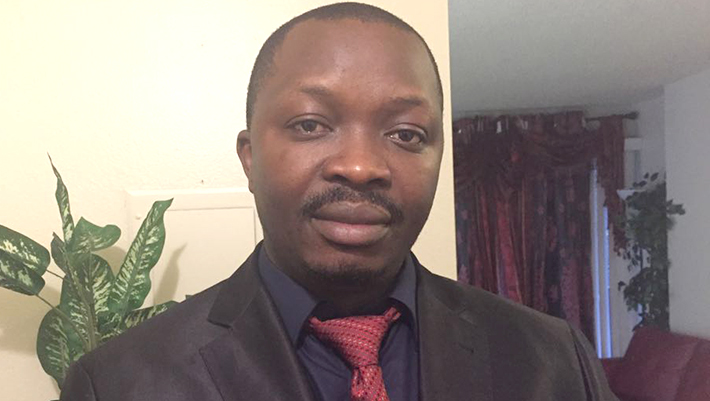
In December, when a 25-year-old Congolese refugee woman aged out of the emergency shelter in Seattle where she had been staying, her case workers called Floribert Mubalama to help her find a place so she wouldn’t end up on the streets.
She ended up moving in with him and his wife instead.
And when a Congolese asylum seeker was transferred to the Northwest Detention Center in Tacoma following an unsuccessful hearing in immigration court, it was Mubalama whom his panicked family called to try to find help.
A refugee himself, who has been in the U.S. since 2014, Mubalama is the person Congolese refugees turn to when things go wrong. He’s interpreter and advocate, counselor and spokesperson. His number is on speed-dial on most of their phones.
The 36-year-old attends practically every social service workshop, brainstorming session and conference taking place in the region, soaking up as much as he can and speaking up on behalf of his fellow Congolese. And he’s getting pretty good at lobbying local and Congressional lawmakers on matters important to his people.
Having fled what has been described as some of the world’s worst violence, people from the Democratic Republic of Congo have been resettling in the U.S. since the start of this decade and in Washington State over the last three years. It is estimated the state is home to close to 600 Congolese refugees.
They are perhaps the least-known group of refugees in the region. And Mubalama believes their newness and small size, compared to other groups, leave them powerless to attract attention and get help with some of their most critical needs.
“We are trying to raise awareness of our situation,” Mubalama said in strongly accented English, one of seven languages he speaks.
Mubalama does the work he does for the community on a voluntary basis, in his spare time, when he’s not at his job at Catholic Community Services.
“I use the tools I have: my phone and Google,” says Mubalama.
Now, he has a new platform from which to do it. The community has formed the Congolese Integration Network, with the mission of not only easing resettlement but linking the community to important public and private service providers.
Mubalama, who serves as its executive director, said he wants Congolese refugees to feel empowered and to have a seat at the table in making decisions that affect them, something they don’t now have.
“To respond to the community needs, we need to be equipped and have resources,” he said. “We need to build influence and make sure we make a lot of noise about our circumstances.”
Resettlement challenges
Last year, the U.S. resettled more than 16,370 Congolese, the largest of any refugee group. By comparison the second largest group came from Syria.
The Congolese arrived from camps in neighboring African countries, many still suffering the effects of war – the slaughter of families and the loss of homes and property.
Mubalama, like many, came from a camp in the southeastern African country of Malawi, where he said he served as a youth leader. His language skills allowed him to act as liaison between the refugees and the agencies serving the camps.
In the U.S., nine volunteer organizations contract with the U.S. Department of State to help refugees resettle in cities across the country.
Typically, arriving refugees are provided furnished housing, medical care and other services for the first three months. They also get help finding work, enrolling their children in school and themselves in English classes.
In terms of direct financial assistance, they are eligible for cash assistance and food stamps and families with minor children are eligible for Temporary Assistance for Needy Families, known as TANF.
Beyond the three months, they may access fund from several organizations and agencies to help with other expenses, such as help with rent and utilities to prevent homelessness.
Like many other refugees arriving in the Puget Sound region, most of the Congolese live in South King County, where housing traditionally has been more affordable and where the resettlement agencies had established longstanding relationships with landlords.
With few exceptions, refugees are required to work. Mubalama, who works with Catholic Community Services, said most find employment as home-health care providers or get warehouse jobs with companies like Amazon and Oberto.
But some of the workers lose their jobs after a while, he said, in large part because of the language barrier.
About two-thirds haven’t completed high school in their home country and only about one-quarter of them speak some English, according to resettlement data.
And Mubalama said while most enroll in language classes shortly after they arrive, not everyone continues to attend for various reasons, including the lingering effects of trauma.
“Some of them, after six months, aren’t even able to communicate enough to introduce themselves to their employers,” he said.
“The difficulty with English, physical and mental health concerns…they are all due to the trauma they experience. I have some education so I can stand by myself,” he said. “But for those who didn’t go to school … it’s very hard.”
Housing crisis
At a recent conference on poverty that included agencies across King, Snohomish and Pierce Counties, Mublama talked about the biggest challenge facing the refugees: Housing.
Rents are going up everywhere, including in South King County where immigrants and refugees in the past could count on more affordable rates.
And with growing demand, landlords are becoming increasingly selective and many are unwilling to rent to new arrivals or people without jobs.
Resettlement agencies admit that securing affordable housing for refugees is getting harder, given the current housing crisis.
Many are searching for creative ways to address the problem, including resettling folks in other regions of the Puget Sound area that they had not considered before.
Some are now even looking to shift arriving refugees to Spokane where there are more options for affordable housing.
Mubalama believes housing should be free for as long as it takes refugees to adjust to their new homelands. While the length of time varies in other countries, he thinks the three months refugees get in the U.S. is not long enough.
“A refugee is someone without a home,” he said. “So when we are resettled, the first thing we think about is a home. That’s the big need.”
The circumstances are leaving many refugees, including the Congolese, facing homelessness.
The slide into homelessness often begins when the government assistance they had been receiving runs out, or their lease expires and their rent goes up or the breadwinner loses a job, making it impossible for a family to cover housing costs.
Mubalama recounted a case last year of a 79-year-old Congolese refugee, who was asked to leave her daughter’s house because there was simply not enough room for everyone.
“The mother was sleeping in the kitchen,” Mubalama said.
The family contacted him. And after calling shelters and not finding a place for her, he took the woman to the Kent Justice Center and left her with a note, explaining her circumstances.
Officials called him and asked him to come and get the woman, reminding him that the Justice Center is a court. Mubalama responded: “But court is about justice.”
They eventually found her housing.
While many of the resettlement agencies have funds available to help refugees remain housed, accessing those funds is often a complicated lesson in red tape – daunting even for someone who was born here.
What’s worse, there’s no one acting as navigator for refugees and on their own they won’t always know how to get help, which could involve shuffling between three or four different agencies to complete the paperwork necessary to get enough money to cover the rent during a month they are short.
That’s a role the Congolese Integration Network would provide, Mubalama said.
“We will be the bridge to connect them, bridge all those limitations for the community,” he said.
The Congolese are also looking for ways to give back and to help people learn about their culture.
One way they hope to do that is through performances by a refugee youth group, called Generation of Hope, which promotes Congolese culture through drama.
The young people are still working out the details of their show, which will tell the story of how they became refugees.
Mubalama said the group is trying to find a sponsor, something the new organization may be able to help facilitate.
“We will be telling the refugee story through acting and film,” Mubalama said. “We want people to know who we are.”