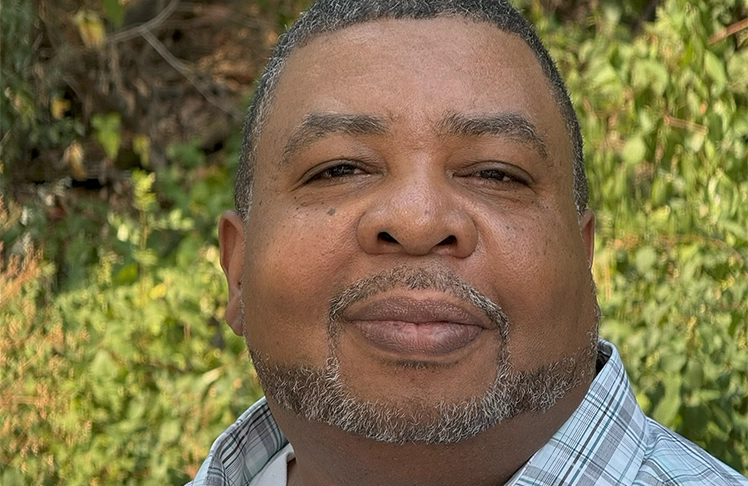
By Aaron Allen, The Seattle Medium
Community Carrot Seattle, a nonprofit dedicated to mentoring and educating young adult entrepreneurs from underserved communities, recently named Chris Rhodes as its first full-time executive director. His appointment, made possible through a capacity-building grant from the M.J. Murdock Charitable Trust, signals a new phase of growth as the organization advances its mission of promoting racial equity through business ownership.
“Chris Rhodes brings the leadership, vision, and fundraising expertise we need to scale Community Carrot’s impact,” said Kesha Rodgers, board chair for Community Carrot Seattle. “His deep commitment to equity and community-rooted change makes him an ideal fit for our mission.”
A Seattle native and graduate of Garfield High School, Rhodes holds a business degree from Clark Atlanta University, a nonprofit management certificate from the University of Illinois at Chicago and has studied at the University of Chicago Graduate School of Business. With more than two decades of experience in nonprofit leadership, he most recently co-led Rooted in Vibrant Communities (RVC), a Seattle-based nonprofit focused on empowering communities of color.
Rhodes said joining Community Carrot aligned with both his professional goals and personal values.
“At Community Carrot, I felt like at this stage of my career I wanted to find a place where there was not only professional synergy but personal synergy as well,” Rhodes said. “The fact that I’m able to impact or help to impact young adults so they navigate starting their own business and what they want their futures to look like really spoke to me.”
“My goal as the first executive director is to really help them manifest their dreams and continue to learn the ins and outs of how to launch a successful business,” he said.
Community Carrot was originally founded in Washington, D.C.’s Petworth neighborhood in response to chronic youth underemployment. Its founders met with more than 200 community members, most from multigenerational poverty, to understand how an entrepreneurship school or program could serve as a pathway to opportunity. That feedback helped shape the model now implemented in Seattle.
The nonprofit provides 18- to 24-year-olds from low-income backgrounds with a 16-week business development program, mentorship, and access to community partners. The program focuses on creating economic mobility through entrepreneurship.
“In my new role, advancing social justice and racial equity by teaching young adults how to start their own successful business is the goal of this organization,” Rhodes said. “Our hope is to really break the cycles of poverty that are often associated with Black communities, in terms of becoming their own boss and giving them the skill set to create other options for not only themselves but for their families.”
During his time at RVC, Rhodes helped scale the organization from five to 28 staff members, co-managed a $5.2 million budget, and led public relations and major donor efforts. He also helped secure multi-year, seven-figure investments through a “Big Bet” initiative.
“The community need for our program requires experienced, full-time leadership, and Chris is the right person to lead our growth and transform the lives of more young entrepreneurs,” said David Sheon, Community Carrot’s founder and former volunteer executive director. “Chris shares our belief that entrepreneurship is a pathway out of poverty and into a position of power.”
Community Carrot places a strong emphasis on inclusion and equity, both in its internal practices and in the way it serves participants. Rhodes said the organization intentionally confronts systemic racism while creating space for diverse voices.
“We practice active listening to be sure that all perspectives are heard,” he said. “We recognize the harm white supremacist systems have caused, and in particular their effects on Black people, Indigenous people, Latinx/Hispanic people, and many other people of color, collectively referred to as BIPOC.
“To us, racial equity and inclusion mean fair opportunity for every person, whatever their race, color, ethnicity, sexual orientation, gender, or religion.”
One of the most compelling examples of Community Carrot’s impact is Jack Pham, a 26-year-old Seattle native and car enthusiast who once struggled with the law and was looking for a path forward. Pham enrolled in Community Carrot’s training program and emerged with the tools to launch his own business.
“I just wanted to change the course of my life,” Pham said. “I needed to take action and Community Carrot was there to help me do it.”
Today, Pham is the founder and CEO of WrapAddict, LLC, a vinyl car-wrapping business. He is one of 76 young adults from historically marginalized Seattle neighborhoods who have launched their own businesses through the program.
“I believe it’s a very useful program, very beneficial because they take you out to see a lot of specialists in different fields that you need to learn to become an entrepreneur,” Pham said. “So, it definitely opened my eyes to know what I needed to do and what I needed to accomplish.
“I believe programs like these are important because it shows people that there’s people out there who really care, who really go the extra mile for someone who they don’t even know. And I feel like that’s really important—to help, for people to know that there’s people out there willing to help.”