by Aaliyah Amos
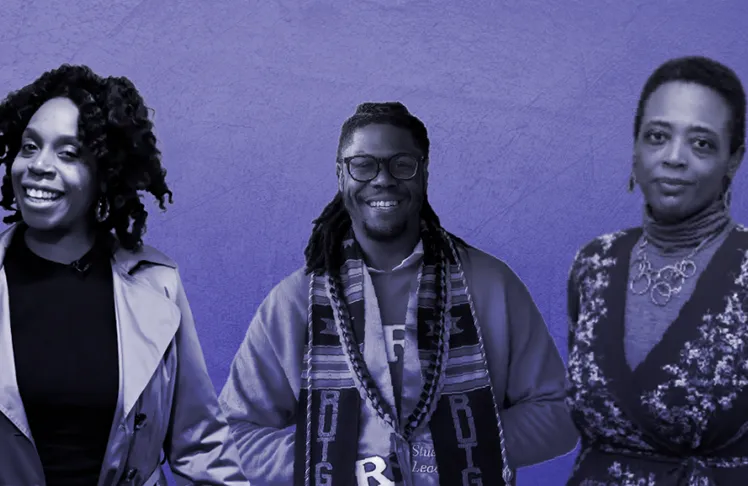
A short, rhyming kindergarten verse that ended with a simple “I love you,” was Kelvin “KJ” Marshall’s first step into poetry. Fifteen years later, Marshall, now 22, understands how that same art form is something deeper: a way to grieve, process and heal — both personally and within the broader Black community.
Now a community health worker from Newark, New Jersey, Marshall blends his work in the community with his love of poetry. His self-published book “Della’s Gospel,” written after the death of his aunt, explores faith, loss, and the emotional weight many Black families experience when navigating systemic stress.
“Poetry has given me an outlet to explore different emotions, but it’s also given me a chance to connect with others,” he says.
Across the country poets like Marshall are turning verse into a tool for racial healing — creating space for reflection, storytelling, and collective understanding. Through community programs, workshops, and open mics, poetry is helping people better understand their lived racial experiences, challenge harmful racial narratives, and build connections across generations.
For Marshall, that work begins by focusing on themes such as social determinants of health, youth development and faith-based experiences. These issues typically stem from questions that arise in his mind as he reflects on the communities he serves.
As he shares his work with other artists at workshops and open mics, Marshall says he has “the privilege of being a student in the game, so I’m able to constantly learn.”
The Role of the Poet Laureate
Across the country, poet laureates are helping lead similar creative, healing-focused spaces that help communities process history and possibility together. Newark Poet Laureate, Margie “Mia X” Johnson describes the role as “an ambassador for poetry and literacy.”
For Johnson, racial healing means finding love despite narratives that have harmed people of color. She has written numerous poems about the Black experience, confronting history and restoring dignity to people whose lives have been distorted or erased.
“Poetry is an effort to help us find and love ourselves inside of stories that have demeaned us – in a life that has hurt and broken us,” she says. “It’s also about wholeness, healing and confronting what we can’t be silent about.”
Through programs like ArtsXChange, which she leads in collaboration with the New Jersey Performing Arts Center, Johnson works to make art accessible at the neighborhood level, responding to residents’ desire for art experiences that reflect their lives.
Appointed by the city in 2024, Johnson carries forward a legacy shaped by late activist and poet Amiri Baraka, who served as New Jersey’s state poet laureate.
“As a poet who grew up reading and loving poetry, I always knew about poet laureates because it was something to strive for,” she says. Baraka’s radical, righteous poems inspired her and demonstrated poetry’s power to drive change.
Though New Jersey discontinued its state poet laureate program, Newark’s poet laureate role exists under the leadership of Mayor Ras J. Baraka, Amiri Baraka’s son.
Her work often confronts historical pain directly and transforms it into power. Her poem “Black Blood Blackness,” featured in the “American Voices” exhibit at the Newark Museum of Art, is displayed beside a whip. It’s a pairing that encourages viewers to reckon with the legacy of slavery while imagining personal and systemic transformation.
She also contributed to a new exhibit in a Newark park honoring Harriet Tubman. The outdoor installation replaced a statue of Christopher Columbus, a statement that Johnson says, signals “we are on the precipice of change.”
“We’re in a Black and Brown-focused city. We have stories to tell,” she says. “I’m a keeper of the flame.”
Poetry as a Bridge Across Communities
For Salaam Green, the inaugural poet laureate of Birmingham, Alabama, “using poetry as a tool to show tangible, intentional, uniformed unity, without trying to make people do it or feel like they can’t do it,” is essential.
“I don’t ever come into the space with, ‘I’m a poet, and we’re going to learn poetry,” she says, laughing. Instead, Green begins with comfortable conversations, slowly introducing writing as a way to reflect and share.
In 2020, she completed a certification program as a listener poet, gathering stories from healthcare professionals and community members grappling with the COVID-19 pandemic and writing poems based on their experiences.
“Those poetic reflections were not perfect, or in any kind of formation,” she says. “They were written to support people in their everyday lives and promote resilience.”
The experience prepared Green for her role as poet laureate by grounding her work in community spaces and shaping how she approaches conversations about harm, healing, and truth.
In working with Birmingham’s diverse communities, Green says she encourages people to become both storytellers and truthtellers who use poetry to reflect honestly on their experiences.
Green acknowledges that not everyone is interested in professional poetry, but she says it can still be a useful tool for personal reflection and connection with loved ones.
As a racial healing facilitator working at community centers across the rural South, Green sees firsthand the harm and trauma that exists in many communities. She believes poetry creates space for racial healing by allowing people to see their full selves and dismantle hierarchies.
Her 2025 poetry collection, “The Other Revival,” addresses the horrors of slavery by reclaiming oppressed narratives and creating space for collective healing. For the book she brought together descendants of enslaved people and descendants of their enslavers.
“These very sensitive topics use poetry as an entryway into these conversations and give people an opportunity to see their full selves,” she says.
“We get to choose our personal revivals,” she says. “As we go through harsh times, we may not see what revival could be. All we have is this ancestral memory.”