By Sydney Goitia-Doran, The Seattle Medium
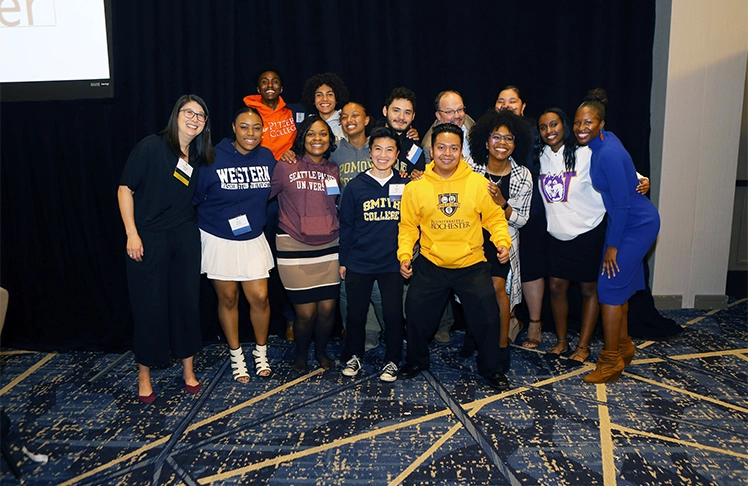
Rainier Scholars, a nonprofit organization in Seattle, is opening doors to college for students who are often overlooked in higher education. The program offers more than 12 years of continuous support to each participant, combining academic instruction and leadership development to increase college graduation rates among the most underrepresented student populations on college campuses.
According to the program’s website, 91% of the program’s scholars have graduated or are on track to graduate from four-year colleges or universities, with most program participants coming from households that qualify as low income and are without a member of their immediate family with a four-year college degree.
Sumiko Huff recently ended her time working for Rainier Scholars after 16 years, most recently as the director of strategic growth and program design. She said Rainier Scholars chips away at solving a larger problem over time by giving students opportunities.
“We always talk about Rainier Scholars as it shouldn’t have to exist. In our ideal world, it wouldn’t have to,” Huff said. “But the current world is intentionally not designed for all kids to thrive.”
“I think Rainier Scholars is a place where you see kids getting what they need and just taking that to the next level and then consequently, they start giving that back,” she added.
Each year, the program begins with a new cohort of about 100 students entering a 14-month academic enrichment phase during the summer after fourth grade. In this phase, students attend two intensive summer sessions and additional classes twice a week during the school year. From sixth through 12th grade, Rainier Scholars partners with schools to offer academic counseling, tutoring and family advocacy, while also providing leadership and career development through retreats and workshops. Support continues through college with counseling and resources provided through graduation.
Huff, who spent 11 years as academic director, said she enjoys seeing students grow throughout the program.
“Just getting to see that whole trajectory from a kid stepping into that opportunity and saying, ‘Yes, I’m willing to try this.’ And then all the different places that it goes from there,” Huff said. “Of course, it’s not just us, but to be part of that, and being able to get all the little updates along the way. I think every teacher probably has a couple kids who stay in touch and do those things. But we get to do this with cohorts of kids across the board, so that’s a lot of fun.”
Huff said Rainier Scholars aims to reinforce positive belief systems in students that allow them to be increasingly successful over time.
“If you want a kid to advocate for themselves, they need to have the belief that there is a community around them that will support their advocacy and that will help them get what they need,” Huff said. “So, you need to create an experience that shows them that is in fact true and reinforce it over time, because depending on where they’ve come from before, if they’ve had positive or negative experiences in the past, they’re going to be on different planes of readiness for those kinds of pieces.”
Kelabe Tewolde, associate director of leadership development at Rainier Scholars, is both an alumnus of one of the program’s earlier cohorts and a former academic counselor. He described his work in leadership development as the “character building” of scholars, helping them navigate new environments such as independent schools.
“There are things that are going to go against them, no matter where they are in their life, and we want to give them the tools to be able to stand up for themselves and be leaders in their community,” Tewolde said. “Both as strong advocates for the things that they believe in, but also strong and willing community members, and we want them to have a sense of community wherever they go.”
Tewolde said programs like Rainier Scholars are important to highlight the value of education in an era where people use artificial intelligence or chase money and fame on social media.
“If we look at our history, there’s a reason why educational opportunities have been denied to people for so long,” Tewolde said. “It’s because that is a route toward freedom, and I think it’s really important that we continue to encourage students from backgrounds like our own to value education, intellectualism and knowing your history.”
In an effort to expand their reach and impact, the program expanded into Tacoma in 2021. While the mission remained the same, the program needed to utilize slightly different methods to reach its goals and objectives. One of the main differences from the Seattle program is the simulation of a college experience by letting the students choose “majors.”
“You can’t just take something that works in Seattle and plug it into Tacoma,” Huff said. “And so really what we’re working on is, we want the same outcomes for kids. All the choices, all the doors open, all those things.”
At both program sites, Huff said, success relies on students and families who take a chance on the program and commit, despite its rigorous nature and long-term involvement.
“Ultimately, at its core Rainier Scholars is an opportunity. The magic doesn’t happen until the people say, ‘Yeah, that’s a challenge that I’m willing to try, even if it might mean I fail at times or if it’s going to be really hard, if it’s going to be challenging,’” Huff said. “When people, kids and their families, step into that place of uncertainty, that is the moment where I think the magic really happens.”
Huff, who is transitioning out of the program but will continue working in education as a teacher, said one of the things that kept her at the organization for so long was the freedom to creatively solve problems for kids and see impact in real time. As the Tacoma site continues to develop and the Seattle site prepares for its next 25 years, Huff sees the program as a multiplier, building upon opportunities for students over time.
“We’re trying to open as many doors and keep them open for as long as possible so that kids have all the choices that they could possibly want,” Huff said. “So, when they do decide, this is the door that I want to walk through, they have every chance of being successful as anyone else who’s doing that work.”