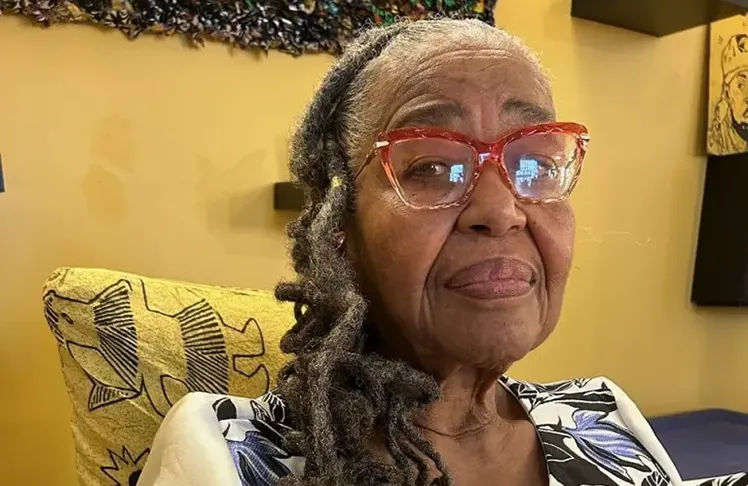
Rev. Vivian Baker Castain didn’t set out to make history. But when she became the first woman to serve as pastor in the Second Episcopal District of the African Methodist Episcopal Church — spanning the District of Columbia, Maryland, North Carolina, and Virginia — she stepped into a role few women before her had been allowed to imagine. The “call” to ministry came later in life, but once it did, she didn’t hesitate. It wasn’t about courage, she says. It was just something I knew.
She grew up in Columbia, South Carolina, where then-Charity Edna Adams, now known as the first Black woman officer and leader of the 6888 Battalion in World War II, was one of her junior high school teachers.
And it was when now Bishop John Richard Bryant returned from his pastorate in Boston to assume leadership at the renowned Bethel AME Church in Baltimore that her ministry officially began. His celebrated ministry style includes the birthing of sons and daughters, of which she is the first, and her favorite name for him is “Daddy Bishop.”
Her years in ministry have not been without conflict, but she speaks her mind and continues to move with whatever she feels is right in the moment. She has stories of being moved from one church to another unexpectedly; of leaders who wouldn’t come to her church unless a man was preaching. She speaks her mind without hesitation, but considers the consequences before she speaks.
She retired in 2000, as the church requires, at the age of 70, but she remains unofficially active in ministry, travels regularly, and has recently decided to stop driving as she approaches 95.
Word In Black: Tell me about the beginnings of your church life.
Rev. Vivian Baker Castain: I really had no thought of preaching at that time because we attended a Baptist Church, and women weren’t accepted as preachers. This lady, who was a Baptist, the wife of a Baptist preacher, would tell me all the time, ‘Vivian, you will make a good pastor’s wife,’ because I could play the piano and all of this. We really weren’t Baptist. I’ve always been Methodist. And when my father remarried a Baptist after my mother died, they all got baptized, but not me. I was about 10, and I was afraid the preacher was going to drown me in the pool. People who knew my mother knew my grandfather was a Methodist preacher, and tried to get me and my brother to remain Methodist.
WIB: So where’d you settle after that?
VBC: Daddy took us to an AME Church, and I ended up at Bethel AME around the same time Bishop Bryant came with his new Pentecostalism, and a lot of people moved from Boston University to Baltimore following him. And the spirit was so high, I got the call to preach. Well, mostly I got the call to give my life to Christ and to preach at the same time. And one of my aunts in South Carolina, the Baptist side of the family, wrote me that I did not have the call to preach. But I didn’t pay her any attention. She didn’t understand what a call was, and she couldn’t tell me. That’s what I knew I had to do. It took me some time because I had to get out of some stuff I was involved in. That was in 1976.
There was also a young man in my family who had a call to preach, and he told me there could only be one preacher in the family, so I waited. He preached in December 1977, and I told him I couldn’t fight it anymore. Rev. Bryant had asked me over and over if I was ready to preach yet. I told him I wasn’t ready, but not what was holding me back. So I decided, and in February 1978, I preached my first sermon.
WIB: What was the next step?
VBC: And then right after that, I was in an interdenominational meeting and somebody asked me, how did I feel going into ministry when women are not allowed to preach? And that I had not even considered. In fact, I wasn’t even that familiar with the Bible. And I told Reverend Bryant that, and he told me, well, you get familiar with it. You do chapter book by book as you go along.
And so, the fact of women not preaching didn’t bother me. The first woman I heard preach after I got the call was Rev. Alfreda Wiggins. Her scripture was, How can you sing the Lord’s song in a strange land? Her title was, ‘But sing you must. I didn’t even know anything about what preachers were supposed to wear, so Rev. Agnes Alston from Gillis was teaching my daughter, and I talked to her about what to wear. She told me black, long sleeves, suits, and dresses. That’s all I knew.
WIB: So tell me about your first assignment?
VBC: My first church was Mount Joy AME in Monkton, Maryland. It was 20 miles from Baltimore, and the roads had a whole lot of curves and all of that going on. But I drove it. It didn’t even bother me at night. Last time I was there, about three years ago in the daytime, I was crying, I was so scared. I was the first woman to pastor there, but that was never an issue out there. I was sent as an itinerant deacon, but I had been well trained by Rev. Bryant, who had us sit in his meetings. When I had to make a decision, I’d ask myself, ‘What would John do?’ We called him John then.
What do you miss about more traditional church?
VBC: I miss our traditional order of worship. I’ve known it all my life, and not having it seems like jerking a rug out from underneath you. Bishop Bryant taught us in detail what every part of our worship service was about and why Richard Allen included it. We have lost our quality of music. The hymns which are so meaningful are rarely sung today. One preacher says the songs that we sing are 7-Eleven — only seven words, 11 times. In our church, it seems like seven words, 50 times! And noticed that our young pastors today are returning to a sense of togetherness, where the churches get together and fellowship. We used to do that and even had a ministerial alliance, which young pastors killed that, overturning what had been done for 200 years. The alliance was effective as well.
I miss most of all trying to teach people how to live the best possible life for the Lord and to make a difference in the world.
WIB: You mentioned Reverends Agnes Alston and Alfreda Wiggins earlier. Who are some of the other women who helped you in ministry?
VBC: Of course, Rev. Cecelia Williams Bryant. Rev. Sarah Francis Davis, an awesome prayer warrior, episcopal daughter of Bishop Bryant, who died too soon. Rev. Joanne Browning, recently retired, who served as co-pastor with her husband, the Rev. Dr. Grainger Browning, at the Ebenezer AME Church in Fort Washington.
WIB: And who are your children in ministry?
VBC: I have several children in ministry who have done well. One was Rev. Julia McCargo, who pastored in the Virginia conference. After she died, the women in ministry created a memorial in her name. Rev. Patrick Hipkins was the pastor of Davis Memorial Church here in Baltimore, but in the Washington conference. He had an awesome food ministry in that church, and after he retired, he continued seven days a week, going to get food from two stores and bringing them to the Walbrook Junction for distribution at the corner of Clifton Avenue and Denison Street. Now there is a street sign there with his name.
At 82, he is still performing this amazing service, which has expanded to other places. His granddaughter is now a pastor in the Washington conference and is also the head of the young adults organization in the Second Episcopal District. I have another daughter in Atlanta, Rev. Dr. Arlene Campbell Robie. She is the niece of Mr Baker, who had a series of beauty salons in Baltimore. Rev. Hedy Jameson Drummond has effectively retired from pastoring in the Washington conference. She and Reverend Hipkins served for years as part of the staff for the annual conferences in Washington.