last week.
By Aaron Allen, The Seattle Medium
Community members expressed outrage over what they describe as aggressive and excessive parking enforcement during Seattle’s Juneteenth celebration held last week at Jimi Hendrix Park, casting a dark cloud over an event that was otherwise record-breaking and peacefully celebrated.
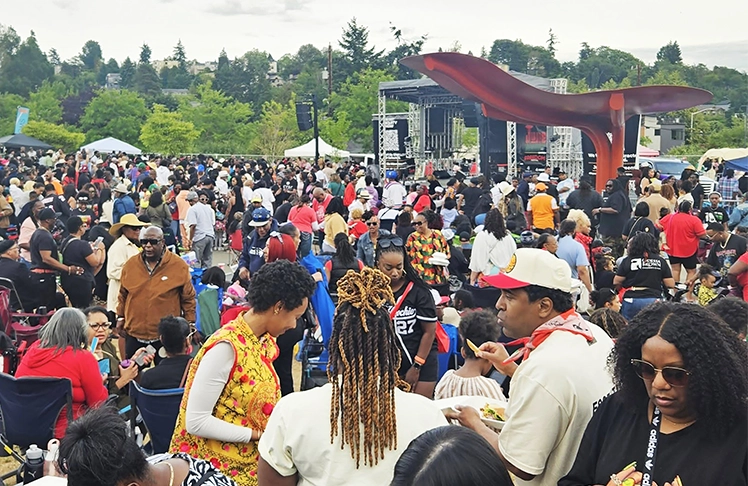
The annual Juneteenth festival, organized by Africatown, Jim Buchanan, and Dope Culture/Third Level Events, drew more than 8,500 attendees to the Central District—considered the cultural and historic heart of Seattle’s Black community. The event featured live music, food, and a safe, family-friendly atmosphere that honored African American heritage and the ongoing struggle for liberation.
“Over 8,500 people attended,” said Anthony Tibbs of Dope Culture LLC. “The #1 Juneteenth celebration on the West Coast and it was amazing. Regardless of the mishaps or issues that may arise, it is unfortunate that such issues of disparity continue to surround our people.”
Several witnesses reported that parking enforcement officers were present throughout the day, issuing citations to vehicles parked in the surrounding neighborhood during the event. The enforcement response drew swift criticism from attendees and community leaders, who viewed the citations as insensitive and disproportionate.
Former State Representative Dawn Mason, speaking on behalf of Seattle’s Black community, called for immediate action from city officials.
“The largest Northwest Juneteenth event, 8,000-plus peaceful, mostly African American celebrants at Jimi Hendrix Park. A family-friendly environment,” said Mason. “I appealed to Chief Barnes to have all the tickets voided and publicly apologize to [the] African American community for this insult.”
The City of Seattle responded with a statement clarifying that while street parking is generally free on Sundays and certain holidays, areas hosting large events may still enforce special event parking rates. Officials advised checking local signage for restrictions, even on recognized holidays like Juneteenth.
Mason emphasized what she called a painful irony—that many of the city officials who attended the event and are responsible for oversight, including the police chief, mayor, and local councilmembers, are all Black.
“Seattle suspends parking enforcement on holidays. Why not ours?” she asked.
Mason also underscored the broader challenges facing Seattle’s displaced Black population. As gentrification has pushed Black communities to the outer edges of King and Pierce counties, access to community spaces in the city has become increasingly difficult. She noted that many attendees traveled long distances to attend the celebration and faced limited transit options.
“Our historic Black community was flung far and wide out of Seattle, with no accessible public transport. We must drive to return home. Then parking is restricted—so tickets become inevitable. Theme, writing tickets was like shooting fish in a barrel. There is freedom, and then there is liberation,” Mason said.