By Aaron Allen, The Seattle Medium
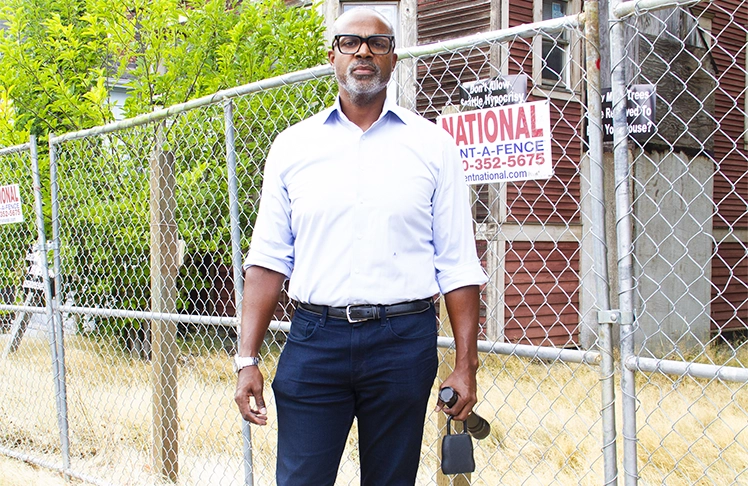
A property dispute in Seattle’s Columbia City neighborhood has sparked a clash between a developer and residents over a planned housing project that would remove five trees from a lot that includes a deteriorating home. The property, located at 3936 S Angeline Street, was recently purchased by developer Albert Clark, who intends to build new homes on the site. His plans, which are legally permitted by the city, have drawn organized opposition from some neighbors.
Leading the protest are Andrea John-Smith and her husband, Darryl Smith, a former Deputy Mayor under the McGinn administration and a former member of the Seattle Planning Commission, who live across the street from the property.
The couple has framed their opposition as an effort to protect the neighborhood’s tree canopy. In an email circulated to neighbors, John-Smith wrote, “My hubby, Darryl Smith and I, Andrea John Smith, plus many others have become aware that the developer, who now owns the property across the street from us 3936 S Angeline St, is going to cut down all five 100-year-old cedars/firs on Friday. We are working to see if we can stop this.”
Last week, the Smiths asked residents and neighbors to attend a neighborhood gathering to further shed light on the issue and are planning to reach out to Seattle city councilmembers and the Department of Construction and Land Use. The couple also invited neighbors to leverage any political or personal connections that could help them with their cause. “Any idea, any leverage, any relationships that you might have, please let me and Darryl know,” the email stated.
Clark, who has lived in Seattle for nearly five decades, responded with sharp criticism, accusing the couple of misleading the public and politicizing what he views as a legally sound development.
“Don’t throw my name in an email blast to the community in order to rile up the community about me, the developer,” Clark said. “Because I don’t have anything to do with Seattle and their process. I have nothing to do with the city of Seattle’s municipal code. I don’t get into that.”
The Smiths claim their concern is not only about the trees but also about the city’s permitting process and the broader implications for how development impacts neighborhood tree canopies.
“The concern was about the way that the process for permitting for tree removal was handled,” John-Smith said. “Ordinances are different depending on if it’s private and then just a single person versus multi-family and there’s all sorts of laws in the books about what you’re supposed to do. The part about how the law is set up and if the law is followed, that’s a public concern and so there are advocacy organizations that track this and lots and lots of different folks all over the city that are concerned because of the tree canopy. So that’s the larger issue and a concern for many people.”
Darryl Smith agrees and says that the issue is not just about this particular project but a broader “houses versus trees” tension created by City policies.
“I think the overall concern is the city’s policy,” Smith said. “It almost forces the developer’s hand where they’re going to build to cut down all of the trees, even really big legacy trees.”
Clark rejects the suggestion that he is acting irresponsibly, stressing that he has followed the city’s process at considerable expense. He also maintains that his critics are making the issue much bigger than it needs to be with respect to this property.
“You can have a problem with the city of Seattle and their tree ordinance. Deal with that with the city of Seattle or buy the property,” Clark said. “They did not approach me from the day I owned that property which went into effect in December of 2024, until last week. They didn’t contact me about buying it from me or coming up with a solution that would work for them to feel good about me developing my property. And that’s the other thing, it is my property, it is not theirs.”
Angela Moore, a local real estate broker and developer, claims to have had a similar experience when trying to develop a property in the neighborhood. According to Moore, she was approached by John-Smith who said, “we need to talk to you about some concerns we have about your property.” While Moore said it is not uncommon for neighbors to raise questions about development, she characterized the interaction as involving “a lot of demands” from someone who did not own the property.
In addition to protests and rallies, Clark claims the dispute has spilled into attacks on his professional reputation. He said negative reviews of his company have appeared online from individuals who have not worked with him or spoken to him directly about the project.
“It’s about my reputation. It’s about what I’ve worked hard for the last 20 plus years with my name and my daddy’s name,” Clark said. “So, it’s my name and my reputation and I’ve already gotten two negative reviews on my real estate Google page. Now, I’ve owned the property since December. But the day after the rally happens, all of a sudden now I get a negative comment on my Google page.”
The Smiths deny encouraging or participating in any effort to harm Clark’s business. John-Smith said the couple’s focus is on influencing city policies to better balance housing development with tree preservation.
“I think there’s been an unfortunate narrative that’s gotten out there,” John-Smith said. “I would have loved to have had more dialogue. I said to Mr. Clark, ‘I don’t have any power here. I don’t own your property. It’s your property. You own the trees. We don’t think there’s anything we can do about the loss of 500 plus year old trees, but we think we can maybe affect the future and take our sorrow about losing those trees and put it into something productive like changing the law so it’s more balanced.’”
Clark, however, continues to defend his approach as consistent with both the law and his professional ethics.
“I’m sitting in front of a property right now that I just developed in North Seattle. I’m looking at four huge cedar trees that I had to keep,” Clark said. “So, it’s not about, oh I’m taking trees down frivolously and the way they presented it to the community was that I did things wrong, that I circumvented the city’s process. So, for me it’s more about my personal integrity, then about the trees themselves. Because, if they wanted me to keep the trees make me an offer to offset my financial responsibility of my property. If you want me to keep two trees, what is that going to do to my development and what I’m expected to get in my return for my development. But they haven’t done that. That’s not what they want. They want to cause a stink and get everybody up in arms.”