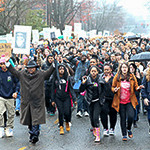
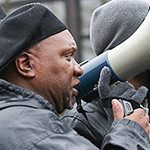
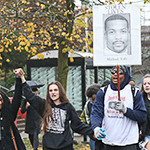
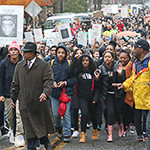
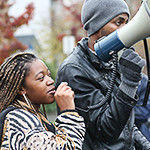
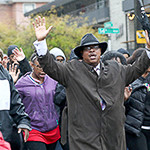
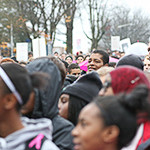
Religious and civil rights leaders from Seattle’s African American community led a spirited march and rally on Tuesday to express their displeasure with the decision of a grand jury in Ferguson, Mo. not to indict police officer Darren Wilson in the shooting death of 18-year old Michael Brown, an African American male who was unarmed at the time.
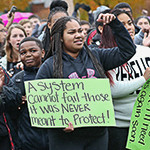
Joined by hundreds of students from Seattle’s Garfield High School, the march not only highlighted what the protesters called an “injustice” in Ferguson, but also shed light on the fact that African American youth feel that this incident is an example of what can happen in any city in America, including right here in Seattle.
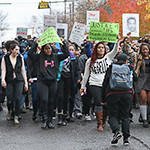
Just minutes prior to the march, passer-by’s could see a mass exodus of Garfield High School, as students made their way out of nearly every door of the school and gathered on 23rd Avenue where they peacefully disrupted traffic and marched towards 23rd & Union to join the protest that was scheduled to begin at 12 noon.
Although the protest was organized by the United Black Christian Clergy and the Seattle/King County NAACP to demand that a federal indictment be filed against Officer Wilson, it was the spirit of the young men and women that fueled the emotion and passion of the march.
“This was their [the students] protest,” said Pastor Carey Anderson of First A.M.E. Church in Seattle. “At 18-yearsold, Michael Brown was one of them, and this was an opportunity for them to express themselves – which they did, and it was a very beautiful thing to see.”
Organizers were not expecting the students to join the march, but as they were assembling on the northeast corner of 23rd & Union they could see a large group of fiery protestors making their way up 23rd avenue yelling “hands up, don’t shoot.” Organizers quickly moved into the intersection and proceeded to march westbound on Union Street, as the students seamlessly joined the protest and fired up the crowd.
According to Anderson, the students organized themselves during their lunchtime and decided to stand up and make a statement about the injustice that has occurred with the decision by the grand jury in Ferguson.
The group proceeded to march downtown to the federal building where they were joined by many other supporters — including students from other Seattle area high schools.
Seattle Mayor Ed Murray joined the protest and could be seen marching along with other protesters.
In a statement released after the Ferguson decisions, Murray said:
“As they learn of today’s grand jury decision in Ferguson, many in the African American community in Seattle and across the country are bound to feel that justice has not been served, and experience tremendous hurt as a result.
For many in the African American community, this decision will likely replicate the pain caused by the tragic shooting itself and underscore this gulf of mistrust, which, if left unattended, will only divide us as one community.
Racial disparities persist, having been built – here and everywhere throughout this country – upon a legacy of decades and decades of institutional bias.
These disparities are very real, and our communities of color bear daily these burdens – and our young African American in particular.
And that’s the deep, unacceptable truth that Ferguson reveals about us a society: We are failing our young African American men.
Too often we are sending them to prison instead of college. Too often they are dying young instead living long lives of fulfillment.
And while I cannot pretend to know the individual experiences of young African American men, I do know that we in this city must be united in how we address these experiences,” Murray concluded in his statement.
Seattle City Councilmember Bruce Harrell believes that the Ferguson decision shows that more transparency is needed in police interactions with the public and has renewed his call for police to wear body cameras across the country.
“The Ferguson decision is a sobering reminder that we need to equip all police officers with cameras,” said Harrell. “The public deserves to have clear video evidence of police and civilian interactions, so we can more accurately examine incidents of police misconduct and produce video and audio evidence when shootings occur. The grand jurors in the case heard 70 hours of testimony from roughly 60 witnesses with differing accounts. One answer to prevent the incident at Ferguson from occurring again is to deploy body cameras on all police officers.”
Organizers not only hope that justice will be served as it relates to the shooting death of Michael Brown, but they also hope that local policy changes are made to help to avoid similar incidents here in Seattle.
King County Executive Dow Constantine believes that Seattle can learn from Ferguson, and the events in Ferguson should be a catalyst for change not only in Seattle, but around the country.
“The events in Ferguson have laid bare the ongoing racial divide that stretches across the breadth of these United States,” said Constantine. “Our task now must be to learn from this moment, and to redouble our efforts to create the long-term, systemic changes our nation needs to fulfill its destiny.”
Pictorial Highlights From The March: