
By Asia Armour
The Seattle Medium
It’s no secret that Seattle has some of the best drinking water in the country, but what many people might not be aware of is the allocation of resources that are necessary to maintain it.
While some might say that Seattleites pay a premium because we have some of the best drinking water in the country, the truth of the matter is that Seattle residents are paying a premium to ensure that future generations have access to the same high-quality drinking water that we enjoy today.
There are about 2,000 miles of steel pipes that run from the Cedar River Municipal Watershed, the main source of Seattle’s drinking water, to the storage facilities, 750,000 residences and 1.5 million people that Seattle Public Utilities (SPU) services.
According to Anna Constance, a naturalist and tour guide at the Cedar River Watershed Education Center, SPU is considering the effects of climate change, population growth, and the issues related to the ongoing water crisis in Flint, Michigan to help determine how the Cedar River watershed is maintained.
Constance said that although the cost of water in Seattle is higher than the national average, the city is using that additional money to invest in the continued safety of its drinking water.
“The city is thinking about when we will need to replace our pipes, instead of letting old pipes corrode and contaminate the source,” she said. “Other cities haven’t gotten to that point yet, so people are actually not paying enough for the repairs or replacements they would need.”
Seattle is in a unique position that allows it to focus on the future of its infrastructure. The water from the Cedar River Watershed flows from a pristine source in the Cascade mountains, pools into lakes and seeps through the land in a natural filtration process, according to a Drinking Water Quality Report released by SPU last year. The benefit of this natural filtering is that the city doesn’t have to install and maintain a costly filtration system.
To get to the Cedar River Watershed, you must drive deep into the Cascade foothills, sidewind around Rattlesnake road until the forest blurs green on either side and silences the roadway in its density. It feels like entering another world that is sacred and undisturbed.
If you stand quietly enough on the shores of Chester Morse Lake inside the Watershed, you can almost hear the canoes that floated on the water a thousand years ago. You could swear you saw swift moving shadows stacking wood for fire on the sand. Presently, all that occupies this space are seafowl that glide over the surface of the lake silently, and the conduits that draw water into the Masonry dam, but this land has a history as rich and deep as all the water in the Pacific.
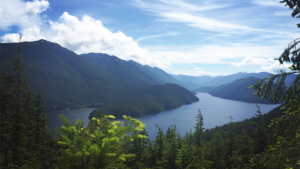
The 100,000 acres of watershed, which is almost twice the size of the city of Seattle, are kept free of agricultural, industrial and recreational activities, and it’s only accessible to the public through supervised tours. It’s managed by a team of experts, including water managers and environmental analysts, who make sure that the City’s water is clean, reliable and environmentally-friendly.
“[The water] starts from a pure source,” Constance said. “Because the land is protected and owned by the city and people are kept out, the land is clean. Whatever goes on the land ends up in the water.”
The watershed is dependent upon seasonal rains in the fall and winter to offset increased use of water in the spring and summer months. If the balance is disturbed, it could impact the ecology of the watershed, which has happened in the past.
Julie Stonefelt, Senior Public Education Specialist at Cedar River, acknowledges that climate change will continue to have an impact on the main source of Seattle’s drinking water, but maintains that, despite the challenges, SPU remains committed to balancing the water needs of its customers and the environmental impacts associated with increased demands.
To that end, SPU has implemented a Cedar River Watershed Habitat Conservation Plan (HCP), a fifty-year, ecosystem-based project meant to “protect and restore habitats of 83 species of fish and wildlife that may be affected by the City of Seattle’s water supply and hydroelectric operations on the Cedar River.
“There’s a certain amount of water that has to stay in the watershed legally for fish and for Lake Washington,” Stonefelt said. “Our system was built on the assumption that every year we will have these huge snowpacks that will slowly melt and refill our system. We all know that that’s changing.”
But Stonefelt said SPU is already preparing to combat the potential effects of climate change.
“Some of the options they’re looking at are making sure our system is connected to Tacoma and Everett,” Stonefelt said. “We also have additional water rights on the Tolt River that we aren’t tapping. We could potentially draw more water from there.”
Stonefelt believes the watershed is the history and future of this city. She relishes the memory of the civic duty that Seattle exercised after the Great Seattle Fire of 1889 – that saw 25 city blocks burned down, including the entire downtown business district, because volunteer firefighters could not maintain enough water pressure to extinguish the fire — to take control of the water supply and establish the watershed.
“Aside from the Great Fire, one of the prime reasons Seattle came out here is because they [the city of Seattle during the 1800’s] were using water from Lake Washington that was contaminated by industrial pollution and human waste,” Stonefelt said. “Regardless of whatever else is happening in the country, our drinking water is from a source where we control all of the land, so we can control the quality of the water.”
Today, Seattle is the only municipality in the nation that owns a watershed. It took the city one hundred years to acquire this land from homesteaders, railroads and company towns. Money and effort that many believe was well-spent.
While the city of Seattle has other water rights that it can tap into, officials with SPU believe that future generations should benefit from the natural resources that were inherited from predecessors.
“Part of what’s special about [the Cedar River] is that one hundred years ago, the people realized we have to protect this land for the future,” Stonefelt said. “We get to be the recipients of that big vision. So now we’re looking at how we can protect it for the future while facing different challenges.”
The Cedar River Watershed has seasonal tours for those wishing to visit the facility. More information is available on the city of Seattle’s website by searching for “watershed tour”.