
This article is one of a series of articles produced by Word in Black through support provided by the Chan Zuckerberg Initiative. Word In Black is a collaborative of 10 Black-owned media outlets across the country
By Aaron Allen, The Seattle Medium
There has been a growing demand for public schools to address the need for more trade occupation learning—not only in art, music, and STEM but also in auto shop, welding, and carpentry.
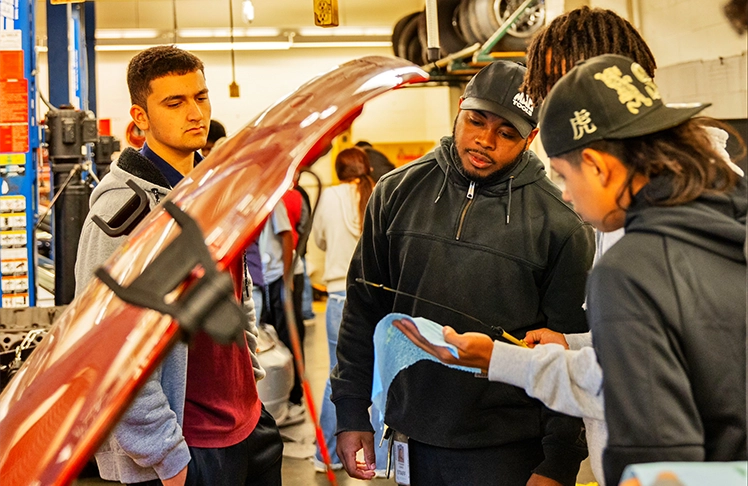
Kent Meridian High School’s Tyshon Jones, who teaches auto shop, emphasizes the importance of learning a trade, especially given the current job market post-pandemic.
While auto shop and the culture created in his classroom might not be for everybody, Jones believes that schools need to see the true value in programs like his and not use them as a placement center for students who don’t excel in traditional academics.
“I have to collaborate with my principal, other administrators, and with school counselors because they think it’s a class that anyone could just get thrown into. It’s not. This is a class,” says Jones. “If you’re interested and like to participate in hands-on activities, then come take this class. If you’re interested in learning what I have to give you or sharing my passion for cars with you, then come take this class.”
For Jones, the program is not just a single class; it’s a pathway to a career.
“Right now, it’s a trade credit that every kid can use to graduate, and every student needs to graduate,” Jones continued. “So, anyone could take the class. But I do have advanced classes where you’d have to take auto technology year one to get into auto technology year two or three.”
David Radford, Principal at Kent Meridian, is a firm supporter of Jones and his work in auto mechanics and Career and Technical Education (CTE), offering students opportunities outside the traditional educational environment.
“Mr. Jones’s Auto Shop class is a wonderful place where students can learn and practice skills that lead to a career as an auto technician,” says Radford. “Mr. Jones’s extensive experience in the industry means that he can lead students through developing skills they can take into the workplace using current auto industry standards. For students who may not be interested in auto mechanics as a career field, they learn appreciation and understanding of how to work with motor vehicles, solve real-life problems, and gain knowledge and skills they can utilize outside the classroom.”
Jones, 26, is a graduate of Kent Meridian High School. His experiences in auto shop classes there prepared him for the automotive technology program at South Seattle College and a professional career as an auto mechanic. Now, he has come full circle as a teacher at his alma mater, which he says is a blessing.
Beginning with the Class of 2020, some public schools have provided students with the opportunity to participate in a CTE program, a sequence of courses that provides a pathway to graduation.
Even though his course is non-traditional, Jones says that subjects like English and math are embedded in the curriculum to ensure students meet requirements in these fields to earn their high school diplomas.
“Classes such as this prepare students to be ready for success in postsecondary education, gainful employment, and citizenship, and equip students with the necessary skill sets to succeed,” says Jones.
According to the Bureau of Labor Statistics, there are many benefits to people who learn a trade. In addition to career growth potential and a pathway to retirement, 83% of tradespeople report being satisfied with their choice of career.
“CTE courses allow students to experience the breadth and depth of several different industry career fields, explore career interests, and gain exposure to potential career fields that would be difficult to obtain outside of school,” says Radford. “Through CTE programs, our students can also build connections with industry experts and recruiters that have the potential to lead to job opportunities in the future.”
Jones has built his curriculum from the ground up, similar to how he teaches students to rebuild engines.
“When it comes to curriculum, I’ve been building the curriculum from the ground up since I started,” says Jones. “Being in the industry a long time, I pulled several different resources such as auto wrecking or Kia, where I worked for several years.”
“This year I partnered up with Ford Motor Company,” Jones adds. “They have what is called the Ace program, which is an online-based curriculum that Ford technicians use to get their certificates through Ford.”
Many students don’t have someone in their community or family to teach them the basics of car maintenance, and Jones finds joy in helping his students learn the fundamentals of mechanics and other essential skills.
“In Kent’s climate, it’s a really diverse school,” says Jones. “A lot of these students don’t have father figures or uncles or grandfathers in their life, so they don’t know how to change a tire. They don’t know how to do a brake job. So, we learn that at school.”
Twin brothers Jackson and Devin Esemann are seniors participating in the Auto Shop and the Boeing Pre-Employment Training Program (BPET), where they have both secured career opportunities at Boeing upon graduation. They believe in the importance of the knowledge and skills they acquired in Mr. Jones’s class.
“I feel like it’s very important as it teaches you just general life skills,” says Jackson. “Stuff that you could use in the future that we go over, how to check your fluids, oil changes, your brakes, stuff about tires. It’s all the very important stuff you need in the future.”
“To piggyback on what Jackson said, it’s good to learn life skills and all that,” says Devin. “Like, you’re stuck in a situation and find yourself having to change your tire and I think it’s a good class to get out of the classroom every once in a while and get your hands dirty, you know.”