By Aaron Allen, The Seattle Medium
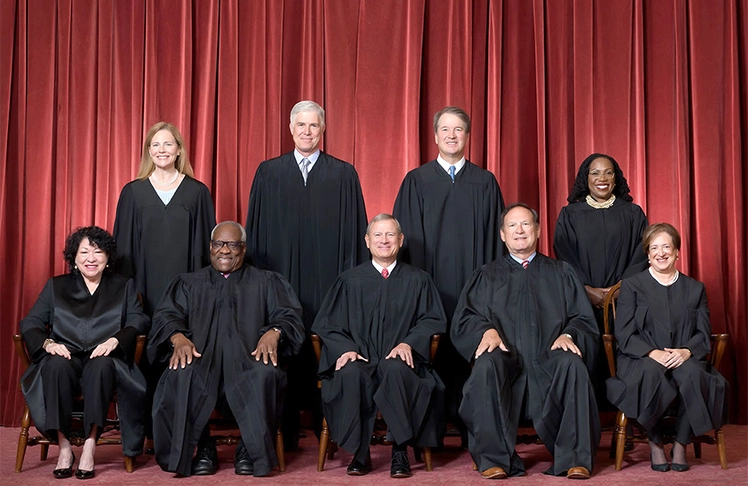
In a 6-3 decision in Vasquez Perdomo v. Noem, the U.S. Supreme Court granted an emergency request from the Trump administration, temporarily halting a lower court’s order that had blocked federal immigration agents from conducting street patrols and detaining individuals based on appearance, language, or perceived immigration status. The ruling, issued on the court’s shadow docket—a process that allows decisions without full briefing or oral arguments—overrides decisions from both a Los Angeles federal court and the 9th Circuit Court of Appeals, which had found the practice amounted to illegal racial profiling.
The unsigned order now gives immigration agents broad latitude to stop and question people based on race or ethnicity, sparking outrage from civil rights advocates and legal experts who warn the ruling opens the door to race-based policing and undermines foundational constitutional protections.
“This decision allows ICE to racially profile Latinos in the Los Angeles area, or even just people that ICE think are Latinos, whether they’re citizens or noncitizens alike,” said Washington State Attorney General Nick Brown. “In the short term, it targets specific communities. But in the long term, it opens the door to race-based policing across this country. It has the real likelihood of creating a constant state of fear in communities of color.”
The decision comes as House Republicans voted down an amendment introduced by Rep. Pramila Jayapal (D-Wash.) that would have explicitly prohibited Immigration and Customs Enforcement (ICE) from detaining or deporting U.S. citizens under any circumstances. The failed amendment adds to growing concern that U.S. citizens of color could be swept up in ICE enforcement actions without due process.
Although the Constitution does not explicitly forbid racial profiling, several amendments offer legal protections:
• The Fourth Amendment protects against unreasonable searches and seizures, with courts historically ruling that detaining individuals solely based on race violates this protection.
• The Fourteenth Amendment’s Equal Protection Clause forbids racial discrimination and provides a foundation for challenging profiling policies.
Legal challenges, including those targeting New York City’s stop-and-frisk practices, have succeeded on these grounds. However, the Supreme Court’s decision in Noem v. Perdomo signals a potential shift in how these protections are applied.
Seattle Mayor Bruce Harrell responded firmly to the ruling, saying the city is prepared to resist enforcement efforts that violate civil rights.
“Having read that decision, I strongly agree with the dissenting opinion. That’s one reason why we’ve invested heavily in legal defense dollars to protect people’s rights,” Harrell said.
“We know under RCW 49.60—our state laws against discrimination—that race-based enforcement is unlawful. We’re not required to cooperate with ICE efforts in our cities. So we believe we have strong legal footing to ensure our immigrant and refugee communities are protected. And as mayor, I am fully committed to upholding those protections,” he added.
The broader implications of the ruling are not limited to immigration enforcement. In April, former President Donald Trump suggested deporting U.S. citizens convicted of violent crimes to El Salvador, raising further concerns about how citizenship and civil liberties might be eroded.
“I think that we definitely find ourselves in a place where there is a slippery slope toward second-class citizenship and also a second-class human existence,” said civil rights attorney James Bible. “This decision is inconsistent with what we’ve traditionally understood to be constitutional rights in America. It’s inconsistent with treating all people equally and affording folks due process of law.”
Justice Sonia Sotomayor, one of the three dissenting justices, delivered a pointed rebuke in her dissent: “Rather than stand idly by while our constitutional freedoms are lost, I dissent.”
King County Councilmember Teresa Mosqueda, an active member of the National Association of Hispanic County Officials (NAHCO), joined the organization in publicly condemning the ruling.
“The Supreme Court has opened the door for the profiling of Americans,” NAHCO’s statement read. “This ruling allows immigration officers to question people based on factors like race, language, or type of employment. It’s a direct threat to the civil liberties of millions.”
Bible says that for many Americans, especially Black and brown communities, profiling has never been a future concern; it has always been a reality.
“I think it absolutely already is the reality,” said Bible. “I don’t think that it’s just potential to expand. It became more of a reality for others the moment that the ruling was made.”
“So, without question, there will be people of all races that end up in a space where they are profiled—unless they happen to be white,” Bible added. “In this particular environment, it typically, and most often, impacts Black and brown folks.”
Attorney General Brown echoed the sentiment, calling the court’s decision not just legally flawed, but morally damaging.
“It is a shameful decision,” said Brown. “It basically says that people of color in the United States of America, regardless of their citizenship, are second-class citizens in the eyes of the law.”
“And I do think it’s important in these moments to pause—to think about the things that we are seeing on the national level, from the president, from the Supreme Court, and others. We need to understand the impacts of these decisions—not just now, but for future generations,” Brown continued. “But we in this office are doing everything that we can to track these decisions, to track the actions from the President of the United States.”