When Rev. Dr. William Alexander Lawson and 13 faithful companions gathered in 1962 to form Wheeler Avenue Baptist Church (WABC) in Houston’s Third Ward, they did so rooted in the spirit of social justice — strengthened by the company of Dr. Martin Luther King Jr., whom Lawson welcomed when others turned their backs on King’s vision of justice. Justice was never an addendum to their ministry; it was, and remains, central to their work — just as it was for Jesus, in whose name the faith is held.
It is no surprise, then, that the plight of the “least of these” is at the center of every bit of ministry that flows from Wheeler Avenue, now led by Rev. Dr. Marcus D. Cosby.
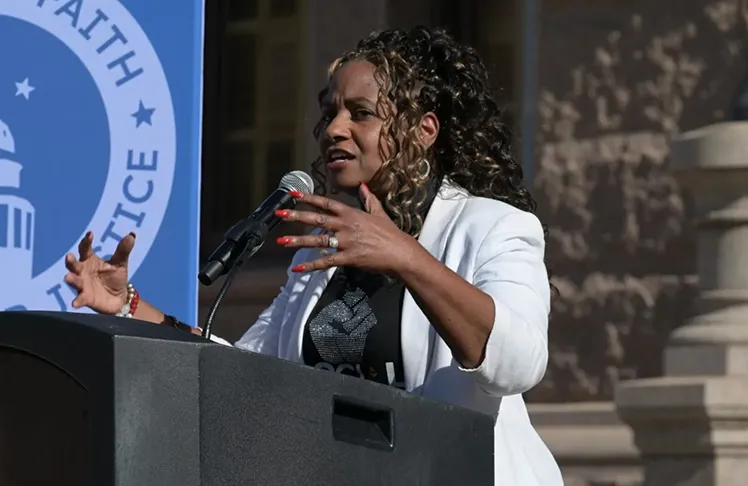
It’s also no surprise that Rev. Angela Ravin-Anderson, WABC’s director of social justice, stood her ground on July 29 and testified before the House Select Committee for Redistricting in opposition to their “attempt to silence our voice and take our power by racist gerrymandering,” as she wrote on her Instagram page.
“Our governor, instead of abiding by the constitution, wants to give the president five new Republican districts before the midterm election by decimating districts that have been the seed and foundation of power for Black and Brown communities throughout Texas,” Ravin-Anderson wrote.
Ravin-Anderson tells Word In Black that the pillars of democracy — and the communities WABC serves — are under siege. But despite the political climate in Texas and nationally, the Black church, she says, will always hold the line.
A Lack of Moral Fortitude
The way redistricting was added to the state’s special legislative session — not as a priority from lawmakers, but at the urging of former President Trump — “smacks of when he was losing and called Georgia, and asked for 11,000 more votes,” Ravin-Anderson says.
In that Jan. 2021 instance, Georgia Secretary of State Brad Raffensperger “had the moral fortitude to stand and say, that doesn’t happen. I can’t do that,” she says. “Unfortunately, what we’ve had here in Texas is someone willing to bow down to that.”
She points to the way the issue of redistricting was introduced into the legislative process.
“This was not an agenda item for the Texas House. It was added even after the special session was announced, and it was added to the agenda at the behest of the president,” she says.
And the consequences, she says, were clear — and targeted.
“What’s interesting about it is in the enactment of following these wishes, the areas that were targeted were the Black and Brown districts that have traditionally been seats of power for our voice.”
It’s a move that strips vital resources from these communities — districts that “were either contracted so that they’re much smaller and tighter,” or the “economic engines were removed,” she says.
Does Government Work for Us?
The need for Ravin-Anderson’s testimony is even more concerning because if the Supreme Court hadn’t removed protective sections of the Voting Rights Act of 1965 and if the John Lewis Voting Rights Advancement Act of 2025 had been passed, Texas leaders would have had to seek approval from the Department of Justice for this move.
It’s the one thing that most disappoints Ravin-Anderson about the Biden administration, that President Biden didn’t use the tool of executive order to enact the John Lewis Voting Rights Act.
“We wouldn’t be in this place had he done that, and a lot of people really don’t understand why this is so important at this time,” she says.
Now “the trust of the people has been broken,” she says. “The government is supposed to work for us, we the people, and that is not the case. And specifically for Black and Brown communities, it is especially not working. It’s harming us. And when there is an intentional decision to use government to hurt us, that is very traumatic.”
The Collapse of Democracy
Ravin-Anderson says what’s happening in Texas isn’t just policy — it’s a slow-motion unraveling of democracy itself.
“We are scrambling to utilize whatever methods we can employ through our democratic means,” she says. “What we are seeing is what happens when a nation’s democracy collapses. What I did not realize is that for a democracy to exist, the players must desire for a democracy to exist. And there are certain things that are understood as the rules that are going to govern us, and we are going to abide by those rules.”
But now, she says, those rules are being rewritten — or discarded entirely.
“We now have a situation where we see there’s no desire for democracy to exist. There’s a desire for an authoritarian government to exist. There’s a desire for an oligarchy to exist. And so now we have a tiered tearing apart at the very fabric of our country.”
In the face of that unraveling, however, one institution remains central to community resilience and resistance: the church.
Standing for Justice
WABC has, in 62 years, expanded into a 12,000-member congregation with far-reaching arms through as many as 72 ministries, including Matthew 25, which helps members with food and emergency housing needs. Indeed, the neighborhood needs constant attention and care.
“It’s an urban area in Houston, and it has experienced all the trauma that urban areas experience. So it keeps us on the front line of what goes on,” she says. And “in a time where we experience increasing inflation, we know that that’s going to be an issue for those who are in our neighborhood.”
No matter what the Trump administration or the Texas legislature does, the church’s identity will always be rooted in spiritual principles and action.
“To stand for justice, to stand for the disenfranchised, to speak out when we we see that things are not in the public sphere, when we see that things are not being done in a fair and just manner for all the people,” she says, “but especially for our community where we’re planted, which is the heart of Third Ward.”