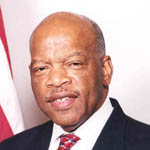
By John Lewis
NNPA Guest Columnist
[Rep. John Lewis’ testimony July 17, 2013 before the Senate Judiciary Committee in the aftermath of the U.S. Supreme Court’s decision in the Shelby v. Holder case that invalidated Section 4 of the Voting Rights Act of 1965.]
Since first being elected to Congress, Congressman Sensenbrenner has been a tireless champion of the Voting Rights Act. I am very proud and pleased to be with him here today.
I’ve said it before, and I say again to you today that sections 4 and 5 are the heart and soul of the Voting Rights Act. The day of the Supreme Court decision broke my heart; it made me want to cry. I felt like saying, “Come, come and walk in the shoes of people who tried to register, tried to vote, but did not live to see the passage of the VRA.”
I know that each of you knows this history, but I think it is important for the record to note what life was like before the Voting Rights Act of 1965. When I first came to Washington, D.C. in 1961, Blacks and Whites could not sit beside each other on buses in Virginia, in North Carolina, in Georgia. We saw signs that said, “White Only. Colored Only.”
In many parts of this country, people were denied the right to register to vote simply because of the color of their skin. They were harassed, intimidated, fired from jobs, and forced off of farms and plantations. Those who tried to assist were beaten, arrested, jailed, or even murdered.
Before the Voting Rights Act, people stood in immovable lines. On occasion, a person of color would be asked to count the number of bubbles in a bar of soap or the number of jelly beans in a jar. In 1964, the state of Mississippi had a Black voting age population of more than 450,000, but only about 16,000 were registered to vote. One county in my native state of Alabama – Lowndes County –was 80 percent African American, but not a single one was able to register to vote. Not one.
Selma is located in Dallas County, Alabama. During this period, only 2 percent of African Americans were registered to vote in this county, and you could only attempt to register on the 1st and 3rd Mondays of the month. Occasionally, people had to pass a so-called literacy test.
Before the Voting Rights Act, three young men I knew – James Chaney, Andy Goodman, and Mickey Schwerner – were working to register African Americans to vote in Mississippi in 1964. They were arrested and released from jail to members of the Klan in the middle of the night. Then they were beaten, shot, and killed.
On March 7, 1965, Hosea Williams, a staff person for Dr. Martin Luther King, Jr., and I attempted to lead a march from Selma to Montgomery. As we marched for the right to vote, more than 500 men, women, and children were chased, beaten, bloodied, and trampled by state troopers. That terrible day became known as Bloody Sunday.
A little over a week later, President Lyndon Johnson came before a joint session of Congress and spoke to the nation. He said, “I speak tonight for the dignity of man and for the destiny of democracy.” And he presented the Voting Rights Act to Congress.
After months of hard work, Congress passed the bill. On August 6, 1965, President Johnson signed the VRA into law and gave me one of the pens he used. I remember this period, and these struggles like it was yesterday. To this day, I truly believe that we are better country, a better people because of the Voting Rights Act.
We have made progress. We have come a great distance, but the deliberate, systematic attempt to make it harder and more difficult for many people to participate in the democratic process still exists to this very day. Only hours after the decision was announced by the Supreme Court — before the ink was even dry — states began to put into force efforts to suppress people’s voting rights.
In a democracy such as ours, the vote is precious; it is almost sacred. It is the most powerful nonviolent tool we have. It is my belief that the Voting Rights Act is needed now more than ever before.
A bipartisan Congress and Republican Presidents worked to reauthorize this law four times. The burden cannot be on those citizens whose rights were, or will be, violated; it is the duty of Congress to restore the life and soul to the Voting Rights Act. And we must do it on our watch, at this time.
Rep. John Lewis, former chairman of the Student Nonviolent Coordinating Committee (SNCC), represents Georgia’s 5th District in Congress.