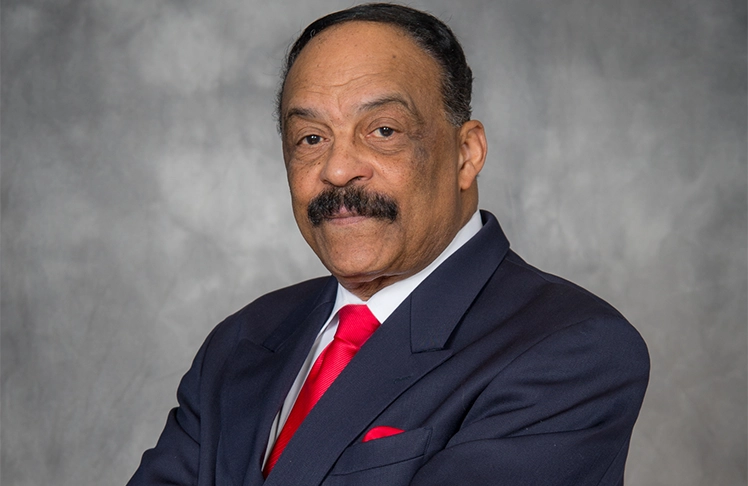
“I have a problem with the firm because people within it are not from Seattle or this state... This work needs expertise in government policy, local history and community engagement to connect with those impacted the most.”

— Eddie Rye
By Aaron Allen, The Seattle Medium
A state‑funded study on reparations for the descendants of enslaved Africans in Washington is drawing criticism after the Washington State Department of Commerce named a consulting firm as the Apparent Successful Bidder, prompting some Black community leaders to question the firm’s qualifications, its ties to the region, and the process utilized by the state to make good on its promise to conduct the study.
Just before the Thanksgiving holiday, Commerce announced the provisional selection of Truclusion, a Dupont-based consulting firm, to conduct the Charles Mitchell and George Washington Bush Study on Reparative Action. The 2025 legislation authorizing the study calls for a comprehensive examination of historical injustices and their lasting impact on descendants of enslaved Africans living in Washington. The study will examine how state laws and systems affected descendants in economics, education and criminal justice and propose reparative measures. Key deliverables could include proposals for cash payments, policy reforms, state-level investments, and recommendations for reforming harmful laws — all backed by cost‑benefit analyses. The preliminary report is due June 2026 and a final report is expected by June 2027.
Former state Representative Jesse Wineberry, a primary proponent of the reparations study, says that the Apparent Successful Bidder (ASB) designation is part of a statewide contracting practice designed to account for potential challenges during the protest period. He noted that, based on past experience, the initially announced bidder often changes once the protest process concludes. Under state procurement rules, firms not selected as the ASB have three days to request a debriefing, followed by another three business days to submit a formal protest. Wineberry described this period as a critical safeguard, allowing unselected bidders and their supporters an opportunity to challenge the evaluation process.
Commerce spokesperson Amelia Lamb confirmed no contract has been awarded, and that the ASB designation does not equate to a contract award.
“The designation of an Apparent Successful Bidder is not a contract award, and no contract has been executed,” Lamb said.
Lamb also said the agency must maintain confidentiality to preserve the fairness of the procurement process, and that additional information will become public only after the protest period ends and the procurement is finalized.
According to its website, Truclusion is company that is majority-owned and majority-managed by BIPOC women based in Dupont, Washington. While approximately four of the company’s core staff appear to be African American or of African descent, some community members claim the company lacks strong cultural and regional connections. While the company does appear to be minority-owned, it does not appear to be Black-owned. That assertion, according to critics, raises concerns about whether Truclusion as the ASB truly reflects the communities most directly affected by the study.
Even though it appears that the primary researchers of the firm are Black women, some community members have concerns about their ties or knowledge of the local landscape, because it appears that they may live outside of the state.
“I have a problem with the firm because people within it are not from Seattle or this state,” says long-time community activist Eddie Rye
In addition, Rye claims that two of the consultants have degrees in fields he believes do not align with the historical, genealogical, and policy analysis required for a reparations study.
“This work needs expertise in government policy, local history and community engagement to connect with those impacted the most,” Rye said.
Wineberry echoed the concerns about statutory alignment.
“Do they meet the qualifications the Legislature and governor mandated for a statewide study? From what I can see, they [appear to fall] short,” Wineberry said.
Still, Commerce and the Washington State Commission on African American Affairs (CAAA) insist the selection followed the law. Lamb said the CAAA assembled an independent scoring team to evaluate proposals against the criteria outlined in the solicitation. She said confidentiality and fairness were maintained throughout the bidding and evaluation process.
Supporters of the study maintain the initiative represents a meaningful step toward acknowledging generational harms and exploring reparative justice. The proposed methodology draws on a social determinants of health framework modeled after Healthy People 2030 to assess how historical injustices affect current disparities in health, education, housing and criminal justice. Proponents believe the resulting report could support evidence‑based reparative policies.
Initial funding of $300,000 came through Engrossed Substitute Senate Bill 5167 (ESSB 5167), sponsored by Bob Hasegawa (D‑Beacon Hill). After the state allocation, The Washington Equity Now Alliance was able to secure additional funding from both King County and Pierce County — $300,000 from King County and $150,000 from Pierce County.
“Our goal was to provide the contractor a robust budget,” said Wineberry. “King County’s unanimous vote added $300,000. Then Pierce County provided another $150,000 after Thanksgiving. That doubled the original allocation.”
In testimony to the Senate Law and Justice Committee, Hasegawa called the study vital for addressing generational inequalities.
“We understand the magnitude of this problem and how generational wealth has been stolen,” Hasegawa said. “This opens the door to a much larger conversation about reparations and ensuring equal opportunities for future generations.”
Despite broad political and financial support, many community leaders remain unsure whether or not the ASB can meet the demands of a thorough, statewide reparations study. Critics argue awarding the ASB to a firm with limited local presence and consultants whose expertise lies outside relevant fields undermines confidence in the study’s legitimacy. This might be a minor point for some, but many activists in the community, who fought very hard to get funding for the study allocated through the state and various local municipalities, feel betrayed by both the process and the system.
For now, the ASB designation represents a tentative but important milestone. The coming months will determine whether the contractor selection stands, whether the contract is finalized, and whether the state’s reparations study can deliver on its ambitious promise of justice and equity. A task that is monumental regardless of the firm that is selected to conduct the study.
Editor’s Note: The Seattle Medium contacted the Department of Commerce prior to press time with additional questions about how long the protest period will last, what happens during and after that period, details on contract amount including county supplements, and what information will be released when procurement is finalized. However, Commerce had not responded prior to press time.