By Dany Villarreal Martinez, The Seattle Medium
For a long time, the archival files of oral history of Black Americans in the Seattle area were tucked away in the Black Heritage Society of Washington State in Seattle. But the gaps were apparent. Stories of the people from the Central District, to the waterfront and throughout Seattle needed to be more fully captured. .
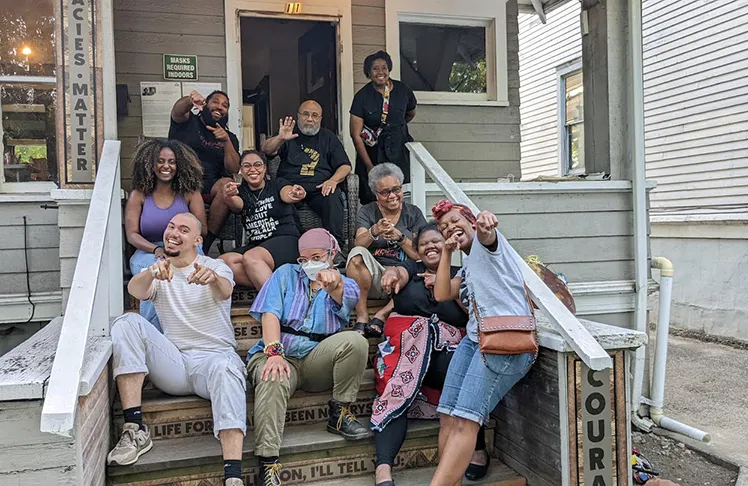
Enter Jill Friedberg and Inye Wokoma, two of the four founding members of Wa Na Wari.
“We found that there was a lack of community capacity for doing community-based oral history and community memory work more generally,” Friedberg said.
Friedberg, along with Zola Mumford, founded the Seattle Black Spatial Histories Institute (SBSHI) to train others to collect these stories before they succumb to time.
The mission of the SBSHI, Wa Na Wari’s paid community story-training program, is to record and preserve Seattle’s Black history. SBSHI grounds the program in the Central District, a historically redlined neighborhood. This is in tune with Wa Na Wari’s anti-displacement mission, according to Sierra Parsons, who is training under SBSHI leadership and was a part of the first cohort in 2021.
“We want to ground the importance in things that are being erased,” Parsons said. “People’s connection to small businesses, and cultural institutions, and their homes— all of those places have to be grounded in spatiality when we’re using the practice of oral history.”
Fellows form a cohort that spends their first year training with oral historians from around the country to become experts in archival research, interviewing methods and transcription techniques.
During their second year, they pitch and complete a public-activation project, in which they “activate” the stories they have gathered from community members, or narrators, by incorporating audio interviews into an interactive form. Wa Na Wari periodically showcases these activation projects.
Each cohort member is free to explore different art mediums for their public-activation project, and present them independently. A full-group exhibition is planned for January 2026, with location to be determined.
It takes about $200,000 to run the SBSHI program for two years, according to Parsons. The second cohort is funded primarily by a Mellon Foundation Grant. The money pays for guest faculty and cohort members. Each cohort member receives a stipend of $10,000 over the course of two years.
Additionally, Wa Na Wari provides a small honorarium to narrators, something unique to oral history practices.
“It’s that balance of honoring their time and also not paying for a particular product or outcome because it really is up to the narrator to take the story wherever,” Parsons said.
Troy Landrum Jr. is a cohort member. In addition to oral-history work, he is a freelance journalist and works full-time at a nonprofit called Choose180, which helps young people faced with court cases.
“It would be beautiful if we could get paid a living wage to do the things that we love,” Landrum Jr. said. “To do art and to build community like we love doing, but it’s about balance.”
Nacala Ayele is another member of the second cohort. Ayele is a joy-actualization coach and works with Black, Indigenous, and people of color to “design their lives around the things that bring them most joy,” she said.
Ayele wants all types of stories to be recorded, “not just the horrific ones, not just the ones that are about scripted bias,” Ayele said. “We want the richness of our stories to be told, and they are very diverse.”
Above all, cohort members are trained to find opportunities to “interview folks who have primarily been taken out of the stories of history,” Landrum Jr. said.
Finding these people has presented its own challenges, though community members overall have been receptive to speaking with an oral historian. And some luck helped, too, according to Landrum Jr.
The cohort members use Zoom H5 Handy Recorders and lavalier mics. The equipment was provided by the institute and lent to cohort members, according to Parsons.
“After doing one interview, you couldn’t do another one for a while,” Landrum Jr. said. “You were tapping into this deep, deep listening that really took you into their stories and took a lot of energy out of you.”
He was assigned the topic of Black educators. He is putting together an interactive exhibit inspired by the second wave of the Great Migration, a period of relocation of six million Black Americans from the rural South to other areas of the country.
“This exhibit for me is inspired by my grandmother’s story,” Landrum Jr. said. “One of my grandmothers migrated from Kentucky to Indianapolis. She was an educator and made a huge difference in the Indianapolis public schools.”
Ayele’s topic is about Black experiences in the Seattle waterfront. Her project will combine themes of healing with water, which she says is a tribute to the living force of her narrators.
Additionally, Ayele is hosting a private session for Black women to listen to excerpts from the oral histories she recorded. She will include activities that will ”allow them to play around with some of the concepts that are presented in the story.”
Applications for the third cohort for the SBSHI have not been released, but the program will continue if funded.
“The number one challenge is that the Mellon Grant ends at the end of this year,” Friedberg said. “And so we don’t want to start cohort three until we know the entire two years is funded.”
But the one thing that will never disappear is the richness and power of a personal story, according to Landrum Jr.
“Some of the only things that we have is our story,” Landrum Jr. said. “And being able to share that with other people is one of the most valuable things that I believe a human person has.”