By Anthony Smith, The Seattle Medium
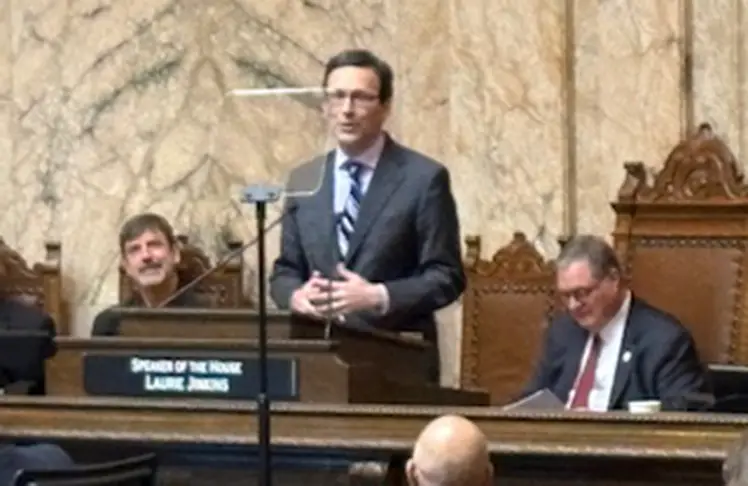
On Tuesday, senators, representatives and media members packed the House chamber to hear Gov. Bob Ferguson address his priorities for the state budget.
Despite the economic struggles on both the state and national levels, Ferguson said that we continue to see growth in Washington state.
“The state of our state remains strong,” Ferguson said. “We have the ninth largest economy in the nation. We have the largest increase in the country in requests to form new businesses, people continue to move to Washington state. And soon the world will be coming here for the biggest sporting event of all, the FIFA World Cup.”
Even with these positive statistics, Ferguson acknowledged that there is a lot of work that needs to be done moving forward.
“I am clear-eyed about the areas where we must do better to keep our growth going,” Ferguson said. “Let’s get back to basics. Invest in our infrastructure, make our tax system more fair, and continue our progress on addressing the housing crisis.”
According to Ferguson, the state can no longer defer investments in our roads and bridges. Currently the state has 80 bridges that are classified as being in “poor” condition and ranks last among all states in the number of potholes that we have on our roadways.
“Our transportation infrastructure is in dire need of investment,” Ferguson said. “That’s why I propose historic investments to take care of our bridges. More than a billion dollars without raising taxes.”
In addition, Ferguson intends to address the growing concern of immigration agents in unmarked vehicles, and arresting people while wearing masks that cover their face.
Ferguson also addressed widespread concerns regarding immigration agents in unmarked vehicles arresting people while wearing face-covering masks. In response to the recent murder of Renee Nicole Good in Minnesota by an ICE
agent, Ferguson announced his support for Senate Bill 5855, which would ban law enforcement officers from wearing masks when interacting with the public. It would also require identification to be clearly displayed on their uniforms.
“[This action by ICE is] horrific, it’s unjust, and it needs to stop now. I’m angry about this, and I think many of you are as well,” said Ferguson. “Let’s get that legislation on my desk immediately so I can sign that into law.”
To help address the state’s budget deficit, Ferguson expressed his support of the proposed “millionaire’s tax,” which would institute a 9.9 percent levy on Washingtonians who make over $1 million in annual income. He cited an expansion of eligibility and increased funding for the Working Families Tax Credit as an example of where the revenue from the millionaire’s tax would go. He also called for a lowering of taxes for small business owners.
Ferguson’s budget also includes a one-time $200 utility credit for 125,000 households and allocates $33 million to expand the Low-Income Energy Assistance Program.
On education, Ferguson urged lawmakers to address Washington’s low FAFSA completion rate, which ranks 47th in the nation. Executive Order 2508, titled “Washington Completes FAFSA,” establishes an advisory board to help high schools boost submission rates. The board includes students to help tailor outreach to their peers.
“We rank 47th (out of 50 states) for families completing the FAFSA,” Ferguson said. “Improving our response rate is something all of us support.”
“Teenagers get their information in ways that adults like us don’t always understand,” Ferguson said. “That’s why our advisory group includes students to help us reach their peers.”
Ferguson encouraged his legislative colleagues to join in the effort, including offering to show up at local high schools and help the campaign.
“Positioning Washington for an even greater and stronger future is why we all serve,” Ferguson said.