By Kiara Doyal, The Seattle Medium
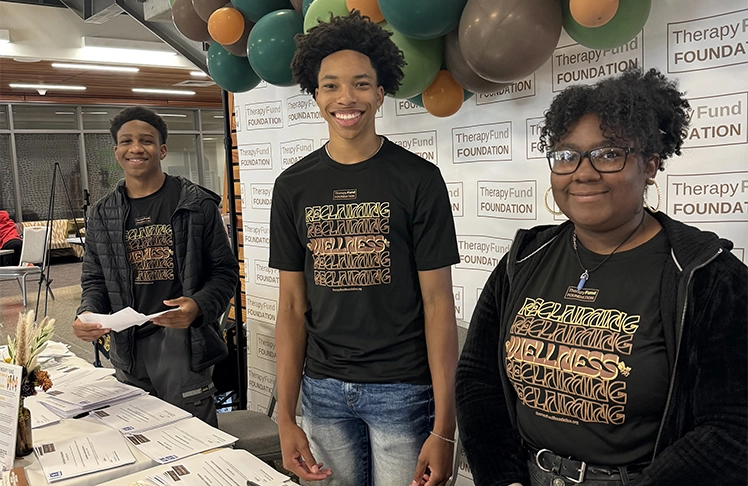
A growing number of young people in Washington are stepping into leadership roles to support mental health in their communities through the Therapy Fund Foundation’s Youth Mental Health Ambassador Program.
The Therapy Fund Foundation, a nonprofit committed to providing free mental health services, advocacy and education to Black community members across Washington state, offers a variety of programs, events and resources designed to support individuals and families. Through community partnerships, outreach and culturally responsive care, the organization works to expand access to mental health support and reduce long-standing disparities.
One of its key initiatives, the Youth Mental Health Ambassador Program, empowers young people to become advocates for mental wellness in their schools and neighborhoods. Ambassadors raise awareness, offer peer support and help reduce the stigma surrounding mental illness while connecting their peers to resources.
“It is specifically designed for youth. Anyone 25 and under can get trained in Mental Health First Aid and essentially be an ambassador in their schools and communities,” said Ashley McGirt, founder and CEO of the Therapy Fund Foundation. “Within that, we have different programs where we train them to be leaders, do leadership skills in the mental health field, and shadow actual clinicians and other professionals who work in mental health.”
McGirt said the Youth Mental Health Ambassador Program is central to the organization’s work and reflects its focus on supporting young people.
“Our mission is to eliminate barriers to healing in Black communities, and we can’t do that if we are not eliminating barriers to the things impacting our youth,” said McGirt. “It is core to it; it is at the forefront. We definitely value youth and prioritize them in our mission to eliminate barriers.”
McGirt said the program is also shaped by the community it serves, offering an approach to mental health that reflects lived experiences rather than traditional models.
“A lot of the time when we are talking about mental health and mental illness, it is from a Eurocentric lens using evidence-based practices that were not for communities that look like us,” said McGirt. “It is something that hasn’t been done before. We are literally the only Black-led organization that is focused specifically on eliminating barriers to healing within Black communities, which includes a primary focus on our youth, and that is why it is super necessary.”
Through the program, youth ambassadors take on active roles in their schools and communities, offering peer support and helping connect others to mental health resources.
“Each thing is different, but the main expectation is that they represent day to day,” McGirt said. “They are out in their schools or communities, listening, eyes open, ears open, paying attention, and providing resources. If they have a friend who is struggling or they see someone at their school, it depends on what they encounter.”
Ambassadors also participate in regular meetings and program activities designed to build leadership skills and deepen their understanding of mental health.
“They have monthly meetings and check-ins, and depending upon which subset program they’re working on, it would either be a monthly or quarterly meeting,” McGirt said.
Although the organization serves communities across Washington, the Youth Mental Health Ambassador Program has primarily operated in Seattle-area schools.
“The schools have varied,” McGirt said. “[The ambassadors] have been present in Rainier Beach, Garfield, Meany Middle School, and elementary schools in the Seattle area. We have also gone into Graham-Kapowsin High School in Puyallup and Lincoln High School in Tacoma.”
Cyanni Wilson, a senior youth ambassador at Graham-Kapowsin High School, said the program has had a meaningful impact on her life.
“I was able to collaborate with people my age and break generational cycles of trauma,” said Wilson. “I learned how to give back to my community and some skills I can take into the real world.”
McGirt said the organization has seen improvements in participants’ mental health based on results from the Patient Health Questionnaire-9, or PHQ-9, a screening tool used to measure levels of depression.
“We do a PHQ-9, so we are constantly checking their PHQ-9 scores and seeing their rates,” McGirt said. “From a mental health standpoint, many who had anger issues or suicidal thoughts shared that they are no longer feeling those things, and that they have been completely eliminated or a decrease in feelings of depression.”
Wilson said the program also shaped her perspective and future goals.
“Since I want to pursue a career in Psychology, the youth ambassador program has given me different opportunities and perspectives that others have,” Wilson said. “I always have had an interest in studying the human behavior of people in general and how certain groups can work as one.”
McGirt acknowledged that discussing mental health can be challenging for both youth and adults, and said the program is designed to help make those conversations easier.
“It can be difficult to have conversations about mental health, mental illness, and destigmatizing mental illness,” said McGirt. “I know we talk a lot about mental health, but for those who actually have a clinical illness, I want them not to have any shame or guilt or anything surrounding it.”