By Aaron Allen, The Seattle Medium
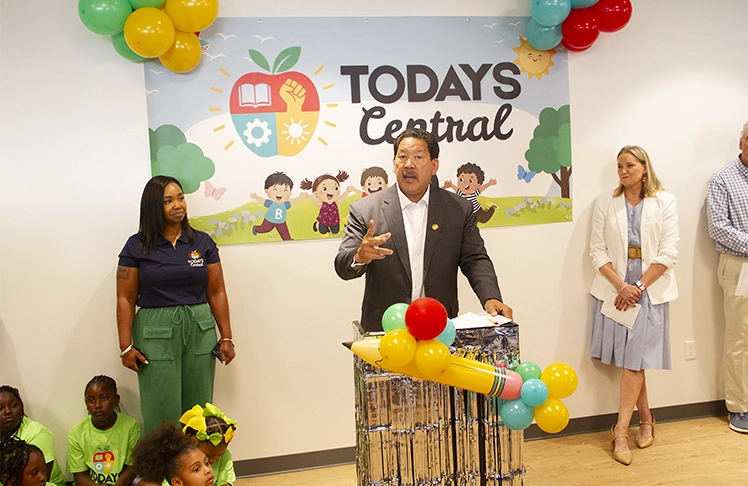
Last week, City leaders, private developers, educators, and community members gathered in Seattle to mark the opening of Rainier 900 and Today’s Central—two initiatives focused on affordable housing and youth development. The event included Seattle Mayor Bruce Harrell, King County Executive Shannon Braddock, A 4 Apple Learning Center owner Appollonia Washington, Peter Nitze of Nitze-Stagen, and representatives from Pinnacle Partners.
Rainier 900, a 396-unit mixed-income apartment complex in the Central District, is among Seattle’s largest privately funded housing developments. The building offers apartments priced for residents earning between 40% and 100% of the area median income, serving as a model for how private investment can contribute to narrowing the city’s affordable housing gap.
Mayor Bruce Harrell said the project aligns with the city’s broader housing strategy.
“The project symbolizes exactly our affordable housing strategy,” Harrell said. “We are here to make sure that we’re keeping people of color, African Americans, as well as individuals who can’t afford to live in Seattle, in Seattle.”
King County Executive Shannon Braddock addressed the significance of cooperation between local governments and private partners.
“I want to give a shout out to everything Seattle is doing to really try to make housing more affordable, bringing in childcare investments. It is truly remarkable, and they’ve been an amazing partner to King County,” Braddock said. “In King County our true north is to make King County a welcoming community where every person can thrive. And this is an example of that kind of action.”
The Rainier 900 project reflects priorities from Mayor Harrell’s One Seattle agenda, which includes reforms to streamline permitting multifamily housing developments. Harrell said the initiative aims to address housing needs alongside other community priorities.
There is an old saying, ‘killing two birds with one stone”. Affordable housing and a community-based learning center offer the Central District a solution to the region’s housing crisis, while addressing the needs of the community’s youth—giving them a head start in their academic and life journeys.
Today’s Central, a youth enrichment program launched by A 4 Apple Learning Center, also opened its new location inside Rainier 900. The program serves children ages 5 to 12, primarily from historically underserved communities, with activities focused on creativity, STEM learning, wellness, and cultural celebration.
Appollonia Washington, co-owner of A 4 Apple Learning Center, described how the center intends to support local youth.
“We are expanding A 4 Apple Learning Center’s brand, opening Today’s Central, tackling obstacles experienced daily by our amazing youth,” Washington said. “We want to support our youth at a greater capacity, making sure that they have a space where they can grow, thrive, and bond with their community members and fellow peers.”
Washington spoke about the center’s goals and the type of environment it seeks to create.
“So, we’re opening Today’s Central. We’re representing what Today’s Central is all about. Bringing STEM programming, bringing health, nutrition, activities. Just wanted a safe haven for our kiddies,” said Washington.
The vision for Today’s Central emerged from conversations with local families and youth.
“I sit in a lot of public safety meetings, and I hear the needs from parents and then I hear the needs from the youth, and so, this vision of mine was brought to life,” Washington said. “My team and I worked hard on it for about a year and I was like, oh my God, we’re here. So today we’re here and we’re opening our doors for Today’s Central to serve our community, the Central District.”
Peter Nitze of Nitze-Stagen spoke about the work involved in bringing the project to completion.
“It was a labor of love to deliver this, and I can tell you it was not easy, but we’re here today with this beautiful building around us,” Nitze said. “So, it can be done. It has been designed, and it is designed to meet many of the city and region’s transportation, climate change, small business, and housing affordability priorities—all of them critical priorities of this city and of our mayor.”
Nitze described how this project fits into the company’s broader efforts to serve community needs.
“The project, which is part of a larger portfolio of multifamily that with our partners and Nitze-Stagen have, is a great example of how private developers can help address the city’s affordable housing gap while serving as stewards for community park building, which is critically important to us,” he said.
The Seattle Office of Housing reported that 2024 marked significant progress in the city’s affordable housing initiatives. The nearly $1 billion 2023 Seattle Housing Levy provided funding for affordable housing projects in its first full year of implementation. Additionally, Seattle received $25 million in payments from developers to support affordable housing development. City housing programs helped 2,288 new households secure affordable homes last year, including 1,284 who moved into apartments that will remain affordable for at least 50 years. The city currently monitors more than 19,000 long-term affordable housing units.
Harrell said the partnerships behind projects like Rainier 900 are key to keeping Seattle accessible to all residents.
“These projects the city invests in with the county are exactly our strategy,” Harrell said. “We want Seattle to be affordable; we can do everything possible to keep it affordable.”