By Alexa Meyer, The Seattle Medium
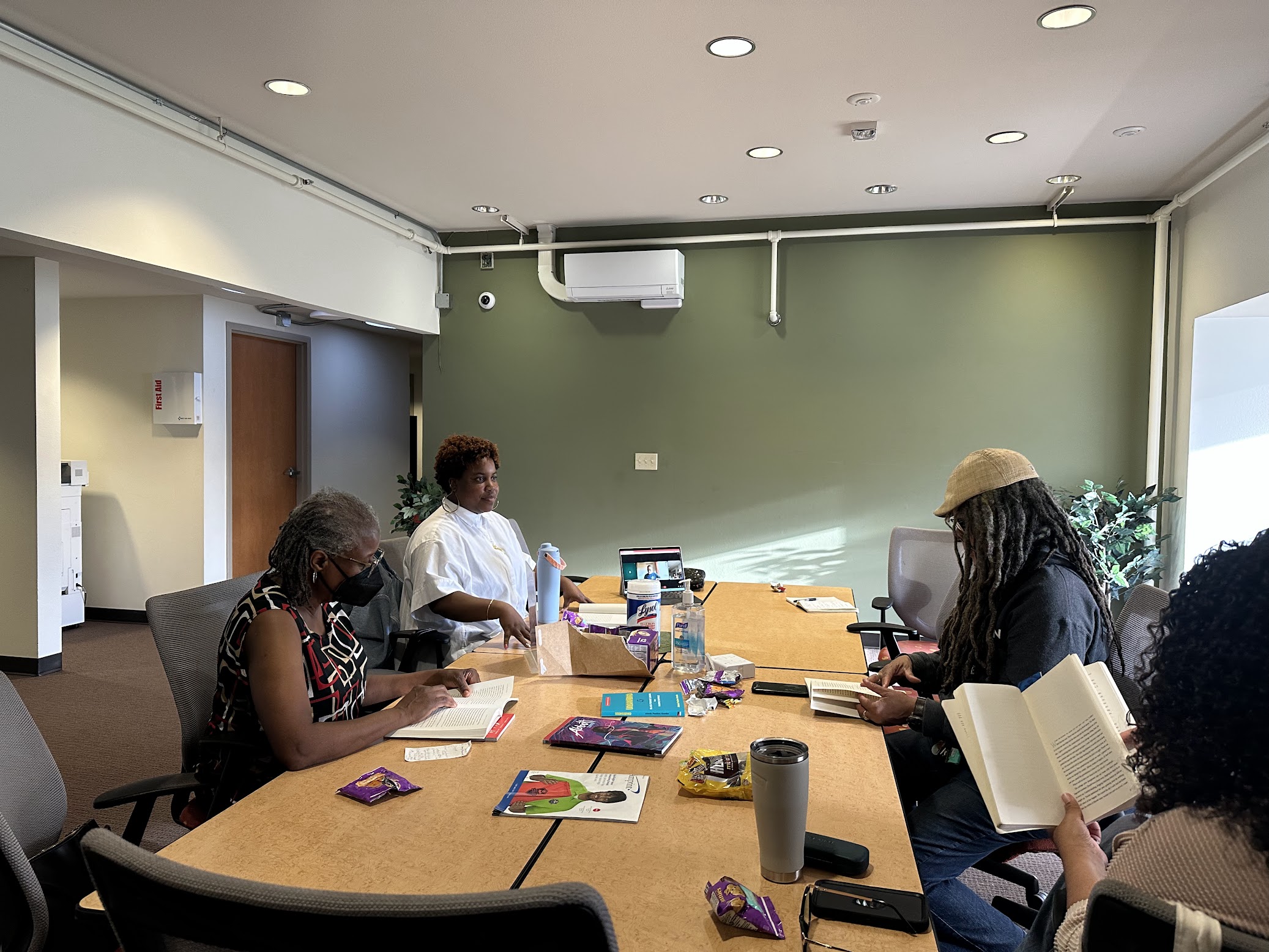
Every fourth Monday of the month, attendees of the “Black Futures Book Club” gather to discuss Afrofuturist literature, and whether there are two members or 15 — and whether everyone has read the whole book or just the first page — facilitator Brooke Bosley says she ensures a discussion full of exploration and growth.
“This is a space where you can dream and you can see yourself, and you can exist,” Bosley said over Zoom. “I think that’s the beauty of Afrofuturism. Some people call it too optimistic, or too utopian, but I feel like it just gives you tools and a framing to really navigate and figure out how you want to exist in the world.”
Hosted at Langston Hughes Performing Arts Institution, “Black Futures Book Club” gets its name from the concept of Afrofuturism, an imaginative framework that centers on Black culture, history and experience while incorporating elements of speculative fiction, science and technology. Mainstream examples of Afrofuturism include Ryan Coogler’s “Black Panther,” or the music of Janelle Monáe.
Afrofuturism goes beyond an aesthetic or genre. It functions more as a worldview and imaginative space where Black people envision futures centered on Black identity, agency and liberation, often imagining possibilities outside of colonial systems.
Bosley is an Afrofuturist and Black feminist scholar whose work is centered around building inclusive communities through design. “Black Futures Book Club” began primarily as a way to continue discussing Afrofuturism, which she focused on in her dissertation at Georgia Institute of Technology.
“I like to tell people it’s not a genre,” Bosley said. “It’s a methodology, it’s a toolkit, it’s a framework. It’s whatever you want it to be in, that moment, right? Afrofuturism is very much an expansive way that Black people are really thinking about how their histories and pasts can, really inform futures and help adapt for the present moment.”
Book club member Arena Manning shared how reading and discussing Afrofuturist literature has shifted how they envision their own life and connection with Black culture and community.
“Afrofuturism has made me think to not just be a passive participant in the world, but to be more active in what I think is beautiful and what I set my intention on,” Manning said.
Bosley moved to Seattle in 2023 from Atlanta. She founded the book club in October 2023 at the Loving Room, an independent Black-owned bookstore and community space in the Central District, where the book club ran until the physical location of the Loving Room closed in October 2024. Bosley spent the next five months looking for a new location, basing her search on the organization’s alignment with the values of the bookclub.
Bosley was initially drawn to Langston because of the Seattle Black Nerd Festival, a weekend that celebrates Black creativity across literature, gaming, comics and more. Langston agreed to partner with Bosley and incorporate the book club into their scheduled programming. This year, 2026, marks the book club’s first full year of programming.
The 12 books scheduled for 2026 cover a wide range of form, genre and content. Alongside discussing more well-known Afrofuturists like Octavia E. Butler, one of Bosley’s goals is to introduce people to up and coming Afrofuturist authors.
The club is open to anyone who wants to discuss the literature, no matter their background or prior experience with Afrofuturism. While Bosley comes into each meeting with a set of general questions about the book, members organically lead the discussion based on what resonated with them. Oftentimes, what stands out the most to Manning are stories from members themselves.
“I think when we talk about the content of the book, it’s insightful, but I think what I enjoy most is when people start talking about their own lives and–real world implications of how the books alter our own perceptions of our lives,” Manning said.
This month , the club read “Love After the End: An Anthology of Two-Spirit and Indigiqueer Speculative Fiction” by a variety of authors. At their meeting, attendees passionately discussed their reactions to the stories while they passed around bags of candy and snacks. The group resonated with the resiliency of marginalized groups who have already experienced the apocalypse of colonization.
Bosley’s gentle leadership of the discussion of “Love After the End” allowed multiple generations to grapple with their own ideas on accessibility of creativity and imagination for people of color in the United States.
“One of the things that I’ve loved recently is that we have a lot of intergenerational folks coming in,” Bosley said. “We’ll have people who are in their 60s, then people who are in their early 20s, and I think those conversations have just been the best, because everyone’s learning from each other and everyone is able to debate about a book in a good way.”
Bosley said the connections have moved beyond the monthly meeting.
“One thing that’s made me kind of just light up is the friendships that have flourished out of the community; that we have people hang out with each other outside of the book club,” Bosley said.
“People have been able to meet other people through the book club, go to events that they wouldn’t have gone to beforehand or read things that they wouldn’t have at first or interact with folks that they may not talk to on a daily basis,” she said.
“I think that right there just speaks to the community and space that we’ve created, that Langston has allowed us to create. And I think it also just speaks to what people are in need of right now, in the moment.”
While “Black Futures Book Club” has five formal meetings left in 2026, Bosley is working on extending the programming into 2027 and beyond.