
By Kiara Doyal, The Seattle Medium
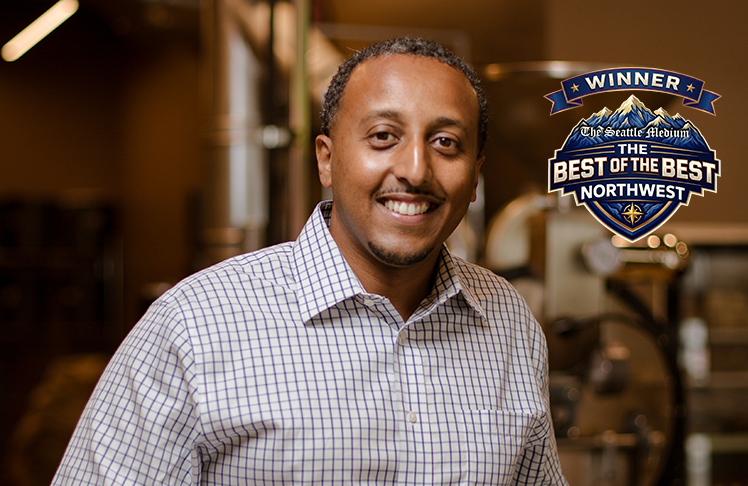
For Efrem Fesaha, founder and CEO of Boon Boona Coffee, coffee has always been about more than what’s in the cup. It is about connecting people, celebrating Africa’s rich coffee heritage and creating spaces where community can gather.
That vision resonated with readers during The Seattle Medium’s inaugural Best of the Best Northwest Readers’ Choice Awards, where Boon Boona Coffee earned first-place honors in the Best Enterprise and Best Non-Alcoholic Black-Owned Beverage categories.
For Fesaha, however, success isn’t measured by awards or the number of cafés the company has opened. When reflecting on Boon Boona’s 14-year journey, he said what matters most is the positive impact the business continues to make.
“It’s honestly the desire to make a positive impact,” Fesaha said. “From the producers that we buy from, the events that we get to have inside of our café spaces, the different organizations that we get to support, and the different small businesses that we get to sell products for, that’s what I’m most proud of.”
That commitment to creating positive impact continues to open new doors for the company.
Earlier this year, Boon Boona opened its newest café along Seattle’s waterfront, positioning the business at one of the city’s most recognizable destinations as Seattle prepares to welcome visitors for the 2026 FIFA World Cup.
“The timing couldn’t have been any better,” Fesaha said. “To have our café at one of the most memorable and iconic spots in the city is exciting. To be part of the waterfront transformation and everything that’s happening leading up to the World Cup has been incredible. We’re just grateful to be a part of it.”
Since opening Boon Boona, Fesaha has remained committed to showcasing African coffee while highlighting the farmers and countries behind every cup. As someone of African descent, he said the business grew from a desire to create stronger connections between his heritage and the communities he serves.
“It started from a place of just love, and there wasn’t enough representation for a product that has its origins in Ethiopia,” Fesaha said. “There are incredible coffee producers from Rwanda, the Democratic Republic of the Congo, Cameroon, and so many other places that don’t always get the spotlight. And to be able to do that is an honor.”
As Boon Boona has expanded, so have its relationships with the coffee producers it partners with throughout Africa. For Fesaha, growth has never been measured simply by sales, but by the strength of those relationships.
Related Article: Thank You For Making Our Inaugural Best Of The Best Northwest Readers’ Choice Awards A Huge Success
“The growth has really allowed us to refine our process. Who we partner with, our relationships are much stronger and much deeper now,” Fesaha said. “The volume has increased, so the impact to the producers has also grown. We still see so much opportunity to keep building, and we are looking to keep building on top of that.”
Like many entrepreneurs, Fesaha said the journey hasn’t been without challenges. During the company’s early years, he often measured himself against milestones he thought should have come sooner.
“The biggest lesson I’ve learned is just being kinder to myself. I was really hard on myself the first seven years,” Fesaha said. “I was thinking, ‘Why haven’t I reached that milestone yet?’ But giving myself more grace and more understanding that this is a journey is the biggest lesson I have learned.”
Today, many customers see Boon Boona as more than a coffee shop. It has become a gathering place where conversation and connection are just as important as the coffee being served.
Fesaha said that atmosphere was intentional and rooted in the traditions he experienced growing up.
Some of his earliest memories are of family members gathering in the living room as coffee beans were roasted, ground and brewed in a traditional Ethiopian clay coffee pot known as a jebena. The process often lasted several hours, creating space for conversation, storytelling and simply spending time together.
“It really comes from the traditions. Coffee is how we socialize,” Fesaha said. “Some of my earliest childhood memories are seeing family gathered together, drinking coffee, and catching up. We wanted to create that same feeling in our cafés where people feel warm and welcomed into a space that is similar to where it comes from.”
That same philosophy shapes how Boon Boona operates today.
Although Fesaha is often recognized as the entrepreneur behind the business, he views its success as a shared accomplishment made possible by employees, customers, coffee producers and community partners.
“It may start off as an individual leading something, but really, in my case, it’s a whole community of folks who have supported me. I look at this opportunity to provide space and an opportunity, but in a communal fashion,” Fesaha said. “To say that these outcomes are my journey alone would be inaccurate. It has been a communal approach with people who have the same vision to build.”
Whether hosting poetry nights, supporting local food vendors, creating opportunities for fellow Black-owned businesses or purchasing more coffee directly from producers overseas, Fesaha said those ripple effects continue to reinforce why he started Boon Boona.
“I wouldn’t want to do anything else. The desire to make a positive impact is what keeps me going, and that is in how we source and by what we are doing in our spaces, and that excites me,” Fesaha said. “Because the volume increases, and we are doing things like having to buy more coffee back in Rwanda, it is moments like that that give me the energy to keep pushing forward.”
For Fesaha, every cup of coffee represents another opportunity to connect people, celebrate Africa’s rich coffee heritage and create spaces where everyone feels welcome. Fourteen years after opening Boon Boona, the company’s greatest achievement isn’t simply the awards it has received or the cafés it has opened. It’s the relationships it has built through a tradition that has always been about bringing people together.
To see the full list of winners visit bestofthebestnw.com