By Aaron Allen, The Seattle Medium
The story of the Black entrepreneur has long been defined by endurance, long hours, sacrifice, and the belief that persistence would eventually lead to stability, success, and legacy.
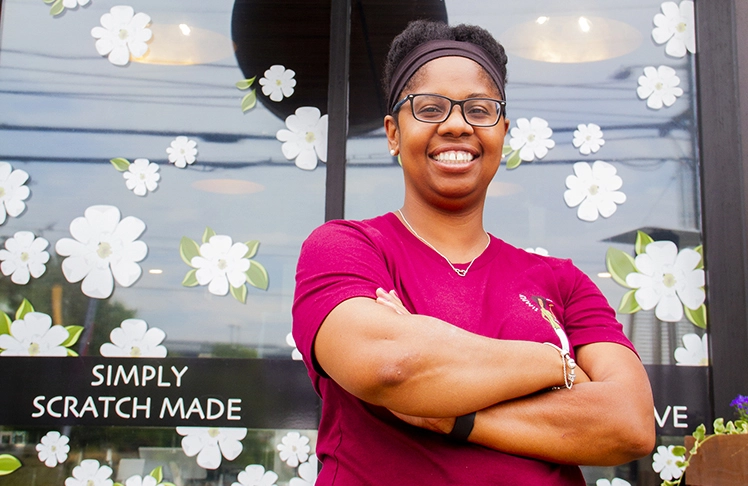
For Seattle business owner Lillian Rambus, that promise feels increasingly uncertain.
After more than a decade running Simply Soulful, Rambus said the idea that a business owner eventually gets to step back has been replaced by something far more immediate.
“You look up, it’s been two or three years, and you’ve been in that place every day,” says Rambus. “I’m not the same spring chicken as I was at 35 when I started this business. So, you have less capacity for doing things.”
What Rambus describes is not just exhaustion. It is the cumulative strain of running a business in an environment where costs are rising, staffing is inconsistent, and the margin for error continues to shrink.
Like many small business owners, Rambus has found herself pulled back into the day-to-day operations, opening the restaurant and working weekends to fill staffing gaps. At the same time, she said, raising prices is not always a viable option in a community already under financial pressure.
“Our government is throwing everything at you and making it harder to build your business and your legacy,” said Rambus. “It’s not making it easier. It’s making it harder.”
Her experience reflects a broader shift in how burnout is understood among Black entrepreneurs. Increasingly, it is not framed as a personal shortcoming, but as the result of operating within systems that offer fewer resources and less flexibility.
Traditionally, entrepreneurship follows a progression. In the early stages, owners are deeply embedded in the day-to-day operations, often doing everything themselves to keep the business afloat. Over time, as the business stabilizes, that model is expected to shift. Owners hire staff, delegate responsibilities, and gradually move out of daily operations and into a more strategic role focused on growth, long-term planning, and scaling the business.
For many Black entrepreneurs, Rambus said, that transition is no longer happening.
Instead, rising costs, limited access to capital, and ongoing operational challenges are forcing many owners back into working in the business rather than on it, leaving them responsible for nearly every aspect of daily operations, with little room to step back or build toward long-term sustainability.
Jeneferness Franke, CEO of the Black Owned Business Emporium, said that imbalance is at the core of the issue.
“One of the things that I want to make very clear is that when it comes to Black entrepreneurs, the burnout isn’t about their weaknesses,” said Franke. “It’s about carrying too much with too little. When it comes to our Black-owned businesses, we’re not getting the support and the resources that we need, and so we’ve got to carry everything, wear all of the hats, and that’s why we become truly burnt out.”
That strain intensified during the COVID-19 pandemic, which upended business models and left many owners navigating an environment with no clear roadmap.
It was an era of profound isolation, where the traditional blueprints for success vanished overnight, leaving leaders with no clear sense of what would come next.
“As iconic institutions that had stood for a century began to shutter, the mental toll of the uncertainty became as heavy as the economic one,” said Theo Martin, owner of Island Soul. “To stand at the helm of a business today is more than just a professional achievement; it is a hard-won testimony of surviving a period where every headline made a business owner wonder, ‘Am I going to be one of them?’”
While the pandemic reshaped the landscape, business owners said the pressure did not ease once restrictions lifted. Instead, it evolved.
Rambus and others point to a combination of rising labor costs, increasing taxes, supply chain challenges and broader economic policies that continue to strain small businesses. In Washington state and Seattle, minimum wage increases tied to inflation have steadily raised labor costs, while national economic shifts, including tariffs, have added pressure to already tight margins.
Unlike employees, business owners are not guaranteed wages, and many said they are often the last to be paid, if they are able to pay themselves at all.
Those conditions have forced difficult decisions. Some owners have reduced employee hours, delayed hiring or made layoffs. Others, like Rambus, have stepped back into frontline roles to keep operations running.
In some cases, business owners said they have become the lowest-paid workers in their own businesses as they absorb the financial strain to keep their doors open.
For Rambus, that reality has become part of the daily calculation of what it takes to keep the business operating.
The traditional model of entrepreneurship, build, grow, and eventually step back, has given way to something far less predictable, where sustainability is not guaranteed and rest is often postponed.
That shift has forced business owners to rethink how they approach both work and survival.
For Rambus, it starts with acknowledging burnout rather than avoiding it.
“It’s going to happen,” she said. “So in those moments, just go ahead and take care of yourself. Figure out what self-care is to you and do that thing.”
Others are adjusting by building systems that reduce the burden on the individual.
Tonya Kellum, who owns an Allstate agency, said her early years in business were defined by burnout before she shifted toward a more structured approach.
“The day to day dealing with payroll, taxes, anything that is business related, I try to have a schedule where I take care of certain things at a certain time,” said Kellum. “Another thing that I am really good at is hiring somebody. I have a great accountant, I have a great payroll company, I have a great customer service representative. I have certain people in place that help me so I don’t have to be a million different things to a million different people.”
For newer entrepreneurs, she said, success is less about endurance and more about problem-solving.
“The people who are the most successful and that make the most money are the people who can solve the most problems,” said Kellum. “So, solve as many problems as you can for people and you’ll never run out of things to do.”
For many business owners, sustaining the work now requires as much faith as it did in the beginning. For Rambus, that means trusting she has built enough infrastructure to carry the business, even when she has to step away for self-care.
“If this thing is still standing when I get back, then we’ll deal with it then,” concluded Rambus.