By Kiara Doyal, The Seattle Medium
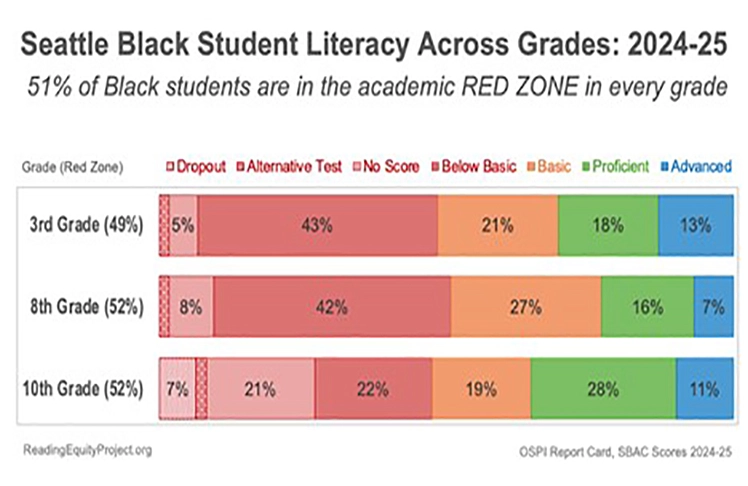
According to the Reading Equity Project, more than half of Black students in Seattle are not reading at grade level, raising urgent questions about whether the way reading has been taught for decades is failing the very students it is meant to serve.
Data from the 2024-25 OSPI report card shows that 51% of Black students in Seattle are not meeting literacy benchmarks, reinforcing concerns about persistent gaps in reading outcomes.
Educators and advocates say the implications go beyond reading scores. Students who struggle with literacy early are more likely to face ongoing academic challenges, making it harder to keep up in other subjects and increasing the risk of long-term educational disparities.
For educators working in Seattle classrooms, those numbers reflect patterns developing over time, often beginning in the earliest grades and becoming more difficult to address as students get older.
Seattle Public Schools veteran and Reading Equity Project board member Gerald Donaldson said literacy challenges can begin as early as first grade and become harder to overcome without early intervention.
“As students get older, there are so many other distractions in and out of school that come in to play that can take you away from that proficiency. And, the school just has to do better. If we know what our levels are, and they are not being met, we have to get better at understanding why that is,” said Donaldson. “I have been at SPS for years, and sometimes we don’t ask our students exactly why they are having trouble, and we sometimes just think well they are having trouble here, but once they get that ability, they will blossom and bloom.”
Donaldson said students who are not reading proficiently by fourth or fifth grade often face increasing challenges as academic demands grow and outside factors begin to compete for attention.
The Reading Equity Project is working to address these challenges by expanding the use of structured literacy, an evidence-based approach grounded in the science of reading. The method breaks reading into a progression of skills, from letter recognition and sound patterns to language structure, helping students build a stronger foundation.
Maria Graham, founder and executive director of the Reading Equity Project, said misconceptions about how reading is taught continue to limit student success.
“There is a myth around this topic, because a lot of folks believe that this method of instruction was just for kids who struggle,” said Graham. “90% of us need this instruction, because it is actually just brain-based. How quickly do you develop new circuits that pattern sound to letters? And many other facets.”
“New readers need to be taught how to sound out words based on language patterns, because our brains understand words from their sounds, not the squiggles on the page,” said Graham. “That symbol-sound translation becomes automatic with practice, but it’s still happening subconsciously.”
While the data focuses on Black students in Seattle, Graham said the issue reflects broader patterns tied to access and opportunity.
“[The instruction] is not found in schools, so historically oppressed students and low-income students are faced with a double-whammy; lack of access to experiences that build background knowledge on top of the lack of instruction,” said Graham. “We cannot end low literacy, and all of the negative fallout it creates, until we address instruction. We are putting band aids without addressing the root causes.”
Donaldson said that despite the challenges, students continue to show a strong willingness to learn and succeed.
“Yes, there are ups and downs, but they are eager, engaged, and determined to do better. They want to be at school, they want to learn, they want to succeed, and they want to have a profession,” said Donaldson. “Even though there have been academic challenges, when you go into a SPS building, their willingness and ability to learn stands out.”
Graham said addressing literacy gaps also requires building a stronger and more diverse network of educators and tutors who reflect the communities served.
“There are hundreds of tutors and teachers scattered around Washington state who are privately trained and they are mostly all white women,” said Graham. “They are not embedded in community, so the other benefit is we need to really diversify as well as expand the teaching base.”
Graham said one goal is to create a trained and paid tutoring workforce rooted in the community and capable of supporting students over time.
Donaldson emphasized the importance of building relationships with students and understanding individual experiences.
“Don’t judge by how they talk, their, family, their parents, and find out what makes them; them. What brings them joy? What do you like to do? And once you do that, you can begin to ask questions, and they will ask you questions,” said Donaldson. “Reading is in everything you do. I don’t care what subject it is, reading encompasses everything we do in life and asking questions.”
Looking ahead, Donaldson said consistency in literacy programs will be critical to long-term success, noting that frequent changes can disrupt progress for both students and educators.
“I am 70 years old now, and between going and working in SPS, a lot of programs have come and gone. I think we don’t stick to them long enough and that always kills me. You might have a neat reading program every 4 years, for example. But once you’re learning something, right? And then it changes, not only does it change, but then the teachers have to learn that process again, and that is hard to do,” said Donaldson. “We need to find something that works, stick to it, master it, and we will see the success and our Black students continuing to achieve. Our babies can be successful, they are successful, but reading is a challenge.”